






A full polishing range.
From cutting and one-step correction to final finishing.
Specialist chemistry. Expert application.
 QUARTZ99 / CERAMIC BASE COAT
The foundation of your coating system.
A layerable quartz base coat designed for mechanical protection. Pair it with a suitable top coat to create the final finish.
For application by NANOLAB certified installers only.
Four formulas. Extended working time. Find the coating for your finish.
Explore the BEAST family of ceramic coatings.
Find the coating for each exterior surface.
 PPF & VINYLGLOSSProtection for glossy films and wraps.Discover
 MATTE & SATINMATTEProtection that respects the finish.Discover
 GLASSWINDOWSExplore dedicated glass protection.Discover
 WHEEL PROTECTIONWHEELSA dedicated coating for your wheels.Discover
 TRIM PROTECTIONPLASTICProtection for plastic surfaces.Discover
Dedicated care for the surfaces inside.
 LEATHER SURFACESLEATHERDiscover NANOLAB leather protection.Discover PLASTIC SURFACESPLASTICProtection for interior plastic surfaces.Discover TEXTILE SURFACESFABRICExplore the latest fabric formulation.Discover
Spray protection, maintenance and upcoming wash products.
 MAINTENANCEBEAST 365Explore the BEAST maintenance range.Discover
Next in washing, cleaning & care.
Ceramic protection for boats and yachts.
An easy-to-apply ceramic coating with an established track record on boats and yachts around the world.
Results vary with surface preparation, exposure and maintenance.
Read 50 MARINE guides →Explore MARINEProtection for the surfaces you live with.
A look at what we’re developing.
From cutting and one-step correction to final finishing.
A wider range for professional vehicle care.
Taking shape alongside BEAST & MATRIX.
Practical guidance for your next coating project.
Explore all guides →
Evaluate liner and formulation compatibility as part of the complete coating package, including relevant contact and storage conditions.
Updated · NANOLAB Knowledge
A closure liner may contact a coating directly during transport or through the package headspace during storage. Selecting it by bottle fit alone does not establish compatibility with the formulation.
Record liner construction, closure material, bottle, dispensing insert and formulation revision. Obtain supplier specifications rather than relying on a generic material name. A small change in the package can create a new product-contact interface.
Define representative storage conditions, orientations, inspection times and controls. Use the actual formulation and appropriate safety procedures. Accelerated conditions need a justified relationship to the intended question; extreme exposure is not automatically a valid shelf-life prediction.
| Package observations | Product observations |
|---|---|
| Swelling, deformation, sealing and leakage | Appearance and specified quality properties |
| Closure operation and material change | Application behaviour under the approved method |
A liner that appears unchanged may still require product testing, and a product that looks normal may not prove seal integrity. Review both evidence streams. If a new liner is accepted, record its supplier specification and effective production batch. Do not silently substitute a visually similar component. The compatibility study should make the approved package reproducible and give later investigations a clear reference point.
Discuss your private-label coating project. For application and care, use the current instructions for the exact product.
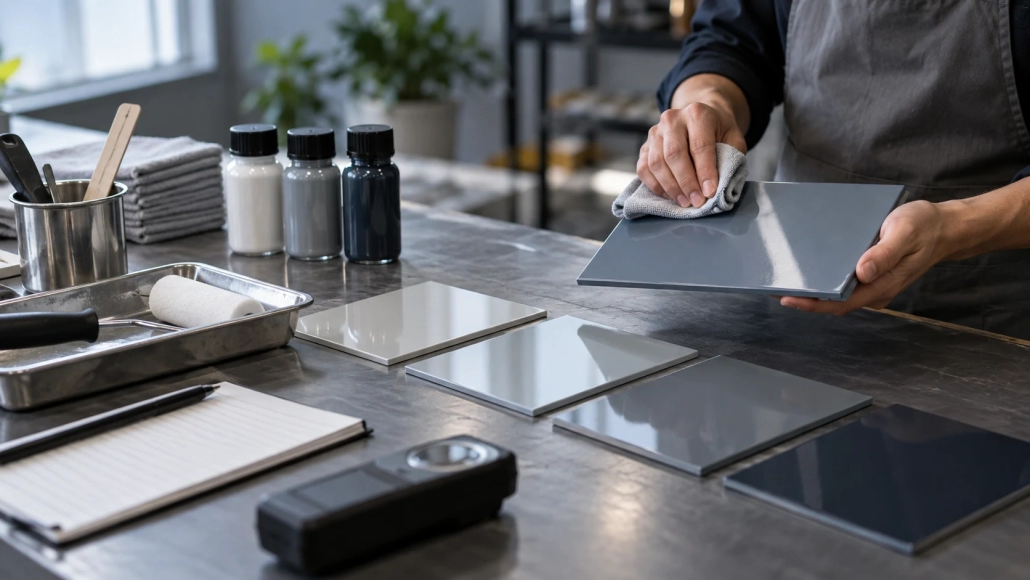
Compare private label coating samples using consistent preparation, application notes, finish checks and aftercare observations.

A liner may initially seal while later changing after contact with the formulation. Short observations cannot establish suitability for the intended storage period.
Evaluate containment, bottle damage and carton appearance as separate outcomes when testing secondary packaging for coating shipments.
 Secondary Packaging Trials: Separate Bottle Integrity from Carton Appearanc...