






A full polishing range.
From cutting and one-step correction to final finishing.
Specialist chemistry. Expert application.
 QUARTZ99 / CERAMIC BASE COAT
The foundation of your coating system.
A layerable quartz base coat designed for mechanical protection. Pair it with a suitable top coat to create the final finish.
For application by NANOLAB certified installers only.
Four formulas. Extended working time. Find the coating for your finish.
Explore the BEAST family of ceramic coatings.
Find the coating for each exterior surface.
 PPF & VINYLGLOSSProtection for glossy films and wraps.Discover
 MATTE & SATINMATTEProtection that respects the finish.Discover
 GLASSWINDOWSExplore dedicated glass protection.Discover
 WHEEL PROTECTIONWHEELSA dedicated coating for your wheels.Discover
 TRIM PROTECTIONPLASTICProtection for plastic surfaces.Discover
Dedicated care for the surfaces inside.
 LEATHER SURFACESLEATHERDiscover NANOLAB leather protection.Discover PLASTIC SURFACESPLASTICProtection for interior plastic surfaces.Discover TEXTILE SURFACESFABRICExplore the latest fabric formulation.Discover
Spray protection, maintenance and upcoming wash products.
 MAINTENANCEBEAST 365Explore the BEAST maintenance range.Discover
Next in washing, cleaning & care.
Ceramic protection for boats and yachts.
An easy-to-apply ceramic coating with an established track record on boats and yachts around the world.
Results vary with surface preparation, exposure and maintenance.
Read 50 MARINE guides →Explore MARINEProtection for the surfaces you live with.
A look at what we’re developing.
From cutting and one-step correction to final finishing.
A wider range for professional vehicle care.
Taking shape alongside BEAST & MATRIX.
Practical guidance for your next coating project.
Explore all guides →
Use shared reference specimens and matched reporting fields when two laboratories disagree about a ceramic-coating measurement.
Updated · NANOLAB Knowledge

Two laboratories can report different results because they tested different specimens, used different methods or handled the same method differently. Sending only the final numbers rarely identifies the cause. A shared-reference exercise helps narrow the disagreement.
Specify the property, method, specimen conditioning, measurement locations and reporting units. Decide whether laboratories will measure the same travelling specimen or matched specimens prepared together. A travelling specimen can change during transport and handling, so its history must accompany it.
Choose a reference appropriate to the measurement and maintain its handling instructions. Ask each laboratory to measure it alongside the coating specimens. Retain raw observations, instrument settings and any invalidated results with reasons.
| Pattern | Possible investigation |
|---|---|
| Reference and samples shift similarly | Method implementation or instrument difference |
| Reference agrees, coating samples differ | Specimen preparation, location or material sensitivity |
| Travelling specimen changes over time | Transport, handling or ageing |
Use the same identified specimen or location where the method permits. A difference between laboratory averages is difficult to interpret if one measured only favourable areas and the other used a fixed map.
Agreement between two laboratories does not prove universal accuracy, and disagreement does not automatically make one incompetent. Review uncertainty, traceability and suitability of the method for the coating and substrate.
The practical output is an agreed measurement procedure and a documented explanation of any remaining difference. If the result will support a commercial claim, obtain appropriate technical review before combining incompatible laboratory results into a single attractive number.
Ask NANOLAB about your surface and intended use. For application and care, use the current instructions for the exact product.
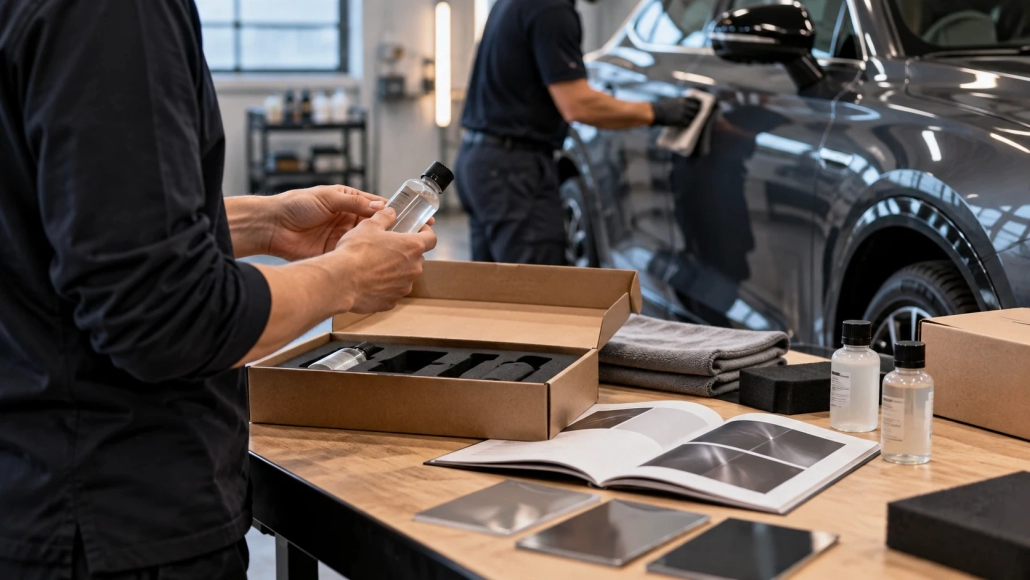
Design a coating field trial with recorded vehicles, use patterns, care routines and inspection points that produce interpretable feedback.
A coating's contribution to gloss should be compared with the same prepared surface before application.
Build a simple uncertainty budget for a coating measurement and distinguish standard uncertainty from repeatability or instrument resolution.
 A Coating Measurement Uncertainty Budget with a Worked Example