






A full polishing range.
From cutting and one-step correction to final finishing.
Specialist chemistry. Expert application.
 QUARTZ99 / CERAMIC BASE COAT
The foundation of your coating system.
A layerable quartz base coat designed for mechanical protection. Pair it with a suitable top coat to create the final finish.
For application by NANOLAB certified installers only.
Four formulas. Extended working time. Find the coating for your finish.
Explore the BEAST family of ceramic coatings.
Find the coating for each exterior surface.
 PPF & VINYLGLOSSProtection for glossy films and wraps.Discover
 MATTE & SATINMATTEProtection that respects the finish.Discover
 GLASSWINDOWSExplore dedicated glass protection.Discover
 WHEEL PROTECTIONWHEELSA dedicated coating for your wheels.Discover
 TRIM PROTECTIONPLASTICProtection for plastic surfaces.Discover
Dedicated care for the surfaces inside.
 LEATHER SURFACESLEATHERDiscover NANOLAB leather protection.Discover PLASTIC SURFACESPLASTICProtection for interior plastic surfaces.Discover TEXTILE SURFACESFABRICExplore the latest fabric formulation.Discover
Spray protection, maintenance and upcoming wash products.
 MAINTENANCEBEAST 365Explore the BEAST maintenance range.Discover
Next in washing, cleaning & care.
Ceramic protection for boats and yachts.
An easy-to-apply ceramic coating with an established track record on boats and yachts around the world.
Results vary with surface preparation, exposure and maintenance.
Read 50 MARINE guides →Explore MARINEProtection for the surfaces you live with.
A look at what we’re developing.
From cutting and one-step correction to final finishing.
A wider range for professional vehicle care.
Taking shape alongside BEAST & MATRIX.
Practical guidance for your next coating project.
Explore all guides →
A development request should identify which requirements are mandatory and where trade-offs are acceptable. Otherwise, improving one feature can create disagreement when another part of the application or supply experience changes.
Updated · NANOLAB Knowledge
The project needs a ranked set of customer outcomes, but ranking alone is insufficient for non-negotiable requirements. Keep fixed constraints separate from preferences and explain why they matter. The manufacturer can then propose options that are technically and commercially relevant to the intended use.
Illustrative example: a brand prefers a different application feel but also requires an established installer workflow. A sample that changes the workflow may be promising, yet it does not meet the original brief automatically. The team must decide whether the trade-off is acceptable and document the revised scope.
Do not assume every desired property can be maximized simultaneously. This guide does not predict a particular formulation response. Keep the discussion tied to observed samples and supplier evidence, and avoid making customer promises while the project's essential trade-offs remain unresolved.
Discuss bulk supply and private-label requirements with NANOLAB. Use the current product documentation for formulation-specific instructions.

Create a clear private label sample approval record linking the selected coating, test conditions, packaging and unresolved questions.
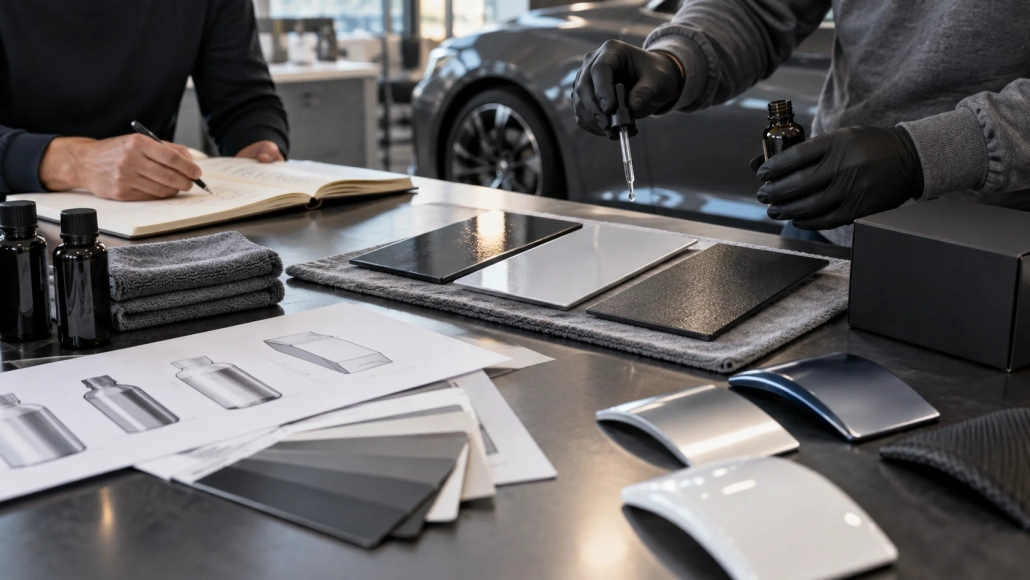
Define cleaning, protective residue, dilution, rinse behaviour and packaging requirements before discussing a private label ceramic shampoo project.

A pilot order should reduce uncertainty before the next purchase. If it is treated only as a small commercial order, the business may consume the stock without learning whether the product, package and support process are ready to scale.