






A full polishing range.
From cutting and one-step correction to final finishing.
Specialist chemistry. Expert application.
 QUARTZ99 / CERAMIC BASE COAT
The foundation of your coating system.
A layerable quartz base coat designed for mechanical protection. Pair it with a suitable top coat to create the final finish.
For application by NANOLAB certified installers only.
Four formulas. Extended working time. Find the coating for your finish.
Explore the BEAST family of ceramic coatings.
Find the coating for each exterior surface.
 PPF & VINYLGLOSSProtection for glossy films and wraps.Discover
 MATTE & SATINMATTEProtection that respects the finish.Discover
 GLASSWINDOWSExplore dedicated glass protection.Discover
 WHEEL PROTECTIONWHEELSA dedicated coating for your wheels.Discover
 TRIM PROTECTIONPLASTICProtection for plastic surfaces.Discover
Dedicated care for the surfaces inside.
 LEATHER SURFACESLEATHERDiscover NANOLAB leather protection.Discover PLASTIC SURFACESPLASTICProtection for interior plastic surfaces.Discover TEXTILE SURFACESFABRICExplore the latest fabric formulation.Discover
Spray protection, maintenance and upcoming wash products.
 MAINTENANCEBEAST 365Explore the BEAST maintenance range.Discover
Next in washing, cleaning & care.
Ceramic protection for boats and yachts.
An easy-to-apply ceramic coating with an established track record on boats and yachts around the world.
Results vary with surface preparation, exposure and maintenance.
Read 50 MARINE guides →Explore MARINEProtection for the surfaces you live with.
A look at what we’re developing.
From cutting and one-step correction to final finishing.
A wider range for professional vehicle care.
Taking shape alongside BEAST & MATRIX.
Practical guidance for your next coating project.
Explore all guides →
A buyer's desired result and a proposed ingredient are not the same specification. Describe the required outcome first so the manufacturer can assess an appropriate formulation approach and the evidence needed to evaluate it.
Updated · NANOLAB Knowledge
Naming an ingredient may be useful background, but it can prematurely constrain development or imply a performance relationship that has not been demonstrated. The brief should identify the substrate, application process, customer and measurable outcome. The technical team can then explain whether the proposed ingredient is relevant.
Illustrative example: a brand asks for a particular additive because it appears in a competitor's marketing. The actual customer need is easier maintenance on an approved finish. A result-focused brief allows the manufacturer to address that need without assuming the named ingredient is necessary or sufficient.
Do not reverse-engineer a competitor's performance from a label or add raw ingredients to a finished coating. This guide does not disclose or prescribe NANOLAB formulations. Technical choices should be made through the agreed development process and validated against the intended product outcome.
Discuss bulk supply and private-label requirements with NANOLAB. Use the current product documentation for formulation-specific instructions.
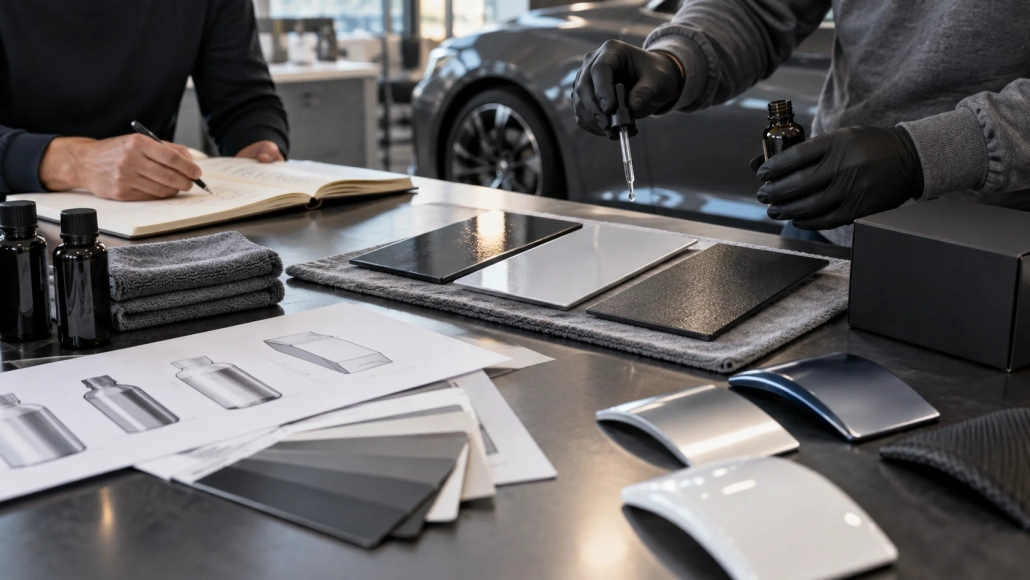
Define cleaning, protective residue, dilution, rinse behaviour and packaging requirements before discussing a private label ceramic shampoo project.

Review genuine product use, available stock and unusual adjustments before placing the next coating supply order.

An enquiry form should collect the information needed for the next useful decision without forcing customers to invent details they do not know. Provide an explicit unknown option where uncertainty is legitimate.