






A full polishing range.
From cutting and one-step correction to final finishing.
Specialist chemistry. Expert application.
 QUARTZ99 / CERAMIC BASE COAT
The foundation of your coating system.
A layerable quartz base coat designed for mechanical protection. Pair it with a suitable top coat to create the final finish.
For application by NANOLAB certified installers only.
Four formulas. Extended working time. Find the coating for your finish.
Explore the BEAST family of ceramic coatings.
Find the coating for each exterior surface.
 PPF & VINYLGLOSSProtection for glossy films and wraps.Discover
 MATTE & SATINMATTEProtection that respects the finish.Discover
 GLASSWINDOWSExplore dedicated glass protection.Discover
 WHEEL PROTECTIONWHEELSA dedicated coating for your wheels.Discover
 TRIM PROTECTIONPLASTICProtection for plastic surfaces.Discover
Dedicated care for the surfaces inside.
 LEATHER SURFACESLEATHERDiscover NANOLAB leather protection.Discover PLASTIC SURFACESPLASTICProtection for interior plastic surfaces.Discover TEXTILE SURFACESFABRICExplore the latest fabric formulation.Discover
Spray protection, maintenance and upcoming wash products.
 MAINTENANCEBEAST 365Explore the BEAST maintenance range.Discover
Next in washing, cleaning & care.
Ceramic protection for boats and yachts.
An easy-to-apply ceramic coating with an established track record on boats and yachts around the world.
Results vary with surface preparation, exposure and maintenance.
Read 50 MARINE guides →Explore MARINEProtection for the surfaces you live with.
A look at what we’re developing.
From cutting and one-step correction to final finishing.
A wider range for professional vehicle care.
Taking shape alongside BEAST & MATRIX.
Practical guidance for your next coating project.
Explore all guides →
A narrowband irradiance value and a broadband value describe different wavelength ranges. Their numbers should not be compared as though both measured the same quantity, even when the reports use similar weathering equipment.
Updated · NANOLAB Knowledge
Q-Lab explains that narrowband spectral irradiance is expressed per wavelength interval, while broadband reporting covers a specified range. A useful coating comparison preserves that distinction. The selected control point and spectral range belong in the test description, not in a footnote that disappears when the result is copied into marketing material.
Illustrative example: a supplier table removes the wavelength information to make two reports fit on one line. The simplified table now invites a numerical ranking that the original reports did not support. Restoring the units and method context is necessary before interpreting the apparent difference.
There is no universal conversion that makes unrelated weathering spectra equivalent for every coating. Do not use a larger irradiance number as a standalone claim of a tougher or more realistic test. The material, exposure cycle and failure endpoint still matter.
Technical references: Q-Lab: Narrowband and wideband irradiance. These sources describe their stated methods or products; they do not certify NANOLAB products or establish compatibility with an unlisted surface.
Ask NANOLAB about the exact product and intended use. Use the current product documentation for formulation-specific instructions.

Find the information that affects product selection, installation and maintenance, and identify missing details before the job begins.
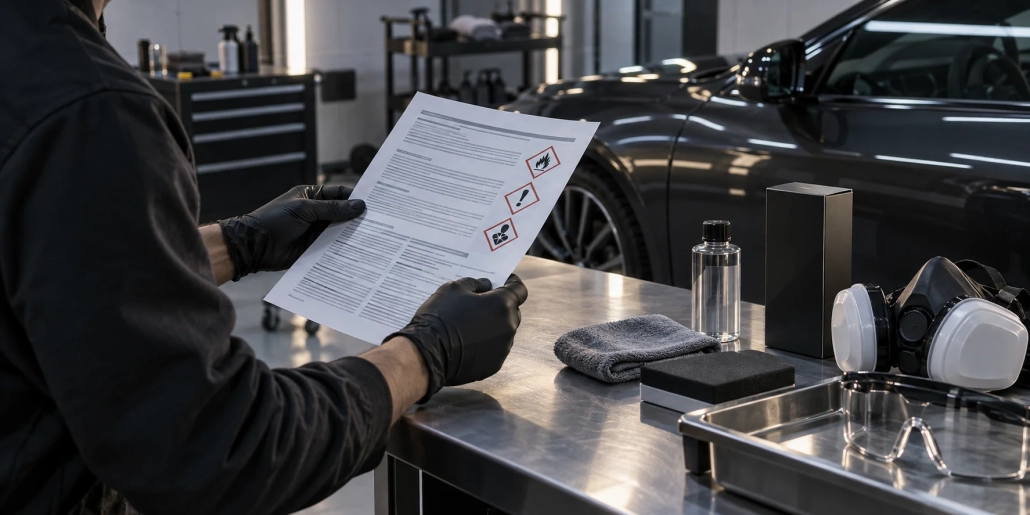
Use the product's current safety information to plan handling, ventilation, protective equipment and response procedures in the workshop.

Dynamic light scattering reports size through particle motion in a liquid. That hydrodynamic measurement need not match a dimension measured from an image of a prepared particle sample. A difference requires interpretation before either result is rejected.