






A full polishing range.
From cutting and one-step correction to final finishing.
Specialist chemistry. Expert application.
 QUARTZ99 / CERAMIC BASE COAT
The foundation of your coating system.
A layerable quartz base coat designed for mechanical protection. Pair it with a suitable top coat to create the final finish.
For application by NANOLAB certified installers only.
Four formulas. Extended working time. Find the coating for your finish.
Explore the BEAST family of ceramic coatings.
Find the coating for each exterior surface.
 PPF & VINYLGLOSSProtection for glossy films and wraps.Discover
 MATTE & SATINMATTEProtection that respects the finish.Discover
 GLASSWINDOWSExplore dedicated glass protection.Discover
 WHEEL PROTECTIONWHEELSA dedicated coating for your wheels.Discover
 TRIM PROTECTIONPLASTICProtection for plastic surfaces.Discover
Dedicated care for the surfaces inside.
 LEATHER SURFACESLEATHERDiscover NANOLAB leather protection.Discover PLASTIC SURFACESPLASTICProtection for interior plastic surfaces.Discover TEXTILE SURFACESFABRICExplore the latest fabric formulation.Discover
Spray protection, maintenance and upcoming wash products.
 MAINTENANCEBEAST 365Explore the BEAST maintenance range.Discover
Next in washing, cleaning & care.
Ceramic protection for boats and yachts.
An easy-to-apply ceramic coating with an established track record on boats and yachts around the world.
Results vary with surface preparation, exposure and maintenance.
Read 50 MARINE guides →Explore MARINEProtection for the surfaces you live with.
A look at what we’re developing.
From cutting and one-step correction to final finishing.
A wider range for professional vehicle care.
Taking shape alongside BEAST & MATRIX.
Practical guidance for your next coating project.
Explore all guides →
A zeta-potential result can contribute to understanding a dispersion, but it does not independently establish the shelf life of a finished coating. Storage performance must be evaluated in the actual product and packaging system.
Updated · NANOLAB Knowledge
Malvern Panalytical's discussion of suspension stability illustrates that more than one mechanism can influence behaviour. Buyers should ask how the measurement relates to the specific formulation instead of applying a universal numerical rule. A result from a diluted laboratory sample may answer a narrower question than long-term storage of the supplied product.
Illustrative example: a raw-material report contains a favourable-looking value, but the finished coating uses a different medium and packaging format. The report cannot be turned directly into a twelve-month expiry claim. The finished system needs its own evidence and approved storage instructions.
Avoid claiming that a particular zeta-potential threshold guarantees stability for every formulation. This guide does not establish a testing protocol or shelf life for NANOLAB products. Use the supplier's current product documentation and ask for clarification when a technical report is being used beyond its stated purpose.
Technical references: Malvern Panalytical: Suspension stability. These sources describe their stated methods or products; they do not certify NANOLAB products or establish compatibility with an unlisted surface.
Ask NANOLAB about the exact product and intended use. Use the current product documentation for formulation-specific instructions.
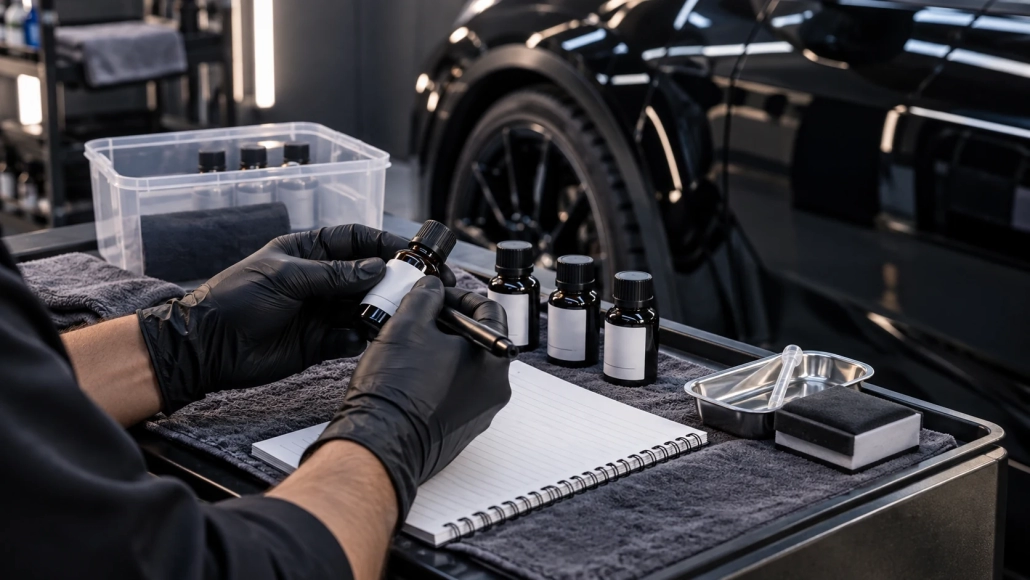
Keep opened-bottle identity and storage history clear without confusing the opening date with an invented universal shelf-life rule.

Agree observable finish and documentation requirements without making unsupported performance guarantees.
A rheology record should explain how the sample remained suitable during the measurement. For materials where evaporation may matter, the laboratory should assess that issue as part of method selection.