






A full polishing range.
From cutting and one-step correction to final finishing.
Specialist chemistry. Expert application.
 QUARTZ99 / CERAMIC BASE COAT
The foundation of your coating system.
A layerable quartz base coat designed for mechanical protection. Pair it with a suitable top coat to create the final finish.
For application by NANOLAB certified installers only.
Four formulas. Extended working time. Find the coating for your finish.
Explore the BEAST family of ceramic coatings.
Find the coating for each exterior surface.
 PPF & VINYLGLOSSProtection for glossy films and wraps.Discover
 MATTE & SATINMATTEProtection that respects the finish.Discover
 GLASSWINDOWSExplore dedicated glass protection.Discover
 WHEEL PROTECTIONWHEELSA dedicated coating for your wheels.Discover
 TRIM PROTECTIONPLASTICProtection for plastic surfaces.Discover
Dedicated care for the surfaces inside.
 LEATHER SURFACESLEATHERDiscover NANOLAB leather protection.Discover PLASTIC SURFACESPLASTICProtection for interior plastic surfaces.Discover TEXTILE SURFACESFABRICExplore the latest fabric formulation.Discover
Spray protection, maintenance and upcoming wash products.
 MAINTENANCEBEAST 365Explore the BEAST maintenance range.Discover
Next in washing, cleaning & care.
Ceramic protection for boats and yachts.
An easy-to-apply ceramic coating with an established track record on boats and yachts around the world.
Results vary with surface preparation, exposure and maintenance.
Read 50 MARINE guides →Explore MARINEProtection for the surfaces you live with.
A look at what we’re developing.
From cutting and one-step correction to final finishing.
A wider range for professional vehicle care.
Taking shape alongside BEAST & MATRIX.
Practical guidance for your next coating project.
Explore all guides →
Understand advancing and receding contact angles, calculate hysteresis, and learn why a tall water bead may still resist movement.
Updated · NANOLAB Knowledge
Contact angle hysteresis is the difference between advancing and receding contact angles. It helps describe why water may form an impressive bead yet remain attached when a surface tilts. Static bead shape and ease of movement are related observations, but they are not the same measurement.
An advancing measurement concerns a contact line moving over previously unwetted surface; a receding measurement concerns retreat. Under a defined method, their difference is reported in degrees. For illustrative angles of 112 and 92 degrees, the hysteresis is 20 degrees.
That subtraction is straightforward, but obtaining comparable angles requires a suitable procedure. Drop volume, dosing, surface condition and measurement geometry matter. Do not combine an advancing result from one method with a receding result from another without justification.
Local roughness and chemical variation can affect how a contact line moves. A droplet that stays in place is not by itself proof that a coating has disappeared. Likewise, a droplet that rolls easily does not establish scratch resistance or long service life.
Compare clean samples under the same conditions. If one surface has detergent residue and another has just been prepared, the difference may reflect their current surface condition rather than the original coating formulation.
A credible demonstration separates static angle, advancing/receding measurements and roll-off behaviour. Label each result and describe the procedure. If the purpose is easier drying, also assess the practical drying process on representative geometry rather than relying entirely on a flat coupon.
For purchasing, ask which water-behaviour property matters to the application. A high initial angle may be visually attractive, while movement and retained droplets may be more relevant to a particular cleaning task. Neither eliminates mineral deposits if contaminated water is allowed to evaporate.
Technical references: KRUSS: Contact angle hysteresis.
For product-specific application instructions, consult NANOLAB technical documentation or ask about your surface and intended use.
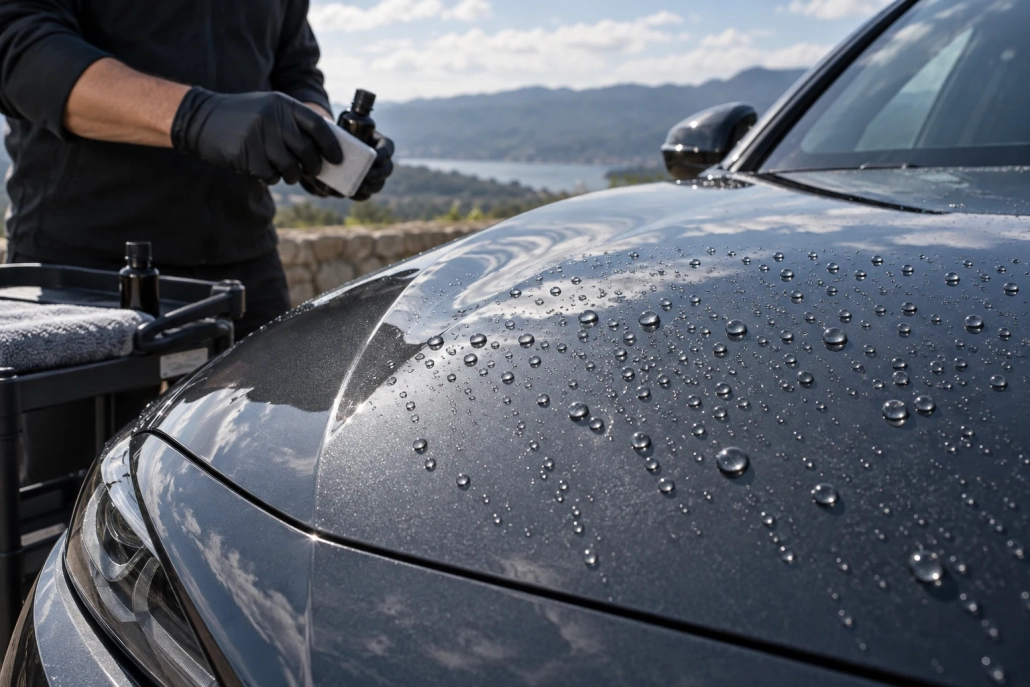
Distinguish the shape of a water drop from how easily it moves when comparing ceramic coating water behaviour.
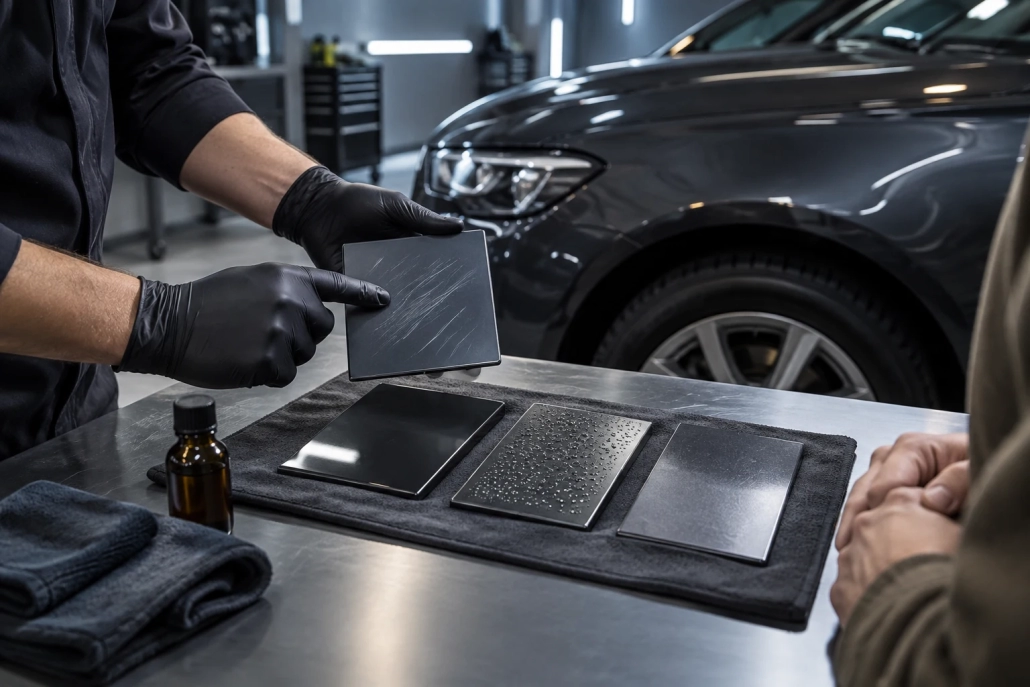
Check whether a laboratory report actually supports a nano coating claim by reviewing sample identity, method, scope, results and the connection to the sold product.
Explore Wenzel and Cassie-Baxter wetting states and why surface texture complicates comparisons between coated glass, paint and plastic.