






A full polishing range.
From cutting and one-step correction to final finishing.
Specialist chemistry. Expert application.
 QUARTZ99 / CERAMIC BASE COAT
The foundation of your coating system.
A layerable quartz base coat designed for mechanical protection. Pair it with a suitable top coat to create the final finish.
For application by NANOLAB certified installers only.
Four formulas. Extended working time. Find the coating for your finish.
Explore the BEAST family of ceramic coatings.
Find the coating for each exterior surface.
 PPF & VINYLGLOSSProtection for glossy films and wraps.Discover
 MATTE & SATINMATTEProtection that respects the finish.Discover
 GLASSWINDOWSExplore dedicated glass protection.Discover
 WHEEL PROTECTIONWHEELSA dedicated coating for your wheels.Discover
 TRIM PROTECTIONPLASTICProtection for plastic surfaces.Discover
Dedicated care for the surfaces inside.
 LEATHER SURFACESLEATHERDiscover NANOLAB leather protection.Discover PLASTIC SURFACESPLASTICProtection for interior plastic surfaces.Discover TEXTILE SURFACESFABRICExplore the latest fabric formulation.Discover
Spray protection, maintenance and upcoming wash products.
 MAINTENANCEBEAST 365Explore the BEAST maintenance range.Discover
Next in washing, cleaning & care.
Ceramic protection for boats and yachts.
An easy-to-apply ceramic coating with an established track record on boats and yachts around the world.
Results vary with surface preparation, exposure and maintenance.
Read 50 MARINE guides →Explore MARINEProtection for the surfaces you live with.
A look at what we’re developing.
From cutting and one-step correction to final finishing.
A wider range for professional vehicle care.
Taking shape alongside BEAST & MATRIX.
Practical guidance for your next coating project.
Explore all guides →
Understand solutions, dispersions and emulsions, check liquid appearance against specifications, and investigate changed coating samples.
Updated · NANOLAB Knowledge
A clear liquid, a milky liquid and a liquid that needs specified mixing can all belong to legitimate coating systems. Appearance alone does not identify performance or prove a formulation has degraded. The first question is whether its condition matches the manufacturer's description.
A solution contains dissolved material at the molecular or ionic level. A dispersion contains a distributed phase within another medium. An emulsion is a type of dispersion involving liquids that are not simply one homogeneous liquid phase. Commercial formulations can be more complex than these short descriptions suggest.
These categories concern the liquid system. They do not reveal the installed film's hardness, weathering resistance or maintenance requirements. Nor does optical clarity prove the absence of particles at every scale.
Use the supplier's appearance specification, storage range and mixing instructions when checking a delivery. Some products require agitation; others should not be handled that way. Do not shake every coating by habit or try to repair a changed sample with extra solvent.
Record whether an unexpected appearance was present on arrival, followed cold transport or appeared after opening. Photograph the closed container where practical and retain the batch identity. A supplier can use that history to distinguish an expected condition from a handling or stability concern.
Suppose a normally clear product develops persistent cloudiness. Do not conclude immediately that it is harmless, and do not apply it to a customer vehicle to find out. Compare it with the documented specification and ask the supplier for disposition. A tiny compatibility test cannot establish that an entire altered batch meets its original performance specification.
The useful receiving check is conformity to the named product, not preference for a particular visual style. Keep appearance, application behaviour and cured performance as separate observations so that a concern can be investigated without inventing a chemical diagnosis.
For product-specific application instructions, consult NANOLAB technical documentation or ask about your surface and intended use.
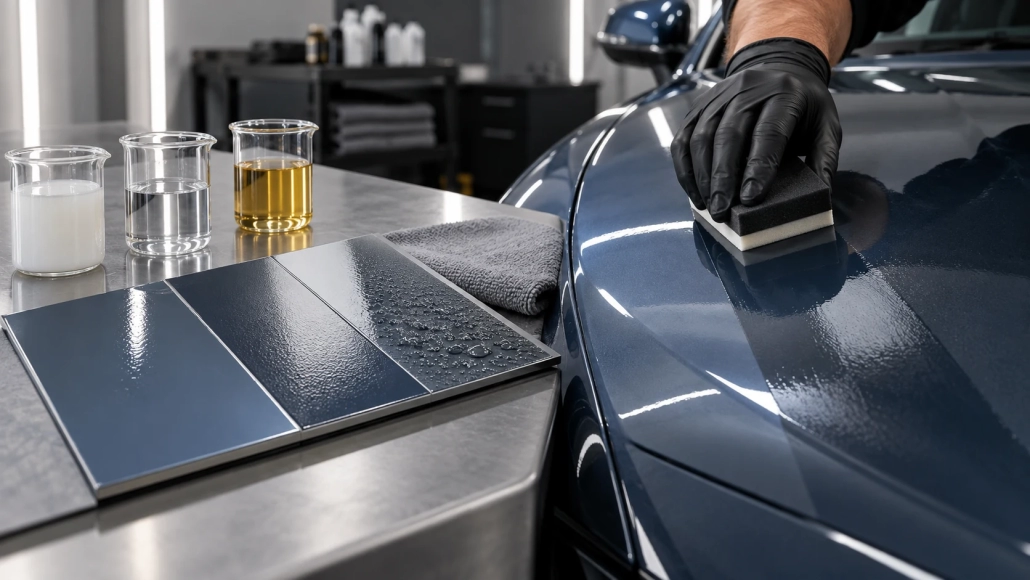
Read coating solids figures alongside application method, finish compatibility and documented performance rather than using one number alone.
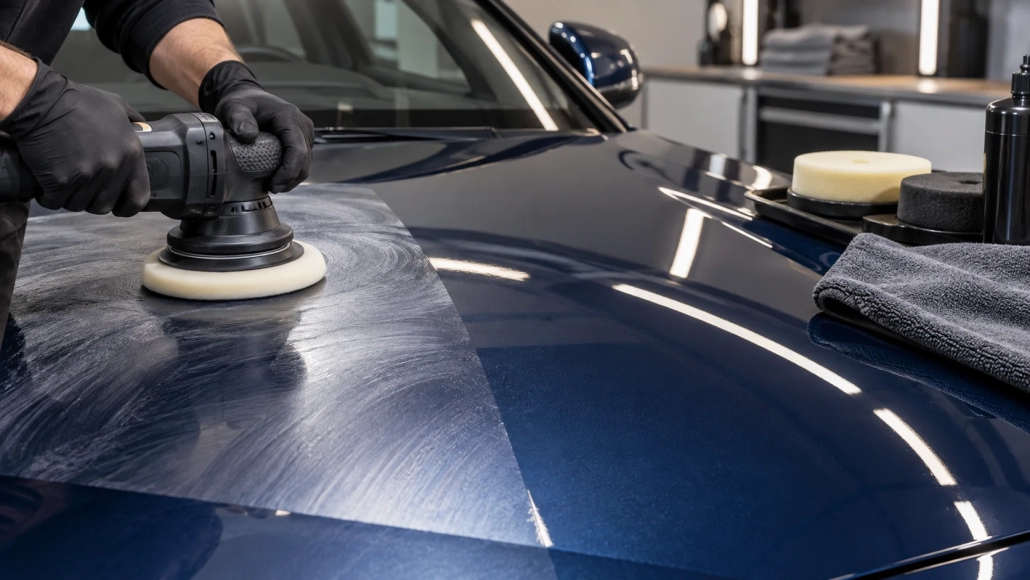
Understand heavy cut compound, fine cut and finishing polish, then choose a paint correction process that fits your paint, machine and intended result.
Understand what coating viscosity reveals about application, which test conditions matter, and why liquid thickness does not prove film protection.