






A full polishing range.
From cutting and one-step correction to final finishing.
Specialist chemistry. Expert application.
 QUARTZ99 / CERAMIC BASE COAT
The foundation of your coating system.
A layerable quartz base coat designed for mechanical protection. Pair it with a suitable top coat to create the final finish.
For application by NANOLAB certified installers only.
Four formulas. Extended working time. Find the coating for your finish.
Explore the BEAST family of ceramic coatings.
Find the coating for each exterior surface.
 PPF & VINYLGLOSSProtection for glossy films and wraps.Discover
 MATTE & SATINMATTEProtection that respects the finish.Discover
 GLASSWINDOWSExplore dedicated glass protection.Discover
 WHEEL PROTECTIONWHEELSA dedicated coating for your wheels.Discover
 TRIM PROTECTIONPLASTICProtection for plastic surfaces.Discover
Dedicated care for the surfaces inside.
 LEATHER SURFACESLEATHERDiscover NANOLAB leather protection.Discover PLASTIC SURFACESPLASTICProtection for interior plastic surfaces.Discover TEXTILE SURFACESFABRICExplore the latest fabric formulation.Discover
Spray protection, maintenance and upcoming wash products.
 MAINTENANCEBEAST 365Explore the BEAST maintenance range.Discover
Next in washing, cleaning & care.
Ceramic protection for boats and yachts.
An easy-to-apply ceramic coating with an established track record on boats and yachts around the world.
Results vary with surface preparation, exposure and maintenance.
Read 50 MARINE guides →Explore MARINEProtection for the surfaces you live with.
A look at what we’re developing.
From cutting and one-step correction to final finishing.
A wider range for professional vehicle care.
Taking shape alongside BEAST & MATRIX.
Practical guidance for your next coating project.
Explore all guides →
Compare weight solids and volume solids correctly, identify the measurement basis, and avoid unsupported coating coverage or thickness claims.
Updated · NANOLAB Knowledge
Weight solids and volume solids describe different proportions. A percentage without its basis is incomplete. Comparing two coatings by that number alone can rank them incorrectly before compatibility, application or performance has even been considered.
Weight solids expresses nonvolatile mass relative to the original liquid mass under the specified test. Volume solids relates the remaining film volume to the original wet volume under the relevant method. Ingredients can have different densities, so equal masses do not necessarily occupy equal volumes.
Suppose two illustrative liquids each contain 50 g of nonvolatile material in 100 g of product. Both are 50 percent solids by weight. If their nonvolatile ingredients and carriers have different densities, their volume-solids values need not match. There is no universal conversion that uses the weight percentage alone.
When a specification lists a solids percentage, request the basis, method and conditions. Reactive coatings can make the interpretation more complicated because curing is not simply solvent evaporation. The supplier should explain what the reported value represents for that formulation.
Do not silently relabel a weight-solids figure as volume solids in a coverage calculator. Likewise, do not multiply a manufacturer's recommended millilitres per square metre by an unspecified percentage and present the result as measured dry-film thickness.
For purchasing, keep separate columns for solids information, recommended application rate, compatible substrates, application window and the relevant test results. A missing solids basis is a documentation question, not proof that the product is poor.
If one supplier supplies weight solids and another volume solids, compare them within their own documented systems. Ask for compatible measurements if that property is essential to the project. A trial can still compare application labour and finished appearance, provided those observations are not described as proof of chemical equivalence or long-term durability.
Technical references: Elcometer: Calculating Dry Film Thickness.
For product-specific application instructions, consult NANOLAB technical documentation or ask about your surface and intended use.
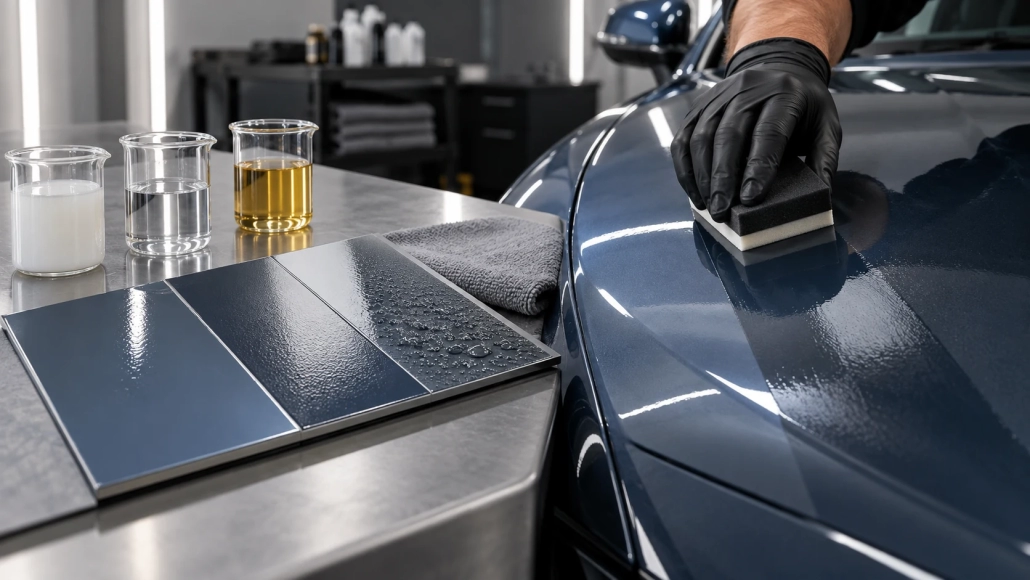
Read coating solids figures alongside application method, finish compatibility and documented performance rather than using one number alone.
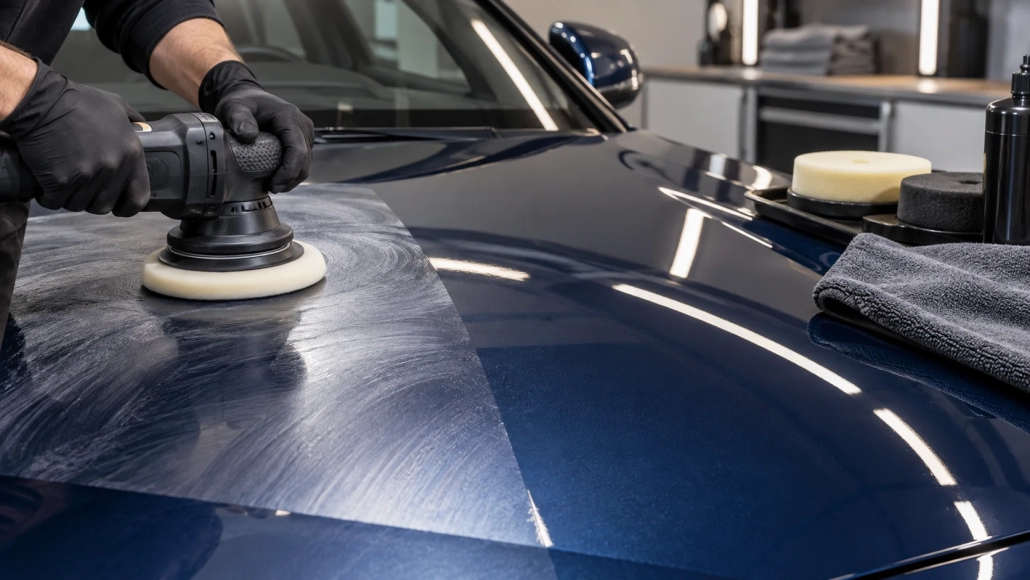
Understand heavy cut compound, fine cut and finishing polish, then choose a paint correction process that fits your paint, machine and intended result.
Calculate predicted dry-film thickness from wet thickness and volume solids, with clear limits for wipe-on ceramic coating applications.