






A full polishing range.
From cutting and one-step correction to final finishing.
Specialist chemistry. Expert application.
 QUARTZ99 / CERAMIC BASE COAT
The foundation of your coating system.
A layerable quartz base coat designed for mechanical protection. Pair it with a suitable top coat to create the final finish.
For application by NANOLAB certified installers only.
Four formulas. Extended working time. Find the coating for your finish.
Explore the BEAST family of ceramic coatings.
Find the coating for each exterior surface.
 PPF & VINYLGLOSSProtection for glossy films and wraps.Discover
 MATTE & SATINMATTEProtection that respects the finish.Discover
 GLASSWINDOWSExplore dedicated glass protection.Discover
 WHEEL PROTECTIONWHEELSA dedicated coating for your wheels.Discover
 TRIM PROTECTIONPLASTICProtection for plastic surfaces.Discover
Dedicated care for the surfaces inside.
 LEATHER SURFACESLEATHERDiscover NANOLAB leather protection.Discover PLASTIC SURFACESPLASTICProtection for interior plastic surfaces.Discover TEXTILE SURFACESFABRICExplore the latest fabric formulation.Discover
Spray protection, maintenance and upcoming wash products.
 MAINTENANCEBEAST 365Explore the BEAST maintenance range.Discover
Next in washing, cleaning & care.
Ceramic protection for boats and yachts.
An easy-to-apply ceramic coating with an established track record on boats and yachts around the world.
Results vary with surface preparation, exposure and maintenance.
Read 50 MARINE guides →Explore MARINEProtection for the surfaces you live with.
A look at what we’re developing.
From cutting and one-step correction to final finishing.
A wider range for professional vehicle care.
Taking shape alongside BEAST & MATRIX.
Practical guidance for your next coating project.
Explore all guides →
Convert coating consumption from grams to millilitres using product density, consistent bottle weighing and clearly separated application losses.
Updated · NANOLAB Knowledge
Weighing a coating bottle is a practical way to monitor consumption, but grams and millilitres are interchangeable only when the liquid density is exactly 1 g/mL. For another density, a direct one-to-one conversion produces a systematic purchasing error.
The relationship is volume = mass divided by density. In an illustrative example, 18 g of a liquid with a documented density of 0.90 g/mL represents 20 mL. If a workshop records that as 18 mL, it understates volume use by 10 percent.
Use a density value for the relevant product and temperature, preferably from the current technical documentation or supplier. Do not substitute the density of an ingredient, a competing product or water. A safety data sheet may provide a range rather than a precise value; that range limits the precision of the conversion.
Use the same bottle, cap and attached dispenser in the before and after readings. Keep the outside clean and dry. A cap left off for the second weighing appears as product consumption. Liquid spilled outside the application is also consumption, although it did not reach the panel.
For example, a 24 g decrease might include 20 g applied and 4 g spilled. The stock record should reflect all 24 g, while an application-efficiency study should identify the spill separately. Neither figure establishes the cured film mass.
A balance displaying whole grams is a poor tool for distinguishing a 1 g difference. Check its appropriate operating range and verification procedure before treating small changes as meaningful. Report sensible rounded values instead of adding decimal places during conversion.
For routine costing, record measured mass, density source, calculated volume and the coated area. Keeping those four fields makes it possible to correct the calculation later if the supplier clarifies the density, without losing the original observation.
Technical references: BYK-Gardner: density-cup measurement procedure.
For product-specific application instructions, consult NANOLAB technical documentation or ask about your surface and intended use.
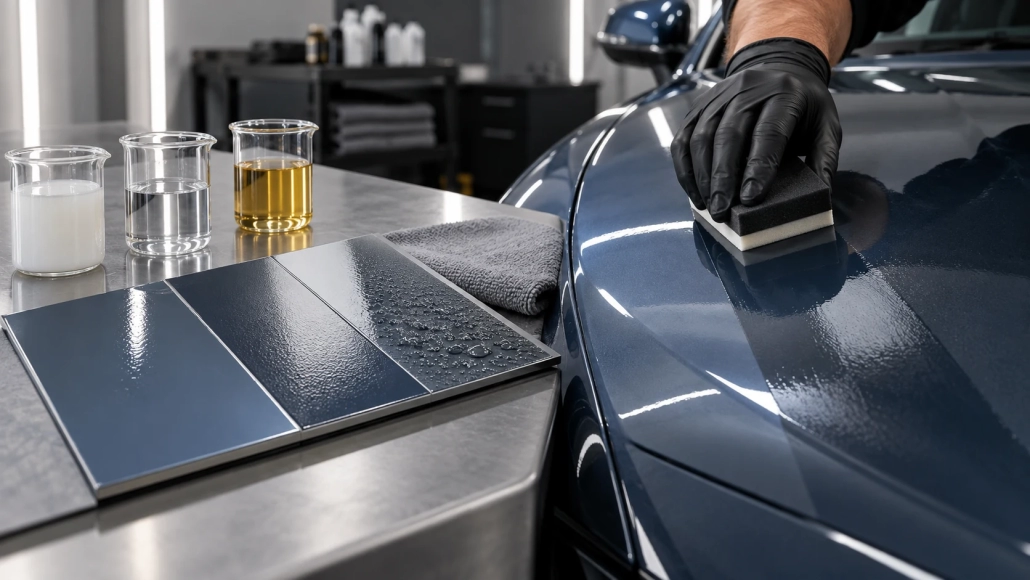
Read coating solids figures alongside application method, finish compatibility and documented performance rather than using one number alone.
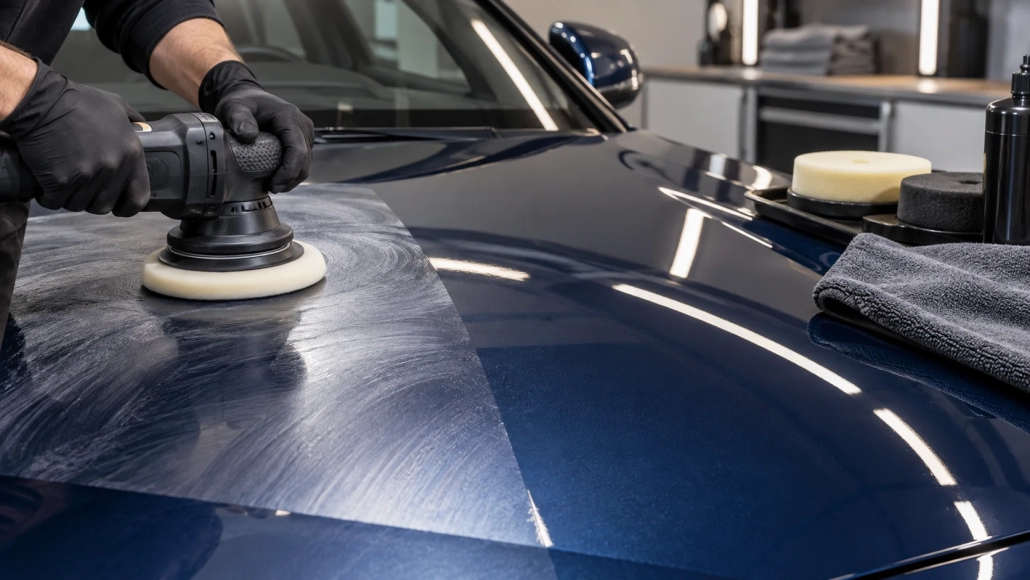
Understand heavy cut compound, fine cut and finishing polish, then choose a paint correction process that fits your paint, machine and intended result.
Learn why a waterborne coating is not necessarily water-soluble after curing, and which documentation matters for application and maintenance.