






A full polishing range.
From cutting and one-step correction to final finishing.
Specialist chemistry. Expert application.
 QUARTZ99 / CERAMIC BASE COAT
The foundation of your coating system.
A layerable quartz base coat designed for mechanical protection. Pair it with a suitable top coat to create the final finish.
For application by NANOLAB certified installers only.
Four formulas. Extended working time. Find the coating for your finish.
Explore the BEAST family of ceramic coatings.
Find the coating for each exterior surface.
 PPF & VINYLGLOSSProtection for glossy films and wraps.Discover
 MATTE & SATINMATTEProtection that respects the finish.Discover
 GLASSWINDOWSExplore dedicated glass protection.Discover
 WHEEL PROTECTIONWHEELSA dedicated coating for your wheels.Discover
 TRIM PROTECTIONPLASTICProtection for plastic surfaces.Discover
Dedicated care for the surfaces inside.
 LEATHER SURFACESLEATHERDiscover NANOLAB leather protection.Discover PLASTIC SURFACESPLASTICProtection for interior plastic surfaces.Discover TEXTILE SURFACESFABRICExplore the latest fabric formulation.Discover
Spray protection, maintenance and upcoming wash products.
 MAINTENANCEBEAST 365Explore the BEAST maintenance range.Discover
Next in washing, cleaning & care.
Ceramic protection for boats and yachts.
An easy-to-apply ceramic coating with an established track record on boats and yachts around the world.
Results vary with surface preparation, exposure and maintenance.
Read 50 MARINE guides →Explore MARINEProtection for the surfaces you live with.
A look at what we’re developing.
From cutting and one-step correction to final finishing.
A wider range for professional vehicle care.
Taking shape alongside BEAST & MATRIX.
Practical guidance for your next coating project.
Explore all guides →
Explain how surface coverage, technique and package size affect purchasing assumptions.
Updated · NANOLAB Knowledge
A bottle count does not explain how much coating a job requires. It says little unless the product, pack size, treatment area and application assumptions are known. A useful estimate begins with the work scope and ends with a purchasing quantity.
Separate included surfaces from excluded areas. A vehicle exterior, a collection of glass panels and a mixed-material assembly cannot be compared simply by the number of objects. Record the relevant area or another justified scope measure and identify any uncertainty in that measurement.
Use current consumption guidance or a documented representative trial. Keep application variation visible and avoid promising a guaranteed number of vehicles per bottle. For example, an estimate based on a small demonstration patch may include trial handling losses that do not represent a repeatable full-job rate.
After calculating the expected requirement, consider available pack sizes and clearly stated planning allowance. Keep purchasing leftovers distinct from material expected to be applied. If the scope changes, revise the calculation before adding another arbitrary bottle. This approach gives purchasing and installation staff a shared explanation of the quantity ordered. It also makes later review useful, because actual use can be compared with the recorded assumptions instead of a bottle count whose origin nobody remembers.
A bottle is a purchasing unit; the treated surface is the work scope. Record both. A count of two bottles says little without pack volume, selected product, included surfaces and the planned process.
For example, two 30 mL bottles and two 50 mL bottles represent different supplied volumes. Neither automatically corresponds to a fixed number of vehicles. Use a worksheet with columns for scope, applicable rate or pilot observation, calculated volume, pack size and remaining uncertainty. Keep unopened stock and opened-product handling requirements separate. This helps a workshop buy appropriate quantities without turning a convenient retail pack size into an unsupported coverage guarantee.
Send your project surface and scope to NANOLAB. For supporting information, review the current product documentation and the related coating guides.
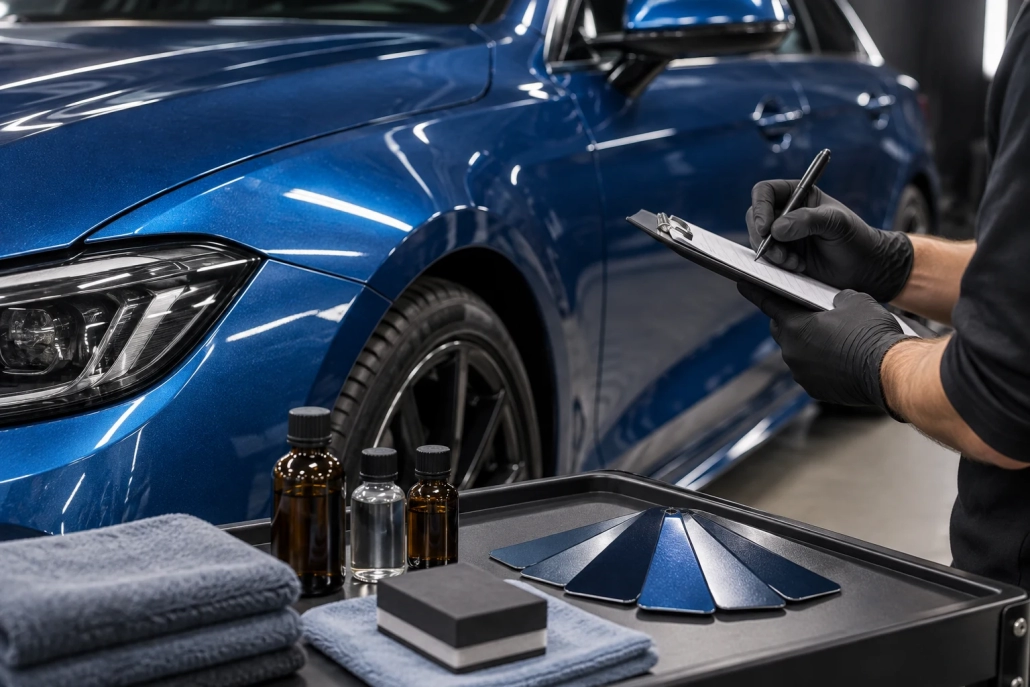
Estimate labour, materials and workshop occupancy from the actual scope, then compare planned and completed work to improve future quotes.
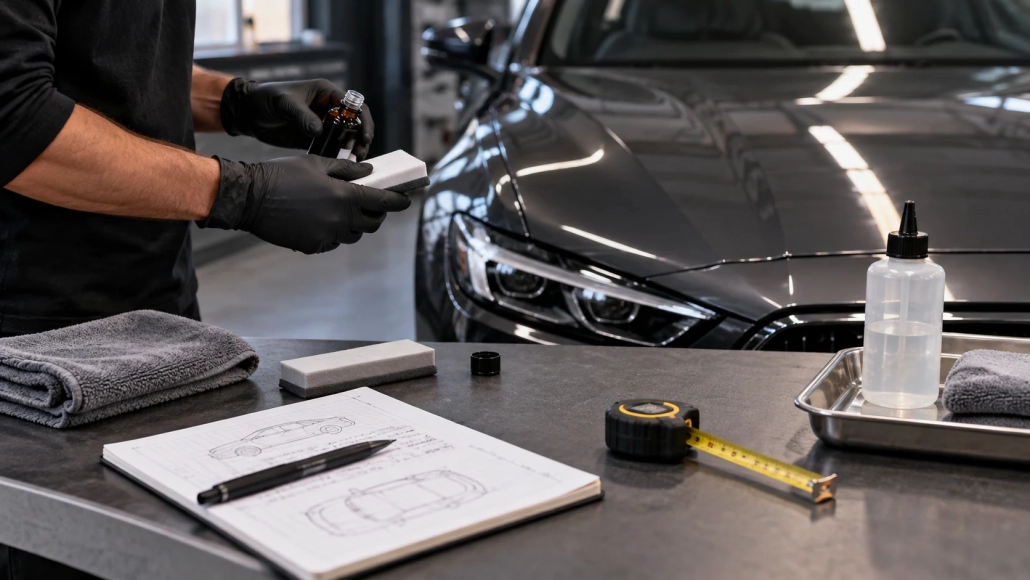
Estimate ceramic coating usage by treated area, application method and product instructions while allowing for normal handling losses.

Make condition-dependent preparation visible so customers understand what drives the proposal.