






A full polishing range.
From cutting and one-step correction to final finishing.
Specialist chemistry. Expert application.
 QUARTZ99 / CERAMIC BASE COAT
The foundation of your coating system.
A layerable quartz base coat designed for mechanical protection. Pair it with a suitable top coat to create the final finish.
For application by NANOLAB certified installers only.
Four formulas. Extended working time. Find the coating for your finish.
Explore the BEAST family of ceramic coatings.
Find the coating for each exterior surface.
 PPF & VINYLGLOSSProtection for glossy films and wraps.Discover
 MATTE & SATINMATTEProtection that respects the finish.Discover
 GLASSWINDOWSExplore dedicated glass protection.Discover
 WHEEL PROTECTIONWHEELSA dedicated coating for your wheels.Discover
 TRIM PROTECTIONPLASTICProtection for plastic surfaces.Discover
Dedicated care for the surfaces inside.
 LEATHER SURFACESLEATHERDiscover NANOLAB leather protection.Discover PLASTIC SURFACESPLASTICProtection for interior plastic surfaces.Discover TEXTILE SURFACESFABRICExplore the latest fabric formulation.Discover
Spray protection, maintenance and upcoming wash products.
 MAINTENANCEBEAST 365Explore the BEAST maintenance range.Discover
Next in washing, cleaning & care.
Ceramic protection for boats and yachts.
An easy-to-apply ceramic coating with an established track record on boats and yachts around the world.
Results vary with surface preparation, exposure and maintenance.
Read 50 MARINE guides →Explore MARINEProtection for the surfaces you live with.
A look at what we’re developing.
From cutting and one-step correction to final finishing.
A wider range for professional vehicle care.
Taking shape alongside BEAST & MATRIX.
Practical guidance for your next coating project.
Explore all guides →
A polishing assessment should test preservation decisions as well as gloss. Use scenarios that require the trainee to stop, investigate or change the plan.
Updated · NANOLAB Knowledge
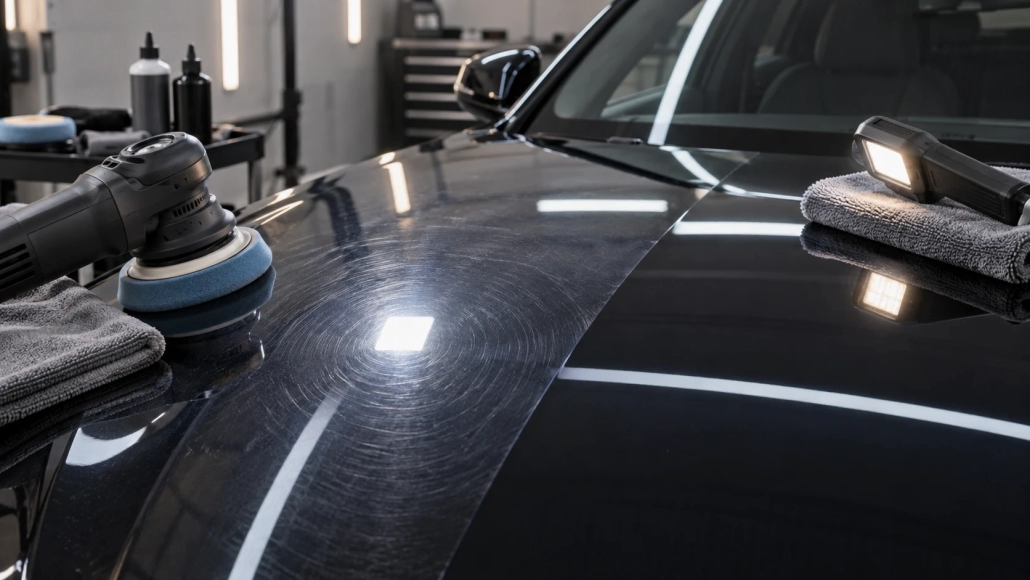
A trainee who can make a practice panel glossy has demonstrated one useful skill. That result does not prove that they can decide when customer paint should receive no further abrasion. Include stopping decisions in practical assessment.
Use identified training panels and a documented, suitable process. State the task, accepted finish and limits before the exercise. Keep unsuitable areas out of actual abrasive practice; a photograph or marked teaching zone can represent a stop condition without deliberately creating damage.
Ask the trainee to explain the selected liquid, pad and machine pairing and identify what information is missing. Recognising an unknown repair history is a better response than inventing a safe polishing allowance.
Score the explanation and action separately. A trainee may name the correct risk while still reaching for a stronger compound without resolving it. That should not pass as controlled decision-making.
Record which tasks can be completed independently, which need direct supervision and which require more training. Keep a specific retraining objective, such as reproducing the accepted inspection method or correctly identifying pad compatibility.
Repeat the practical assessment on a different suitable scenario so memorising one panel does not become the entire qualification. Avoid treating attendance or a product purchase as proof of competence.
Use the test-panel record to define the surface and the exclusion map to assess communication of preservation decisions.

 Car Polish Testing: A Practical Workshop Reference