






A full polishing range.
From cutting and one-step correction to final finishing.
Specialist chemistry. Expert application.
 QUARTZ99 / CERAMIC BASE COAT
The foundation of your coating system.
A layerable quartz base coat designed for mechanical protection. Pair it with a suitable top coat to create the final finish.
For application by NANOLAB certified installers only.
Four formulas. Extended working time. Find the coating for your finish.
Explore the BEAST family of ceramic coatings.
Find the coating for each exterior surface.
 PPF & VINYLGLOSSProtection for glossy films and wraps.Discover
 MATTE & SATINMATTEProtection that respects the finish.Discover
 GLASSWINDOWSExplore dedicated glass protection.Discover
 WHEEL PROTECTIONWHEELSA dedicated coating for your wheels.Discover
 TRIM PROTECTIONPLASTICProtection for plastic surfaces.Discover
Dedicated care for the surfaces inside.
 LEATHER SURFACESLEATHERDiscover NANOLAB leather protection.Discover PLASTIC SURFACESPLASTICProtection for interior plastic surfaces.Discover TEXTILE SURFACESFABRICExplore the latest fabric formulation.Discover
Spray protection, maintenance and upcoming wash products.
 MAINTENANCEBEAST 365Explore the BEAST maintenance range.Discover
Next in washing, cleaning & care.
Ceramic protection for boats and yachts.
An easy-to-apply ceramic coating with an established track record on boats and yachts around the world.
Results vary with surface preparation, exposure and maintenance.
Read 50 MARINE guides →Explore MARINEProtection for the surfaces you live with.
A look at what we’re developing.
From cutting and one-step correction to final finishing.
A wider range for professional vehicle care.
Taking shape alongside BEAST & MATRIX.
Practical guidance for your next coating project.
Explore all guides →
Build a polishing-panel library that distinguishes original paint, documented repairs and unknown finishes instead of treating all test panels as equivalent.
Updated · NANOLAB Knowledge
A discarded bonnet can be useful for training or comparing polishing systems, but its unknown paint history limits what the result demonstrates. A useful test-panel library starts with identification and traceability.
Give each panel a unique identifier. Record the substrate, known paint system, repair history, acquisition date and available supplier or bodyshop information. Mark unknown information as unknown. Do not assign a clear-coat hardness category from the vehicle badge alone.
Keep photographs of the starting surface and records of cleaning, sanding and correction already performed. A panel previously used for repeated demonstrations should not silently become the fresh control for the next compound comparison.
Map unused reference areas and working cells against stable panel features. Record which system has been applied to each zone. Separate training exercises that create or remove substantial defects from product trials intended to compare existing comparable damage.
Where possible, allocate adjacent comparable zones to candidates and retain an untouched reference. If zones begin with different defects or different repair systems, label the comparison as exploratory instead of presenting it as equal-condition evidence.
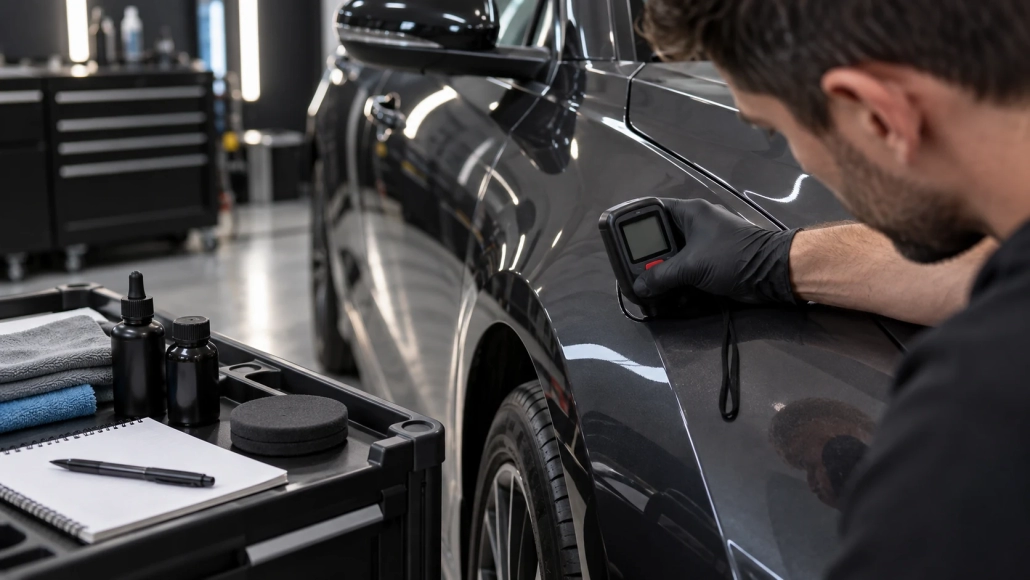
Inspect before each new exercise. A panel can remain suitable for learning tool handling while no longer being appropriate for further aggressive correction or a finish comparison. Thickness readings may contribute to the record, but conventional total-film measurements do not automatically reveal the remaining clear coat.
Retire zones from abrasive testing when their condition no longer supports the planned work. Keep them for visual teaching only if that role remains useful, and identify that restriction clearly.
Use the repeatable measurement map to preserve readings and the coded comparison method to reduce assessor expectations. Together, these records make trial conclusions specific to the surface actually tested.

 Polishing Service Callbacks: Reproduce the Inspection First