






A full polishing range.
From cutting and one-step correction to final finishing.
Specialist chemistry. Expert application.
 QUARTZ99 / CERAMIC BASE COAT
The foundation of your coating system.
A layerable quartz base coat designed for mechanical protection. Pair it with a suitable top coat to create the final finish.
For application by NANOLAB certified installers only.
Four formulas. Extended working time. Find the coating for your finish.
Explore the BEAST family of ceramic coatings.
Find the coating for each exterior surface.
 PPF & VINYLGLOSSProtection for glossy films and wraps.Discover
 MATTE & SATINMATTEProtection that respects the finish.Discover
 GLASSWINDOWSExplore dedicated glass protection.Discover
 WHEEL PROTECTIONWHEELSA dedicated coating for your wheels.Discover
 TRIM PROTECTIONPLASTICProtection for plastic surfaces.Discover
Dedicated care for the surfaces inside.
 LEATHER SURFACESLEATHERDiscover NANOLAB leather protection.Discover PLASTIC SURFACESPLASTICProtection for interior plastic surfaces.Discover TEXTILE SURFACESFABRICExplore the latest fabric formulation.Discover
Spray protection, maintenance and upcoming wash products.
 MAINTENANCEBEAST 365Explore the BEAST maintenance range.Discover
Next in washing, cleaning & care.
Ceramic protection for boats and yachts.
An easy-to-apply ceramic coating with an established track record on boats and yachts around the world.
Results vary with surface preparation, exposure and maintenance.
Read 50 MARINE guides →Explore MARINEProtection for the surfaces you live with.
A look at what we’re developing.
From cutting and one-step correction to final finishing.
A wider range for professional vehicle care.
Taking shape alongside BEAST & MATRIX.
Practical guidance for your next coating project.
Explore all guides →
Understand why DA polishing pressure depends on the supported system and how excessive or inconsistent loading can undermine a repeatable result.
Updated · NANOLAB Knowledge
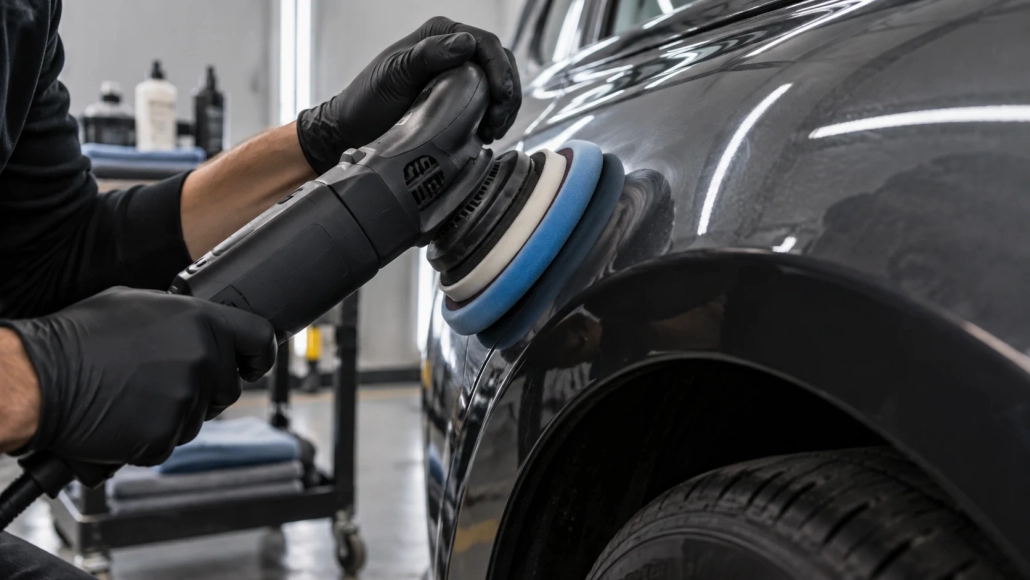
Pressure changes the way the pad contacts the surface and how the tool behaves. There is no universal hand-force number suitable for every DA, pad and polish. Use the system’s instructions and observe the result rather than treating force as the main control for correction.
Maintain the intended pad orientation and a stable working posture. An awkward reach can create uneven loading even if the operator thinks the pressure is light.
Do not compensate for poor access by leaning heavily on one edge of the pad. Change position or choose a suitable smaller setup where the panel requires it.
On a free-spinning DA, load and contact can affect rotation. If rotation is consistently poor, investigate the setup rather than simply adding more pressure.
A gear-driven DA maintains its coupled movement, but continued rotation does not prove the applied force is appropriate. Pad deformation, handling and heat still require control.
If correction slows, inspect pad loading and the working film. A saturated or contaminated pad may need cleaning or replacement. Additional force does not restore a clean cutting face.
Check whether the remaining defect is within the intended correction scope. A stubborn isolated mark is not automatically a request for heavier pressure across the entire panel.
Use the manufacturer’s description and record practical observations: stable contact, rotation behaviour where relevant, ease of control and the cleaned finish. Keep the wording consistent within the studio.
For comparison tests, avoid changing force, pad and liquid simultaneously. A controlled change tells you more than an aggressive attempt that happens to produce more shine.
The aim is repeatable useful correction with acceptable finish quality. Pressure is one process variable, not a substitute for appropriate abrasives, a clean pad and a defensible stopping decision.
Choose a dual-action polish by machine movement, defect level and pad system, then validate correction and finish before working around the vehicle.
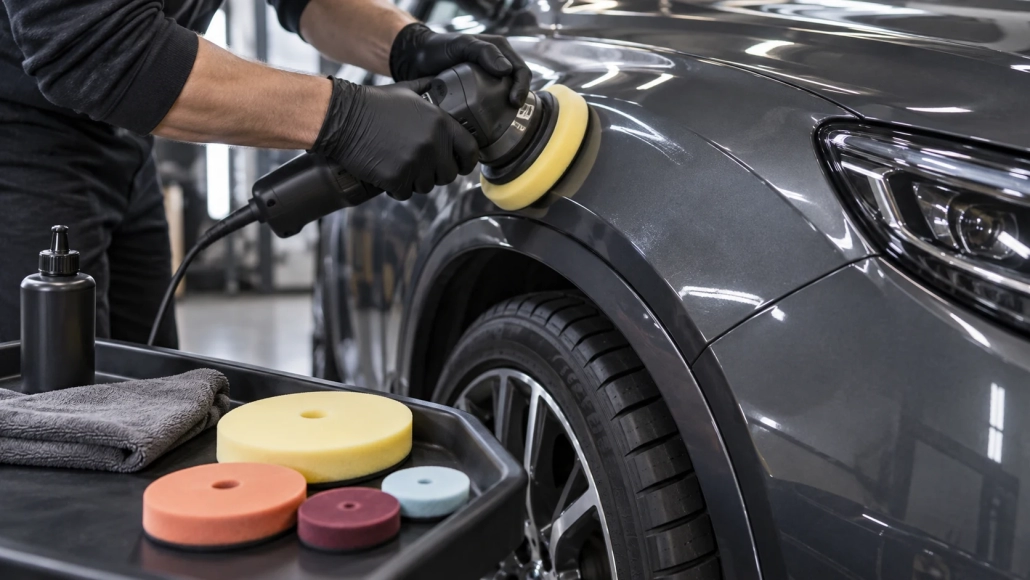
Plan a consistent polishing path and evaluate arm speed, overlap and coverage without relying on a universal seconds-per-pass rule.
Diagnose inconsistent rotation on free-spinning dual-action polishers by checking pressure, pad contact, curves and the approved setup.

 Arm Speed and Overlap in DA Polishing