






A full polishing range.
From cutting and one-step correction to final finishing.
Specialist chemistry. Expert application.
 QUARTZ99 / CERAMIC BASE COAT
The foundation of your coating system.
A layerable quartz base coat designed for mechanical protection. Pair it with a suitable top coat to create the final finish.
For application by NANOLAB certified installers only.
Four formulas. Extended working time. Find the coating for your finish.
Explore the BEAST family of ceramic coatings.
Find the coating for each exterior surface.
 PPF & VINYLGLOSSProtection for glossy films and wraps.Discover
 MATTE & SATINMATTEProtection that respects the finish.Discover
 GLASSWINDOWSExplore dedicated glass protection.Discover
 WHEEL PROTECTIONWHEELSA dedicated coating for your wheels.Discover
 TRIM PROTECTIONPLASTICProtection for plastic surfaces.Discover
Dedicated care for the surfaces inside.
 LEATHER SURFACESLEATHERDiscover NANOLAB leather protection.Discover PLASTIC SURFACESPLASTICProtection for interior plastic surfaces.Discover TEXTILE SURFACESFABRICExplore the latest fabric formulation.Discover
Spray protection, maintenance and upcoming wash products.
 MAINTENANCEBEAST 365Explore the BEAST maintenance range.Discover
Next in washing, cleaning & care.
Ceramic protection for boats and yachts.
An easy-to-apply ceramic coating with an established track record on boats and yachts around the world.
Results vary with surface preparation, exposure and maintenance.
Read 50 MARINE guides →Explore MARINEProtection for the surfaces you live with.
A look at what we’re developing.
From cutting and one-step correction to final finishing.
A wider range for professional vehicle care.
Taking shape alongside BEAST & MATRIX.
Practical guidance for your next coating project.
Explore all guides →
Choose DA operating speed using the exact tool, pad and polish instructions, then inspect the result instead of copying another machine's dial number.
Updated · NANOLAB Knowledge
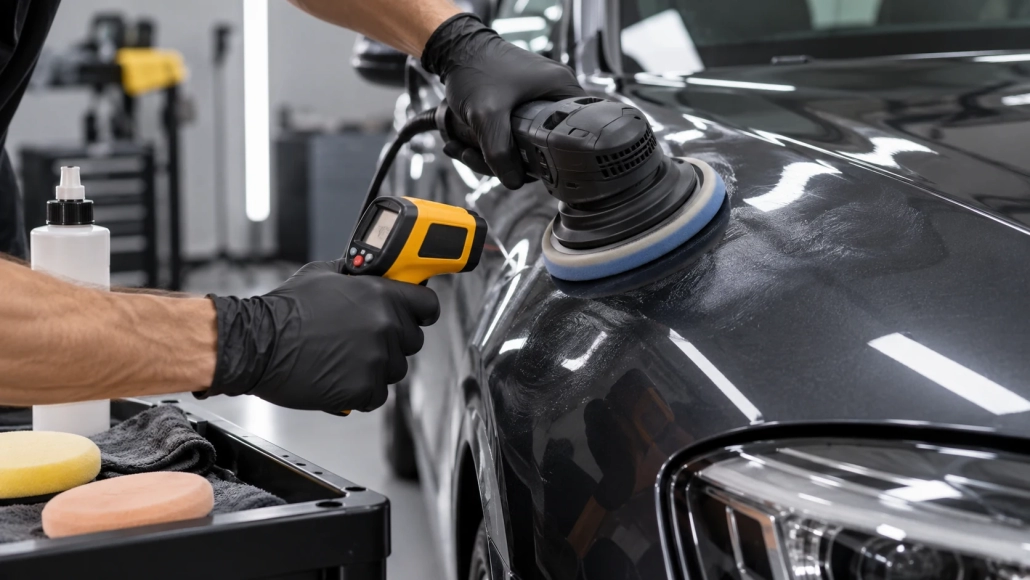
Speed four on one DA is not necessarily equivalent to speed four on another. Dial labels, operating ranges and load response differ. A useful polishing instruction identifies the machine and system, not just a number.
Read the machine, pad and liquid instructions together. Distinguish rotational speed from orbital movement where the documentation does. Do not treat RPM and OPM as interchangeable units.
Also check any consumable limits. A physically compatible pad can still have restrictions that affect the allowable setup.
Some systems specify a lower setting for distributing product and another for the working cycle. Follow the actual procedure rather than assuming every stage uses one speed.
Keep the pad on the surface and operate the tool as instructed to control product distribution. Changing speed does not correct excessive liquid, poor pad contact or an unsuitable working area.
If the result is poor, record whether the issue is insufficient correction, difficult control, residue drying or finish quality. Inspect pad condition and movement before increasing the setting.
Change one meaningful variable at a time where practical. Otherwise, a successful result provides little information about which adjustment helped.
A complete note includes tool model, pad, liquid, section, setting and relevant handling observations. Record the inspected outcome after residue removal, including any refinement needed.
Do not assume maximum speed means maximum useful productivity. Cleanup, pad maintenance and finishing work contribute to total time. Equally, the lowest setting is not a universal finishing rule.
The appropriate speed is part of a supported process that works on the actual surface. If the manufacturer has no guidance for the proposed combination, obtain it or select a documented system rather than inventing a numerical recipe.
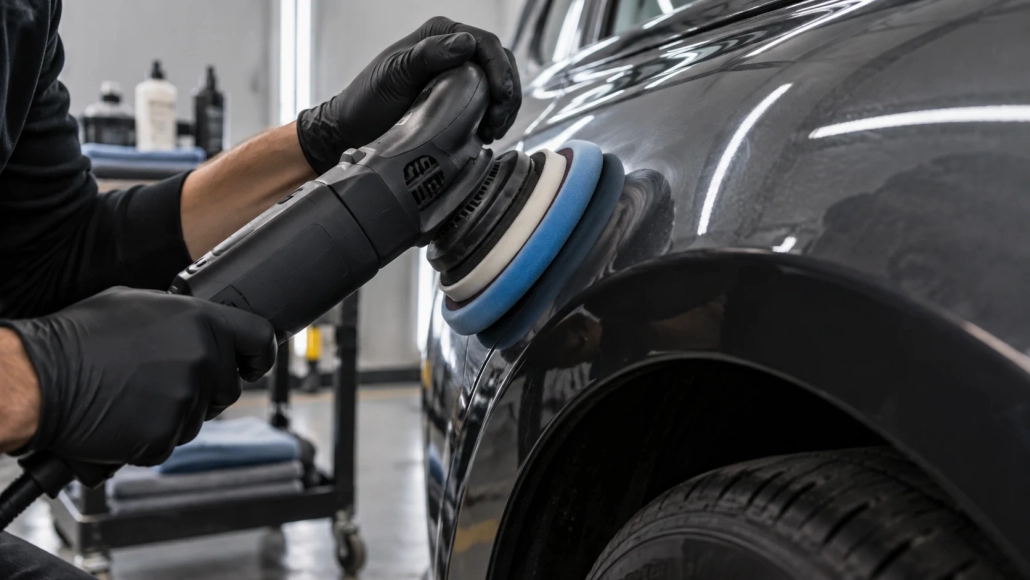
Choose a dual-action polish by machine movement, defect level and pad system, then validate correction and finish before working around the vehicle.
Understand why DA polishing pressure depends on the supported system and how excessive or inconsistent loading can undermine a repeatable result.
Plan polishing sections, pad rotation and inspection pauses to keep heat and tool control within the limits of the surface and equipment.

 Pressure on a DA Polisher: Control, Contact and Correction