






A full polishing range.
From cutting and one-step correction to final finishing.
Specialist chemistry. Expert application.
 QUARTZ99 / CERAMIC BASE COAT
The foundation of your coating system.
A layerable quartz base coat designed for mechanical protection. Pair it with a suitable top coat to create the final finish.
For application by NANOLAB certified installers only.
Four formulas. Extended working time. Find the coating for your finish.
Explore the BEAST family of ceramic coatings.
Find the coating for each exterior surface.
 PPF & VINYLGLOSSProtection for glossy films and wraps.Discover
 MATTE & SATINMATTEProtection that respects the finish.Discover
 GLASSWINDOWSExplore dedicated glass protection.Discover
 WHEEL PROTECTIONWHEELSA dedicated coating for your wheels.Discover
 TRIM PROTECTIONPLASTICProtection for plastic surfaces.Discover
Dedicated care for the surfaces inside.
 LEATHER SURFACESLEATHERDiscover NANOLAB leather protection.Discover PLASTIC SURFACESPLASTICProtection for interior plastic surfaces.Discover TEXTILE SURFACESFABRICExplore the latest fabric formulation.Discover
Spray protection, maintenance and upcoming wash products.
 MAINTENANCEBEAST 365Explore the BEAST maintenance range.Discover
Next in washing, cleaning & care.
Ceramic protection for boats and yachts.
An easy-to-apply ceramic coating with an established track record on boats and yachts around the world.
Results vary with surface preparation, exposure and maintenance.
Read 50 MARINE guides →Explore MARINEProtection for the surfaces you live with.
A look at what we’re developing.
From cutting and one-step correction to final finishing.
A wider range for professional vehicle care.
Taking shape alongside BEAST & MATRIX.
Practical guidance for your next coating project.
Explore all guides →
Use gloss measurements alongside visual inspection and controlled sampling, without treating one instrument reading as a complete description of the finish.
Updated · NANOLAB Knowledge
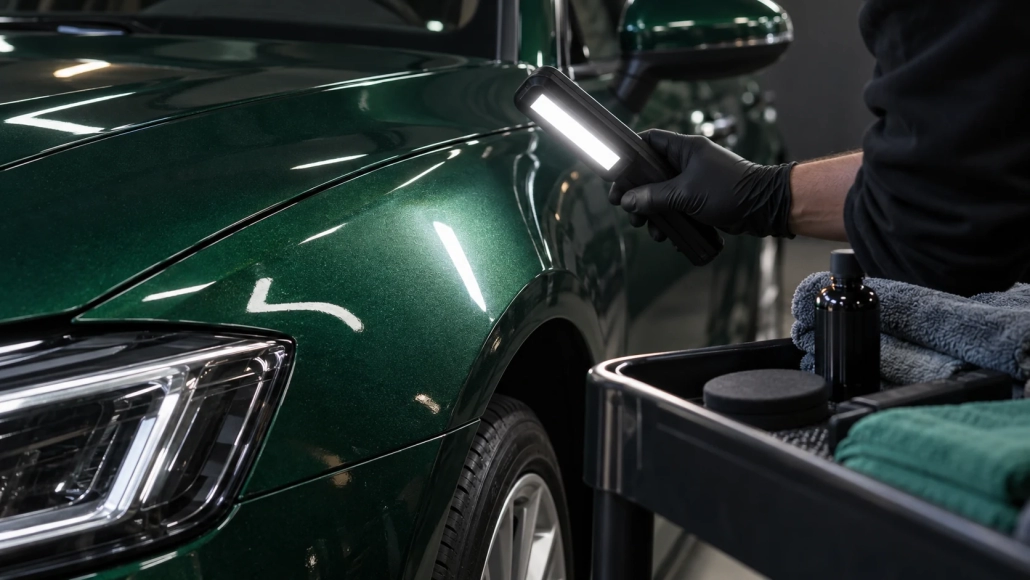
A gloss meter can add useful quantitative information to polish testing, but one reading cannot describe every aspect of the finish. Scratches, haze, texture and reflection clarity need separate assessment. Define the question before choosing the measurement.
Follow calibration, geometry and operating instructions. Record the measurement angle and use an area suitable for that instrument. Curvature and placement can affect repeatability.
Map consistent locations without contaminating the surface. Comparing unrelated places before and after can produce a difference caused by local variation rather than the polishing process.
Measure and photograph the surface in a defined condition before correction. After polishing, use the agreed compatible residue-removal method and return to the same inspection condition.
An oily after-reading compared with a clean before-reading does not demonstrate permanent mechanical improvement. If evaluating a protective film, treat that as a separate test with its own baseline.
Use directional light for the defect field and broader reflections for consistency. A higher gloss reading does not prove that an isolated scratch has disappeared or that fine haze is absent from every angle.
Record several relevant locations and the spread of results instead of selecting only the highest value. Include areas that could not be measured reliably and explain why.
A workshop test can show a change under stated conditions. It does not establish the same percentage improvement on every colour, tool or paint system.
Record pad, liquid, machine, removal method and surface condition alongside the readings. Avoid adding impressive decimal places when repeatability does not support that precision.
A credible comparison combines controlled measurements with honest photographs and observations of remaining defects. Another technician should be able to understand what changed, what stayed uncertain and how the result could be reproduced.
Understand where fine cut polish fits between stronger compounding and final finishing, and use the paint's response to decide its role.
Use complementary lighting and viewing angles to reveal scratches, haze and coating residue without relying on one bright reflection.

 Dual-Action Polish: Choosing a Liquid and Process for Your DA