






A full polishing range.
From cutting and one-step correction to final finishing.
Specialist chemistry. Expert application.
 QUARTZ99 / CERAMIC BASE COAT
The foundation of your coating system.
A layerable quartz base coat designed for mechanical protection. Pair it with a suitable top coat to create the final finish.
For application by NANOLAB certified installers only.
Four formulas. Extended working time. Find the coating for your finish.
Explore the BEAST family of ceramic coatings.
Find the coating for each exterior surface.
 PPF & VINYLGLOSSProtection for glossy films and wraps.Discover
 MATTE & SATINMATTEProtection that respects the finish.Discover
 GLASSWINDOWSExplore dedicated glass protection.Discover
 WHEEL PROTECTIONWHEELSA dedicated coating for your wheels.Discover
 TRIM PROTECTIONPLASTICProtection for plastic surfaces.Discover
Dedicated care for the surfaces inside.
 LEATHER SURFACESLEATHERDiscover NANOLAB leather protection.Discover PLASTIC SURFACESPLASTICProtection for interior plastic surfaces.Discover TEXTILE SURFACESFABRICExplore the latest fabric formulation.Discover
Spray protection, maintenance and upcoming wash products.
 MAINTENANCEBEAST 365Explore the BEAST maintenance range.Discover
Next in washing, cleaning & care.
Ceramic protection for boats and yachts.
An easy-to-apply ceramic coating with an established track record on boats and yachts around the world.
Results vary with surface preparation, exposure and maintenance.
Read 50 MARINE guides →Explore MARINEProtection for the surfaces you live with.
A look at what we’re developing.
From cutting and one-step correction to final finishing.
A wider range for professional vehicle care.
Taking shape alongside BEAST & MATRIX.
Practical guidance for your next coating project.
Explore all guides →
Use a controlled wipe-off comparison to distinguish polishing defects from marks introduced by towels, residue or the removal process.
Updated · NANOLAB Knowledge
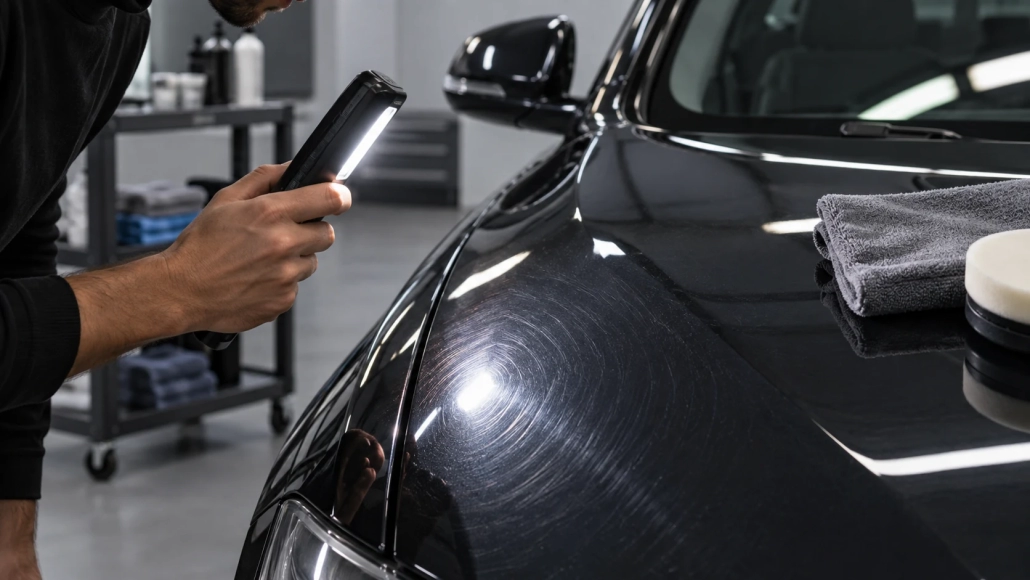
A panel may look clear before wipe-off and then show fine lines. The removal step can create marks, but it can also reveal defects previously hidden by residue. Distinguish those possibilities before repeating the abrasive process.
Choose a representative section and use the prescribed polish-removal method. Inspect a clean appropriate towel for contamination and expose fresh contact faces as needed.
Observe the direction and location of visible marks. Compare them with the wiping path and machine-worked area. Alignment is a clue, not proof by itself.
On an equivalent section, use a fresh suitable towel and the compatible cleaner if the system calls for one. Apply only the pressure needed for the specified method. Avoid repeated dry rubbing of resistant residue.
If removal remains difficult, review product loading, cycle length, pad condition and panel temperature. A residue problem should be corrected at its source rather than overcome with more force.
An inspection cleaner can expose marks that already existed under oils. If a stable pattern returns regardless of wiping direction, the correction process may be incomplete.
If new lines repeatedly track towel contact, investigate contamination and surface sensitivity. Continually machine-polishing while recreating marks at wipe-off produces work without a lasting result.
Record towel type, cleaner and removal approach when a combination preserves the accepted finish. Keep final-inspection towels away from cutting dust, dressing and general cleanup.
Check the towel face after use, not just when it first leaves the clean storage box. Residue picked up from adjacent trim or a dirty seam can change its condition mid-panel.
This diagnostic makes the finishing process more efficient and more honest. A successful polish must survive the preparation needed for protection, rather than appearing acceptable only while lubricating residue remains on the paint.
Understand where fine cut polish fits between stronger compounding and final finishing, and use the paint's response to decide its role.
Use gloss measurements alongside visual inspection and controlled sampling, without treating one instrument reading as a complete description of the finish.
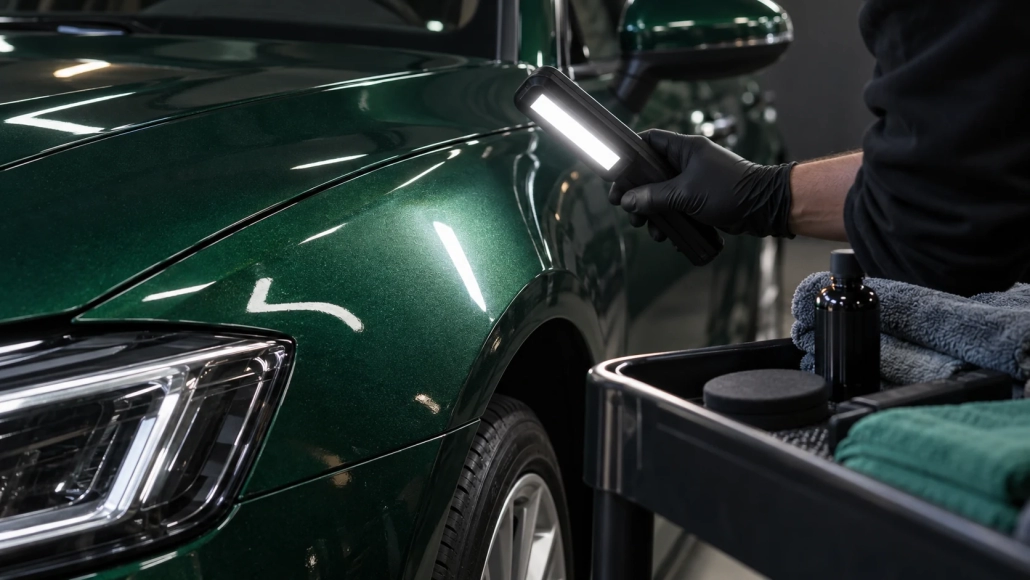
Identify polishing trails under suitable lighting and verify refinement before applying a ceramic coating to glossy paint.

 Using a Gloss Meter to Compare Car Polish Results