






A full polishing range.
From cutting and one-step correction to final finishing.
Specialist chemistry. Expert application.
 QUARTZ99 / CERAMIC BASE COAT
The foundation of your coating system.
A layerable quartz base coat designed for mechanical protection. Pair it with a suitable top coat to create the final finish.
For application by NANOLAB certified installers only.
Four formulas. Extended working time. Find the coating for your finish.
Explore the BEAST family of ceramic coatings.
Find the coating for each exterior surface.
 PPF & VINYLGLOSSProtection for glossy films and wraps.Discover
 MATTE & SATINMATTEProtection that respects the finish.Discover
 GLASSWINDOWSExplore dedicated glass protection.Discover
 WHEEL PROTECTIONWHEELSA dedicated coating for your wheels.Discover
 TRIM PROTECTIONPLASTICProtection for plastic surfaces.Discover
Dedicated care for the surfaces inside.
 LEATHER SURFACESLEATHERDiscover NANOLAB leather protection.Discover PLASTIC SURFACESPLASTICProtection for interior plastic surfaces.Discover TEXTILE SURFACESFABRICExplore the latest fabric formulation.Discover
Spray protection, maintenance and upcoming wash products.
 MAINTENANCEBEAST 365Explore the BEAST maintenance range.Discover
Next in washing, cleaning & care.
Ceramic protection for boats and yachts.
An easy-to-apply ceramic coating with an established track record on boats and yachts around the world.
Results vary with surface preparation, exposure and maintenance.
Read 50 MARINE guides →Explore MARINEProtection for the surfaces you live with.
A look at what we’re developing.
From cutting and one-step correction to final finishing.
A wider range for professional vehicle care.
Taking shape alongside BEAST & MATRIX.
Practical guidance for your next coating project.
Explore all guides →
Keep cosmetic coating work distinct from structural and condition assessment when a boat is being inspected for purchase.
Updated · NANOLAB Knowledge
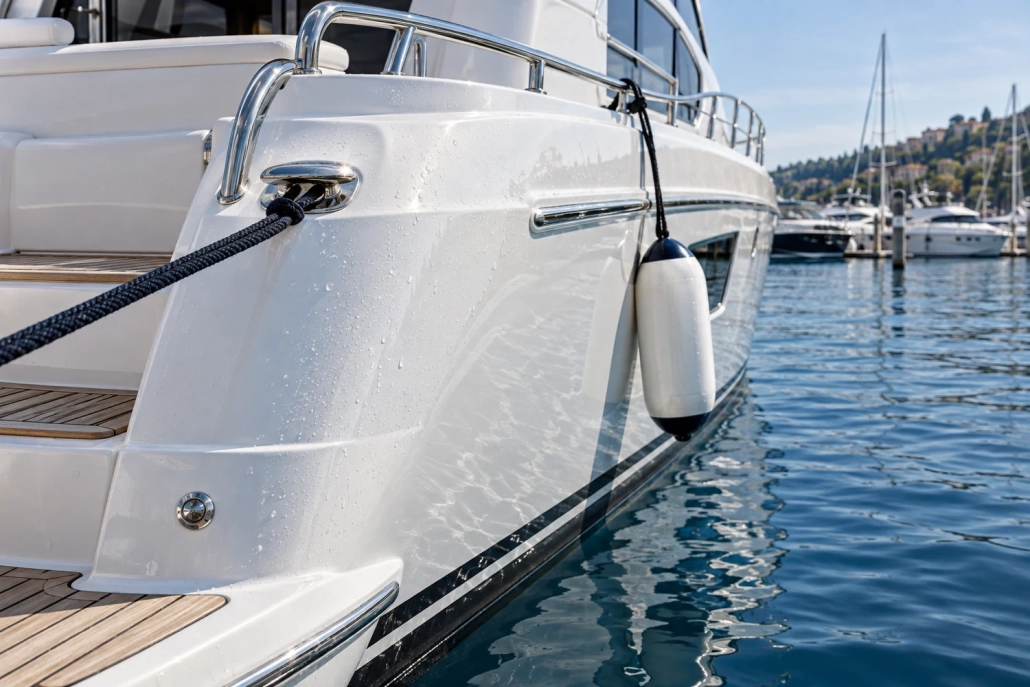
A ceramic coating can change the appearance and maintenance characteristics of a compatible surface. It should not be presented as evidence of a boat’s structural condition or used to conceal defects before a survey. Buyers need an accurate history of cosmetic work.
Discuss planned polishing and coating with the owner and survey professional before beginning. They can determine whether inspection should occur first for the specific vessel. Do not interpret a glossy surface as proof that the underlying material is sound.
Record visible damage, oxidation, repairs and areas excluded from the coating scope. Cosmetic preparation may change what is visible, so photographs taken before work are useful context for later questions.
State which surfaces were cleaned, polished and coated, along with the product and date. Avoid language suggesting that a thin surface treatment repairs cracks, resolves moisture concerns or replaces marine maintenance. Those questions belong to qualified vessel assessment.
Use NANOLAB MARINE for the product’s actual supported role. Do not extend its surface-care description into structural or seaworthiness claims.
If ownership changes, provide the new owner with the coating record and care requirements. Include any local areas completed later, because they may have different curing or maintenance dates.
An honest cosmetic record helps the surveyor and buyer understand what they are seeing. It also gives the new owner a useful care starting point without confusing an attractive finish with an evaluation of the boat’s underlying condition.
A pre-coating inspection prevents attractive results in one area from hiding unresolved problems elsewhere.
Plan residue removal, surface inspection and local protection when a boat's name or graphics are replaced.
Compare coating condition by real exposure when one side of a berthed boat receives more sun or contamination than another.
 Ceramic Coating After Boat Graphics Replacement