






A full polishing range.
From cutting and one-step correction to final finishing.
Specialist chemistry. Expert application.
 QUARTZ99 / CERAMIC BASE COAT
The foundation of your coating system.
A layerable quartz base coat designed for mechanical protection. Pair it with a suitable top coat to create the final finish.
For application by NANOLAB certified installers only.
Four formulas. Extended working time. Find the coating for your finish.
Explore the BEAST family of ceramic coatings.
Find the coating for each exterior surface.
 PPF & VINYLGLOSSProtection for glossy films and wraps.Discover
 MATTE & SATINMATTEProtection that respects the finish.Discover
 GLASSWINDOWSExplore dedicated glass protection.Discover
 WHEEL PROTECTIONWHEELSA dedicated coating for your wheels.Discover
 TRIM PROTECTIONPLASTICProtection for plastic surfaces.Discover
Dedicated care for the surfaces inside.
 LEATHER SURFACESLEATHERDiscover NANOLAB leather protection.Discover PLASTIC SURFACESPLASTICProtection for interior plastic surfaces.Discover TEXTILE SURFACESFABRICExplore the latest fabric formulation.Discover
Spray protection, maintenance and upcoming wash products.
 MAINTENANCEBEAST 365Explore the BEAST maintenance range.Discover
Next in washing, cleaning & care.
Ceramic protection for boats and yachts.
An easy-to-apply ceramic coating with an established track record on boats and yachts around the world.
Results vary with surface preparation, exposure and maintenance.
Read 50 MARINE guides →Explore MARINEProtection for the surfaces you live with.
A look at what we’re developing.
From cutting and one-step correction to final finishing.
A wider range for professional vehicle care.
Taking shape alongside BEAST & MATRIX.
Practical guidance for your next coating project.
Explore all guides →
Separate shower leakage, retained water and drying marks before deciding whether a glass coating or another part of the enclosure needs attention.
Updated · NANOLAB Knowledge
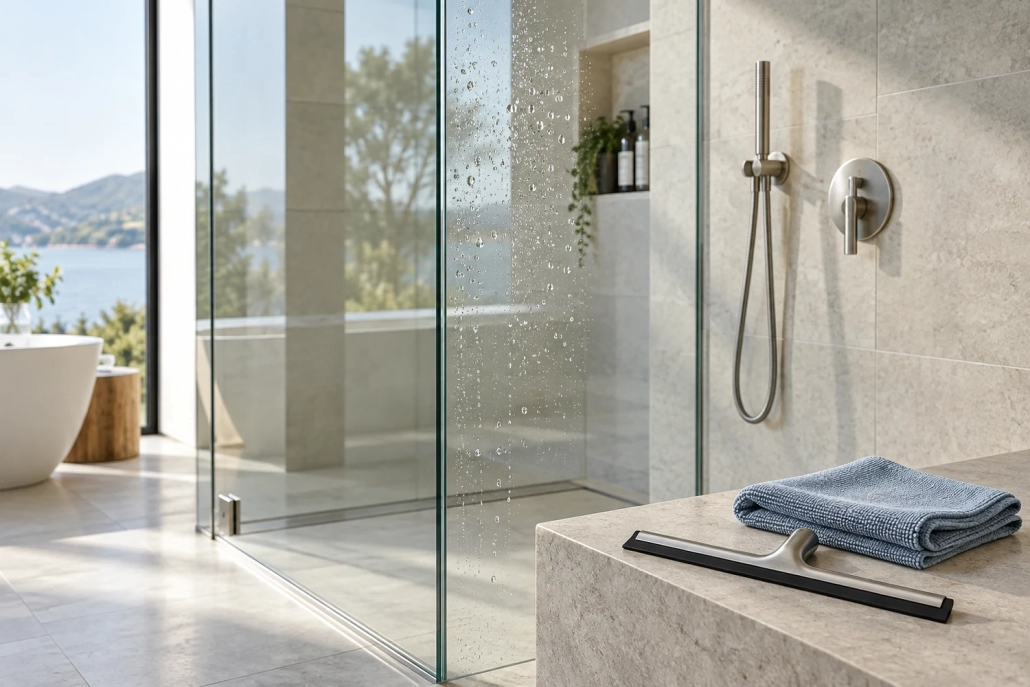
Water outside a shower and marks on its glass are different problems. A surface coating is not a substitute for an enclosure’s seals, drainage and installation design. Begin by locating where the water travels.
Note whether water crosses a door edge, emerges from a channel, collects on a ledge or dries on the broad glass face. Use photographs showing the enclosure rather than only the final mark. Record when the observation occurs during ordinary use.
| Observation | Responsible review |
|---|---|
| Water escapes a joint | Enclosure installation and sealing |
| Water remains in a channel | Drainage and hardware condition |
| Dry residue on glass | Water, cleaning and surface condition |
Applying another coating layer will not establish that a leaking joint is properly assembled. Similarly, stronger descaling chemistry will not repair an obstructed or damaged component. Refer hardware and sealing concerns to the responsible installer.
Use the supported care method and assess the dry result. If deposits recur in a particular location, compare that area with its water exposure. Local recurrence may reflect repeated wetting rather than uniform loss of coating performance.
Document the enclosure repair or adjustment separately from any glass cleaning or coating work. This allows a later complaint to be compared with the correct intervention.
The practical goal is a functioning shower assembly and maintainable glass. Treating every water-related complaint as a coating failure can delay the repair that actually resolves the customer’s problem.
Discuss a shower-glass coating project. For application and care, use the current instructions for the exact product.
A test patch should represent the actual enclosure, including its existing finish and maintenance needs.
A shampoo leak can leave concentrated residue that spreads during wiping. Remove it before judging the condition of the glass coating.
Investigate cleaner and water trapped in shower-door channels before attributing recurring streaks on nearby coated glass to coating failure.
 Residue inside Shower Door Channels: Separate Trapped Cleaner from Coating ...