






A full polishing range.
From cutting and one-step correction to final finishing.
Specialist chemistry. Expert application.
 QUARTZ99 / CERAMIC BASE COAT
The foundation of your coating system.
A layerable quartz base coat designed for mechanical protection. Pair it with a suitable top coat to create the final finish.
For application by NANOLAB certified installers only.
Four formulas. Extended working time. Find the coating for your finish.
Explore the BEAST family of ceramic coatings.
Find the coating for each exterior surface.
 PPF & VINYLGLOSSProtection for glossy films and wraps.Discover
 MATTE & SATINMATTEProtection that respects the finish.Discover
 GLASSWINDOWSExplore dedicated glass protection.Discover
 WHEEL PROTECTIONWHEELSA dedicated coating for your wheels.Discover
 TRIM PROTECTIONPLASTICProtection for plastic surfaces.Discover
Dedicated care for the surfaces inside.
 LEATHER SURFACESLEATHERDiscover NANOLAB leather protection.Discover PLASTIC SURFACESPLASTICProtection for interior plastic surfaces.Discover TEXTILE SURFACESFABRICExplore the latest fabric formulation.Discover
Spray protection, maintenance and upcoming wash products.
 MAINTENANCEBEAST 365Explore the BEAST maintenance range.Discover
Next in washing, cleaning & care.
Ceramic protection for boats and yachts.
An easy-to-apply ceramic coating with an established track record on boats and yachts around the world.
Results vary with surface preparation, exposure and maintenance.
Read 50 MARINE guides →Explore MARINEProtection for the surfaces you live with.
A look at what we’re developing.
From cutting and one-step correction to final finishing.
A wider range for professional vehicle care.
Taking shape alongside BEAST & MATRIX.
Practical guidance for your next coating project.
Explore all guides →
Calculate RO rejection and recovery separately, understand their different denominators, and compare systems under relevant conditions.
Updated · NANOLAB Knowledge
Reverse-osmosis rejection describes the reduction in a specified solute concentration. Recovery describes the share of feedwater collected as permeate. A system can have a high rejection percentage without a high recovery percentage, because the denominators are different.
For an illustrative concentration comparison, feedwater at 400 units and permeate at 20 units gives rejection of (400 − 20) ÷ 400 × 100 = 95 percent. The units and measurement method must match on both sides.
For an illustrative flow comparison, 40 litres of permeate from 100 litres of feedwater gives 40 percent recovery. That leaves 60 litres in the concentrate stream, ignoring other losses for this simplified example. The 95 percent rejection does not mean 95 litres became product water.
Pressure, temperature, feedwater composition and operating configuration can affect performance. Record those conditions and use the supplier's procedure for evaluating or normalizing results. A casual comparison across different seasons may be misleading.
When using conductivity as a practical surrogate for dissolved salts, preserve that description. Do not relabel a calculated conductivity rejection as a laboratory measurement of every contaminant.
Rejection helps assess the selected water-quality property. Recovery helps assess water use and system operation. Both should be considered with permeate production rate, maintenance needs and downstream requirements.
Do not alter valves or operating limits simply to maximize a percentage. The equipment supplier should determine a suitable operating configuration for the feedwater and system. For a detailing business, the meaningful outcome is enough acceptable rinse water delivered reliably, with understood water consumption and operating cost—not the highest isolated number on a sales sheet.
Technical references: DuPont: RO and NF principles and terminology.
For product-specific application instructions, consult NANOLAB technical documentation or ask about your surface and intended use.
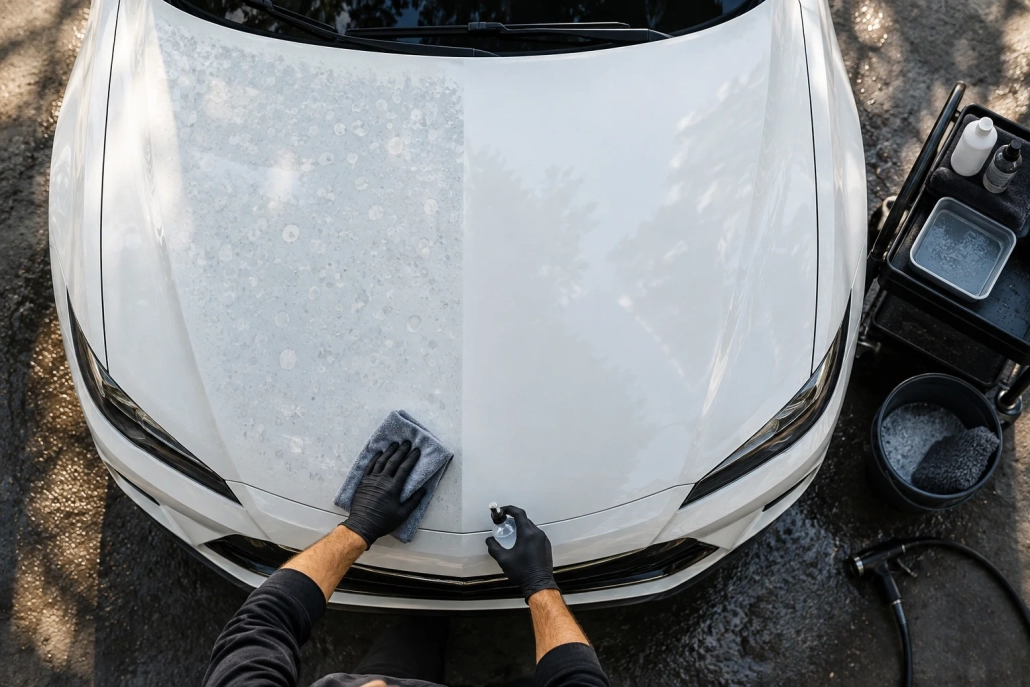
Understand why softened water and deionised rinse water are different when planning washing and drying for a ceramic-coated car.
A TDS display can help monitor a water-treatment system, but it does not describe every contaminant or guarantee that drying will leave no marks.
Build a consistent DI outlet-water monitoring record and investigate rising readings before relying on the system for another wash job.