






A full polishing range.
From cutting and one-step correction to final finishing.
Specialist chemistry. Expert application.
 QUARTZ99 / CERAMIC BASE COAT
The foundation of your coating system.
A layerable quartz base coat designed for mechanical protection. Pair it with a suitable top coat to create the final finish.
For application by NANOLAB certified installers only.
Four formulas. Extended working time. Find the coating for your finish.
Explore the BEAST family of ceramic coatings.
Find the coating for each exterior surface.
 PPF & VINYLGLOSSProtection for glossy films and wraps.Discover
 MATTE & SATINMATTEProtection that respects the finish.Discover
 GLASSWINDOWSExplore dedicated glass protection.Discover
 WHEEL PROTECTIONWHEELSA dedicated coating for your wheels.Discover
 TRIM PROTECTIONPLASTICProtection for plastic surfaces.Discover
Dedicated care for the surfaces inside.
 LEATHER SURFACESLEATHERDiscover NANOLAB leather protection.Discover PLASTIC SURFACESPLASTICProtection for interior plastic surfaces.Discover TEXTILE SURFACESFABRICExplore the latest fabric formulation.Discover
Spray protection, maintenance and upcoming wash products.
 MAINTENANCEBEAST 365Explore the BEAST maintenance range.Discover
Next in washing, cleaning & care.
Ceramic protection for boats and yachts.
An easy-to-apply ceramic coating with an established track record on boats and yachts around the world.
Results vary with surface preparation, exposure and maintenance.
Read 50 MARINE guides →Explore MARINEProtection for the surfaces you live with.
A look at what we’re developing.
From cutting and one-step correction to final finishing.
A wider range for professional vehicle care.
Taking shape alongside BEAST & MATRIX.
Practical guidance for your next coating project.
Explore all guides →
Use broad, directional and customer-relevant lighting to inspect a ceramic coating while keeping the inspection sequence consistent.
Updated · NANOLAB Knowledge
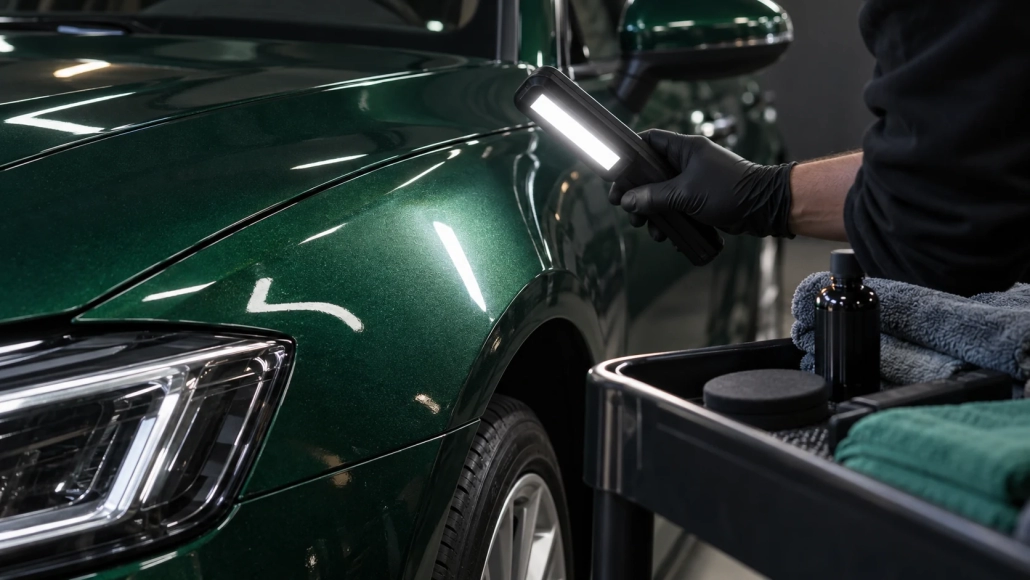
A coating can look even under one light and show residue under another. An inspection route using three complementary lighting conditions is more useful than repeatedly increasing the brightness of one lamp.
| Condition | Primary question |
|---|---|
| Broad diffuse light | Is the panel’s overall appearance even? |
| Directional inspection light | Are local streaks, haze or surface marks visible? |
| Representative delivery light | Does the finish remain acceptable where the customer will see it? |
Keep lamp position, viewing distance and panel orientation reasonably repeatable. Move the observer and light deliberately; reflections can conceal a defect when viewed straight on. Do not confuse a bright reflected lamp with proof of a uniform coating.
Start with a broad view of each panel, then examine its edges, curves and adjoining trim. Finish with the likely customer viewing position. Record the location of a concern on a panel map so another person can find it without guessing.
For a dark vehicle, a wide reflection may reveal an uneven patch while a directional lamp shows polishing marks beneath it. Those observations can coexist. Separate the suspected coating residue from the underlying paint condition before selecting a correction method.
Inspect an accepted area under the same conditions. Compare neighbouring surfaces with similar geometry where possible. A curved panel and a flat panel may reflect differently even when both are acceptable, so a visual difference alone is not a diagnosis.
Use clean handling practices and avoid touching the paint to point out defects. If a correction is required, follow the coating-specific procedure and repeat the full inspection of the affected area. A successful local wipe under one lamp does not complete the review.
Record the lights used and unresolved areas at handover. This is especially useful when installation and final inspection are performed by different people. The aim is reproducible visibility, not an unrealistic promise that every possible lighting condition has been tested.
Ask NANOLAB about your surface and intended use. For application and care, use the current instructions for the exact product.

Use clear checkpoints before application, after levelling and at handover to make coating work consistent and traceable.
Use complementary lighting and viewing angles to reveal scratches, haze and coating residue without relying on one bright reflection.
Map gloss readings across a coated bonnet to distinguish overall improvement from local variation hidden by a single average.

 A Gloss Map for a Coated Bonnet: Find Variation Before Averaging