






A full polishing range.
From cutting and one-step correction to final finishing.
Specialist chemistry. Expert application.
 QUARTZ99 / CERAMIC BASE COAT
The foundation of your coating system.
A layerable quartz base coat designed for mechanical protection. Pair it with a suitable top coat to create the final finish.
For application by NANOLAB certified installers only.
Four formulas. Extended working time. Find the coating for your finish.
Explore the BEAST family of ceramic coatings.
Find the coating for each exterior surface.
 PPF & VINYLGLOSSProtection for glossy films and wraps.Discover
 MATTE & SATINMATTEProtection that respects the finish.Discover
 GLASSWINDOWSExplore dedicated glass protection.Discover
 WHEEL PROTECTIONWHEELSA dedicated coating for your wheels.Discover
 TRIM PROTECTIONPLASTICProtection for plastic surfaces.Discover
Dedicated care for the surfaces inside.
 LEATHER SURFACESLEATHERDiscover NANOLAB leather protection.Discover PLASTIC SURFACESPLASTICProtection for interior plastic surfaces.Discover TEXTILE SURFACESFABRICExplore the latest fabric formulation.Discover
Spray protection, maintenance and upcoming wash products.
 MAINTENANCEBEAST 365Explore the BEAST maintenance range.Discover
Next in washing, cleaning & care.
Ceramic protection for boats and yachts.
An easy-to-apply ceramic coating with an established track record on boats and yachts around the world.
Results vary with surface preparation, exposure and maintenance.
Read 50 MARINE guides →Explore MARINEProtection for the surfaces you live with.
A look at what we’re developing.
From cutting and one-step correction to final finishing.
A wider range for professional vehicle care.
Taking shape alongside BEAST & MATRIX.
Practical guidance for your next coating project.
Explore all guides →
Inspect prepared gelcoat for remaining oxidation, texture and repair differences before deciding whether it is ready for a protective coating.
Updated · NANOLAB Knowledge
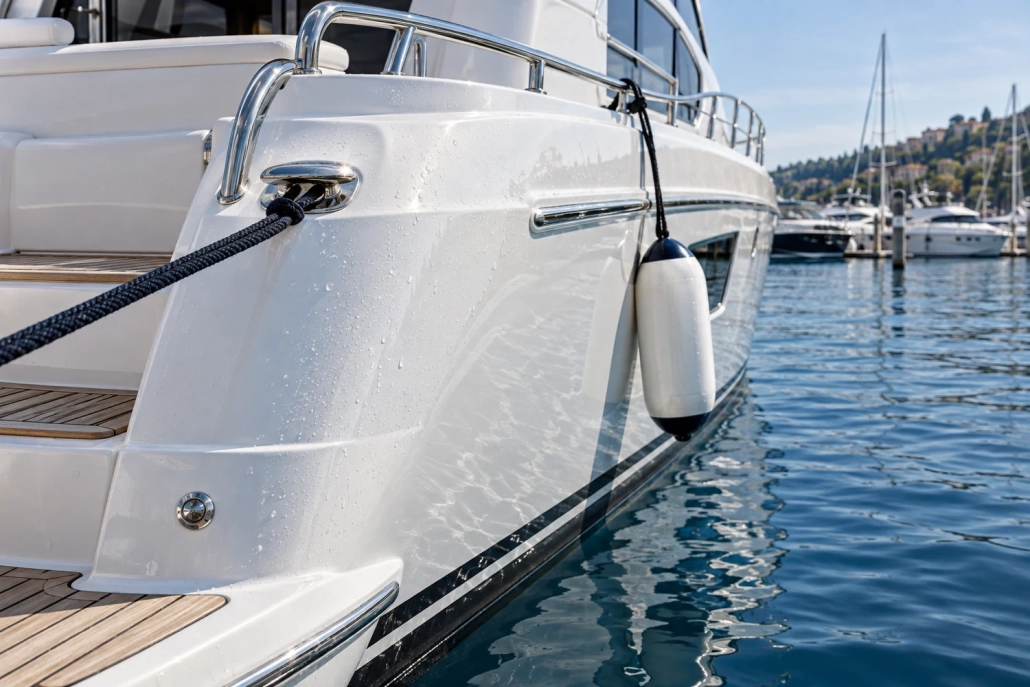
Gelcoat can retain texture or repair differences after appropriate polishing. Those features should not automatically be labelled oxidation, and a coating should not be expected to erase them. Establish an accepted preparation baseline before protection.
Use suitable lighting and compare broad reflections with local detail. Record chalky appearance, uneven colour, visible repairs and texture separately. A wet surface can temporarily look more uniform, so keep wet and dry observations clearly labelled.
| Observation | Question |
|---|---|
| Powdery or chalky surface condition | Is further suitable preparation required? |
| Consistent moulded texture | Is this the intended surface character? |
| Local repair difference | Does the repair need separate acceptance? |
| Streaking after preparation | Could residue or wiping be involved? |
Follow a process suitable for the gelcoat condition and construction. Agree a stopping point rather than repeatedly polishing to chase every variation. Record the combination used and the accepted result after appropriate residue removal.
A previously weathered hull may improve substantially while retaining differences between original and repaired areas. That can be an acceptable outcome if it matches the agreed scope. Do not promise that a transparent coating will make dissimilar underlying finishes identical.
A panel retains a broad reflection texture after surface chalking has been addressed. The texture is stable and matches an adjacent accepted area. Further aggressive correction solely to flatten the reflection may not fit the preservation goal.
Another area may continue to transfer residue during the approved preparation check. That requires further assessment before coating rather than assuming the coating will stabilise an unresolved surface condition.
Document the dry finish, remaining limitations and product-specific preparation requirements. Keep traction-critical and other excluded areas outside the cosmetic treatment scope.
A clear baseline lets later inspections distinguish normal retained texture from new contamination or deterioration. It also makes the owner’s expectations more realistic before the coating is applied.
Ask NANOLAB about your surface and intended use. For application and care, use the current instructions for the exact product.
A pre-coating inspection prevents attractive results in one area from hiding unresolved problems elsewhere.
Chalky or faded gelcoat should be assessed before a protective coating is applied.
Create a marine coating exclusion map for functional and mixed-material areas so cosmetic protection does not spread beyond its approved scope.
 A Boat’s Mixed Materials: Build a Coating Exclusion Map