






A full polishing range.
From cutting and one-step correction to final finishing.
Specialist chemistry. Expert application.
 QUARTZ99 / CERAMIC BASE COAT
The foundation of your coating system.
A layerable quartz base coat designed for mechanical protection. Pair it with a suitable top coat to create the final finish.
For application by NANOLAB certified installers only.
Four formulas. Extended working time. Find the coating for your finish.
Explore the BEAST family of ceramic coatings.
Find the coating for each exterior surface.
 PPF & VINYLGLOSSProtection for glossy films and wraps.Discover
 MATTE & SATINMATTEProtection that respects the finish.Discover
 GLASSWINDOWSExplore dedicated glass protection.Discover
 WHEEL PROTECTIONWHEELSA dedicated coating for your wheels.Discover
 TRIM PROTECTIONPLASTICProtection for plastic surfaces.Discover
Dedicated care for the surfaces inside.
 LEATHER SURFACESLEATHERDiscover NANOLAB leather protection.Discover PLASTIC SURFACESPLASTICProtection for interior plastic surfaces.Discover TEXTILE SURFACESFABRICExplore the latest fabric formulation.Discover
Spray protection, maintenance and upcoming wash products.
 MAINTENANCEBEAST 365Explore the BEAST maintenance range.Discover
Next in washing, cleaning & care.
Ceramic protection for boats and yachts.
An easy-to-apply ceramic coating with an established track record on boats and yachts around the world.
Results vary with surface preparation, exposure and maintenance.
Read 50 MARINE guides →Explore MARINEProtection for the surfaces you live with.
A look at what we’re developing.
From cutting and one-step correction to final finishing.
A wider range for professional vehicle care.
Taking shape alongside BEAST & MATRIX.
Practical guidance for your next coating project.
Explore all guides →
Assess dark deposits on a coated transom with suitable cleaning and a separate check of the underlying finish.
Updated · NANOLAB Knowledge
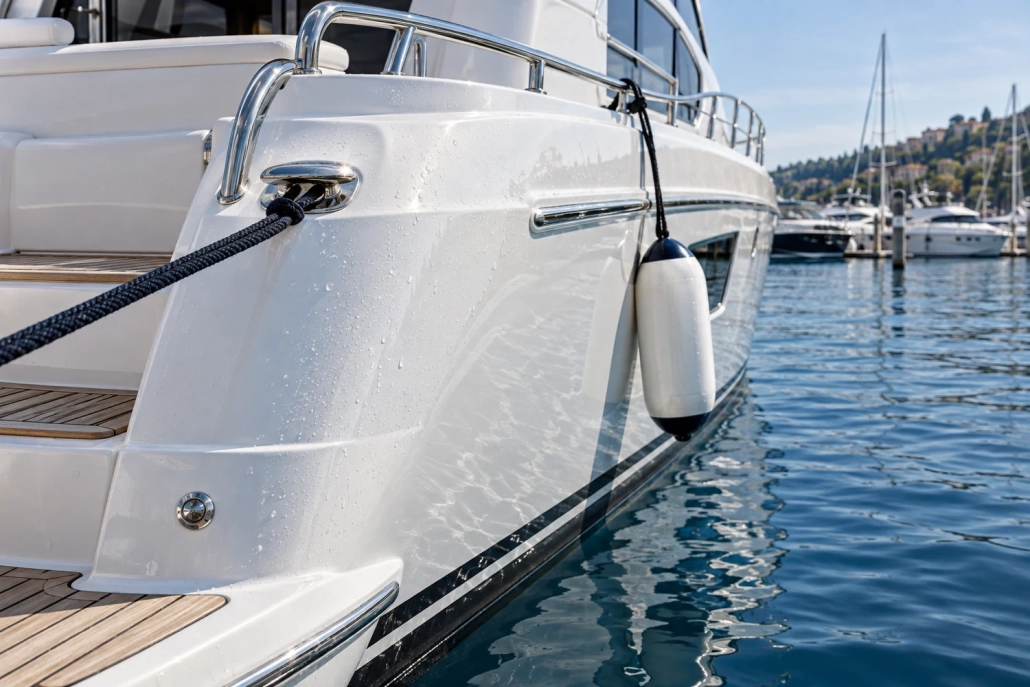
A boat transom may collect dark residue near exhaust outlets. Ceramic coating does not make every deposit removable with plain water, and visible staining should be assessed before stronger chemicals are selected. The finish and the source of contamination both matter.
Note where the deposit appears, whether it is recurring and how it relates to normal vessel use. Photograph the dry surface before cleaning. If there is an unusual change in exhaust behaviour or a mechanical concern, refer that separately to a qualified marine service professional.
Identify paint, gelcoat, metal and nearby fittings. Keep product selection tied to those actual materials and any existing coating. Do not assume a cleaner suitable for an engine component is appropriate for a coated cosmetic surface.
Use a marine cleaner approved for the substrate and protection, following dilution, dwell and rinsing directions. Test a small suitable area before expanding. Prevent runoff from reaching unsupported adjacent materials and follow applicable site procedures.
After cleaning, inspect whether a remaining mark is surface residue or an apparent change in the finish. Avoid repeated aggressive scrubbing or polishing before that distinction has been assessed.
Review NANOLAB MARINE for coating-specific care and ask for guidance where cleaner compatibility is uncertain. Record any local correction or recoating separately from ordinary washing.
A transom with recurring exposure may need targeted checks more frequently than sheltered hull sides. Use the observed pattern to set that routine, while keeping coating maintenance distinct from the vessel’s mechanical servicing requirements.
A cleaner must suit both the protective coating and the material beneath it.
Coordinate lifting and coating schedules so fresh protection and existing finishes are assessed around strap contact areas.
Coordinate coating readiness, cover contact and the boat's storage plan before winter shrink-wrapping.
 Ceramic Coating and Boat Lift Straps: Plan the Contact Areas