






A full polishing range.
From cutting and one-step correction to final finishing.
Specialist chemistry. Expert application.
 QUARTZ99 / CERAMIC BASE COAT
The foundation of your coating system.
A layerable quartz base coat designed for mechanical protection. Pair it with a suitable top coat to create the final finish.
For application by NANOLAB certified installers only.
Four formulas. Extended working time. Find the coating for your finish.
Explore the BEAST family of ceramic coatings.
Find the coating for each exterior surface.
 PPF & VINYLGLOSSProtection for glossy films and wraps.Discover
 MATTE & SATINMATTEProtection that respects the finish.Discover
 GLASSWINDOWSExplore dedicated glass protection.Discover
 WHEEL PROTECTIONWHEELSA dedicated coating for your wheels.Discover
 TRIM PROTECTIONPLASTICProtection for plastic surfaces.Discover
Dedicated care for the surfaces inside.
 LEATHER SURFACESLEATHERDiscover NANOLAB leather protection.Discover PLASTIC SURFACESPLASTICProtection for interior plastic surfaces.Discover TEXTILE SURFACESFABRICExplore the latest fabric formulation.Discover
Spray protection, maintenance and upcoming wash products.
 MAINTENANCEBEAST 365Explore the BEAST maintenance range.Discover
Next in washing, cleaning & care.
Ceramic protection for boats and yachts.
An easy-to-apply ceramic coating with an established track record on boats and yachts around the world.
Results vary with surface preparation, exposure and maintenance.
Read 50 MARINE guides →Explore MARINEProtection for the surfaces you live with.
A look at what we’re developing.
From cutting and one-step correction to final finishing.
A wider range for professional vehicle care.
Taking shape alongside BEAST & MATRIX.
Practical guidance for your next coating project.
Explore all guides →
Include delayed observations and representative geometry when checking solvent compatibility on decorative finishes and plastic components.
Updated · NANOLAB Knowledge

Immediate appearance is only one stage of a compatibility check. A decorative finish or polymer component may show a change after the solvent has evaporated or after the part returns to service.
Record substrate, decorative layer, adhesive, repairs and geometry where relevant. A flat coupon may not represent a bent, fastened or multilayer component. Use supplier guidance to decide which sample is representative.
Specify the exact product, contact method and permitted exposure. Agree inspection intervals and relevant conditioning with the material supplier or laboratory. Avoid inventing a universal “safe after one hour” rule for unrelated materials.
PLEXIGLAS guidance illustrates why stress and chemical exposure must be considered together for acrylic components. Other decorative materials need their own evidence. A successful trial applies to the tested combination and process, not every solvent in the same informal category. If the application depends on an unknown finish or unsupported exposure, stop and obtain clarification before treating the installed surface. Preserve both immediate and delayed images in the compatibility record.
The sources below support the stated concepts or describe their own methods. The worked scenarios are editorial examples, not NANOLAB test results.
Ask NANOLAB about your surface and intended use. For application and care, use the current instructions for the exact product.
Use clear checkpoints before application, after levelling and at handover to make coating work consistent and traceable.
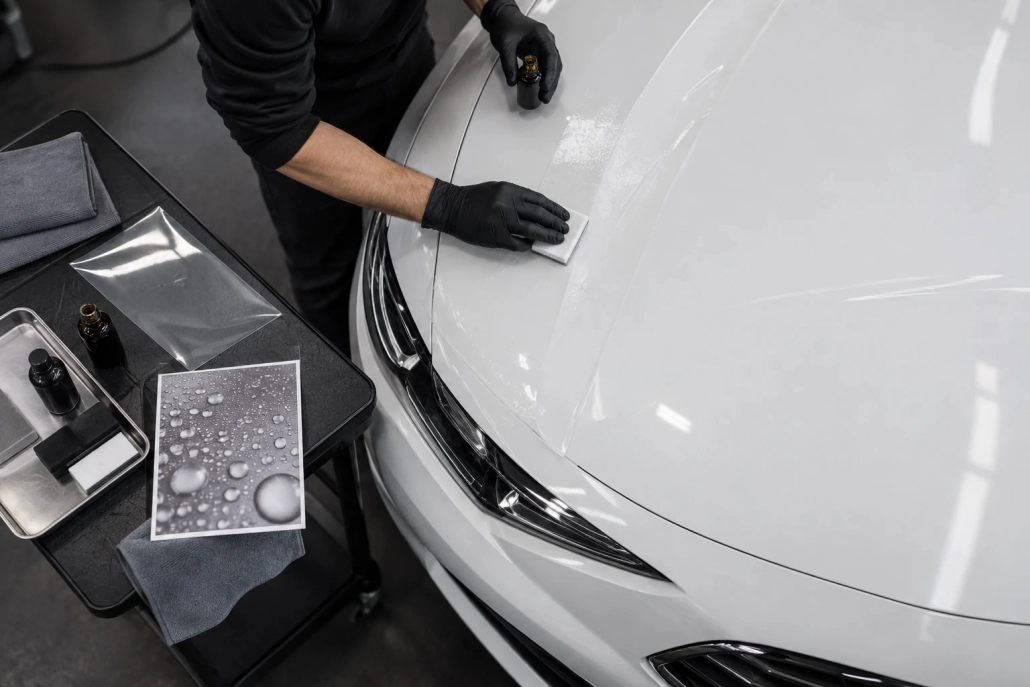
Check film condition, finish compatibility and the approved coating process before applying ceramic protection over paint protection film.
Specify whether a chemical spot remains wet, is replenished or dries down, because those exposures answer different coating-resistance questions.
 Chemical Spot Tests: Distinguish Dwell Time, Replenishment and Dry-Down