






A full polishing range.
From cutting and one-step correction to final finishing.
Specialist chemistry. Expert application.
 QUARTZ99 / CERAMIC BASE COAT
The foundation of your coating system.
A layerable quartz base coat designed for mechanical protection. Pair it with a suitable top coat to create the final finish.
For application by NANOLAB certified installers only.
Four formulas. Extended working time. Find the coating for your finish.
Explore the BEAST family of ceramic coatings.
Find the coating for each exterior surface.
 PPF & VINYLGLOSSProtection for glossy films and wraps.Discover
 MATTE & SATINMATTEProtection that respects the finish.Discover
 GLASSWINDOWSExplore dedicated glass protection.Discover
 WHEEL PROTECTIONWHEELSA dedicated coating for your wheels.Discover
 TRIM PROTECTIONPLASTICProtection for plastic surfaces.Discover
Dedicated care for the surfaces inside.
 LEATHER SURFACESLEATHERDiscover NANOLAB leather protection.Discover PLASTIC SURFACESPLASTICProtection for interior plastic surfaces.Discover TEXTILE SURFACESFABRICExplore the latest fabric formulation.Discover
Spray protection, maintenance and upcoming wash products.
 MAINTENANCEBEAST 365Explore the BEAST maintenance range.Discover
Next in washing, cleaning & care.
Ceramic protection for boats and yachts.
An easy-to-apply ceramic coating with an established track record on boats and yachts around the world.
Results vary with surface preparation, exposure and maintenance.
Read 50 MARINE guides →Explore MARINEProtection for the surfaces you live with.
A look at what we’re developing.
From cutting and one-step correction to final finishing.
A wider range for professional vehicle care.
Taking shape alongside BEAST & MATRIX.
Practical guidance for your next coating project.
Explore all guides →
Preserve the working state of a ceramic-coating job across a shift change so the next operator knows what is complete, waiting or unresolved.
Updated · NANOLAB Knowledge

A vehicle halfway through coating contains several different states: prepared areas, applied sections, completed sections and exclusions. A shift handover that says only half finished leaves too much to interpretation.
Mark each area with an explicit state linked to the product’s procedure. Record relevant application and waiting times, product batch and any interrupted section. Keep the map off the vehicle surface unless an approved identification method is used.
| State | Handover information |
|---|---|
| Prepared | Preparation completed and protection maintained |
| Application in progress | Exact boundary and timing |
| Completed | Inspection and remaining requirements |
| Held | Reason and person responsible for resolution |
The outgoing and incoming operators should compare the map with the actual vehicle where possible. Point out difficult recesses, repaired surfaces and any area intentionally excluded. Do not rely on apparent gloss or water behaviour to identify what has been treated.
If an application boundary or processing time is unknown, obtain product-specific guidance. Repeating a step may not be equivalent to completing it correctly, particularly when preparation or additional-layer conditions matter.
Record the time and any outstanding decisions. Update tool and working-container identity so the incoming operator does not confuse leftover materials with a fresh setup.
A concise handover protects continuity without requiring a lengthy narrative. The test is practical: can another trained operator identify the next valid action for every panel without guessing what the previous person intended?
Ask NANOLAB about your surface and intended use. For application and care, use the current instructions for the exact product.
Use clear checkpoints before application, after levelling and at handover to make coating work consistent and traceable.
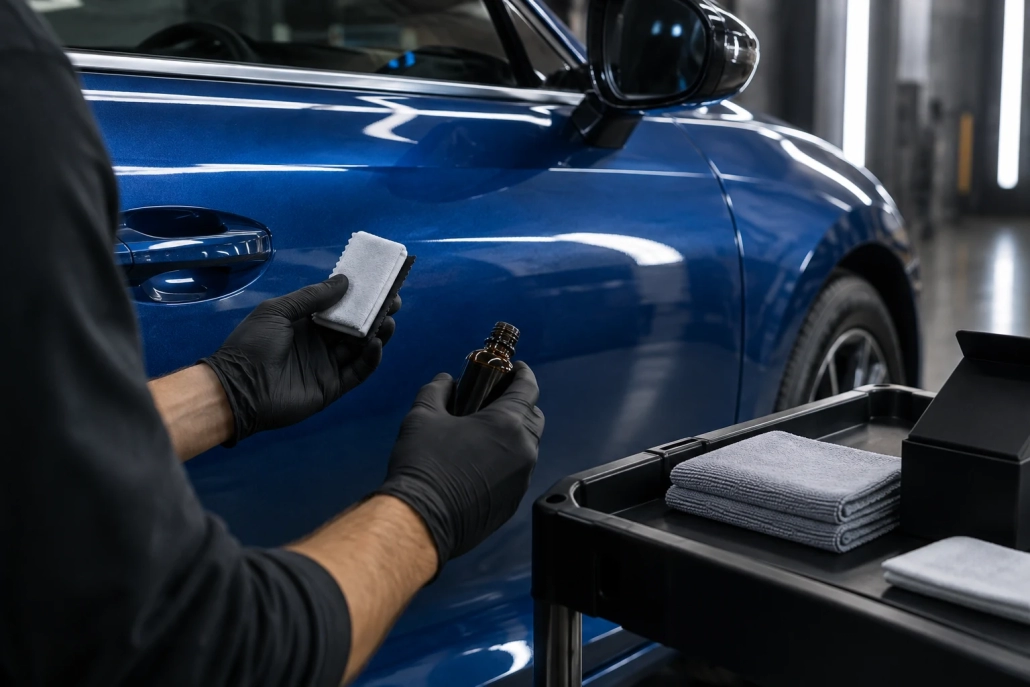
Understand why wipe-off timing changes with the formula and environment, and why a stopwatch cannot replace product-specific guidance.
Compare two coating bottles using matched applicators, surfaces and timing so differences in tool condition do not masquerade as product variation.
 Comparing Two Coating Bottles without Confounding Applicator Condition