






A full polishing range.
From cutting and one-step correction to final finishing.
Specialist chemistry. Expert application.
 QUARTZ99 / CERAMIC BASE COAT
The foundation of your coating system.
A layerable quartz base coat designed for mechanical protection. Pair it with a suitable top coat to create the final finish.
For application by NANOLAB certified installers only.
Four formulas. Extended working time. Find the coating for your finish.
Explore the BEAST family of ceramic coatings.
Find the coating for each exterior surface.
 PPF & VINYLGLOSSProtection for glossy films and wraps.Discover
 MATTE & SATINMATTEProtection that respects the finish.Discover
 GLASSWINDOWSExplore dedicated glass protection.Discover
 WHEEL PROTECTIONWHEELSA dedicated coating for your wheels.Discover
 TRIM PROTECTIONPLASTICProtection for plastic surfaces.Discover
Dedicated care for the surfaces inside.
 LEATHER SURFACESLEATHERDiscover NANOLAB leather protection.Discover PLASTIC SURFACESPLASTICProtection for interior plastic surfaces.Discover TEXTILE SURFACESFABRICExplore the latest fabric formulation.Discover
Spray protection, maintenance and upcoming wash products.
 MAINTENANCEBEAST 365Explore the BEAST maintenance range.Discover
Next in washing, cleaning & care.
Ceramic protection for boats and yachts.
An easy-to-apply ceramic coating with an established track record on boats and yachts around the world.
Results vary with surface preparation, exposure and maintenance.
Read 50 MARINE guides →Explore MARINEProtection for the surfaces you live with.
A look at what we’re developing.
From cutting and one-step correction to final finishing.
A wider range for professional vehicle care.
Taking shape alongside BEAST & MATRIX.
Practical guidance for your next coating project.
Explore all guides →
Assess coated boat surfaces near fenders using contact duration, movement and cleanliness records alongside appearance inspections.
Updated · NANOLAB Knowledge
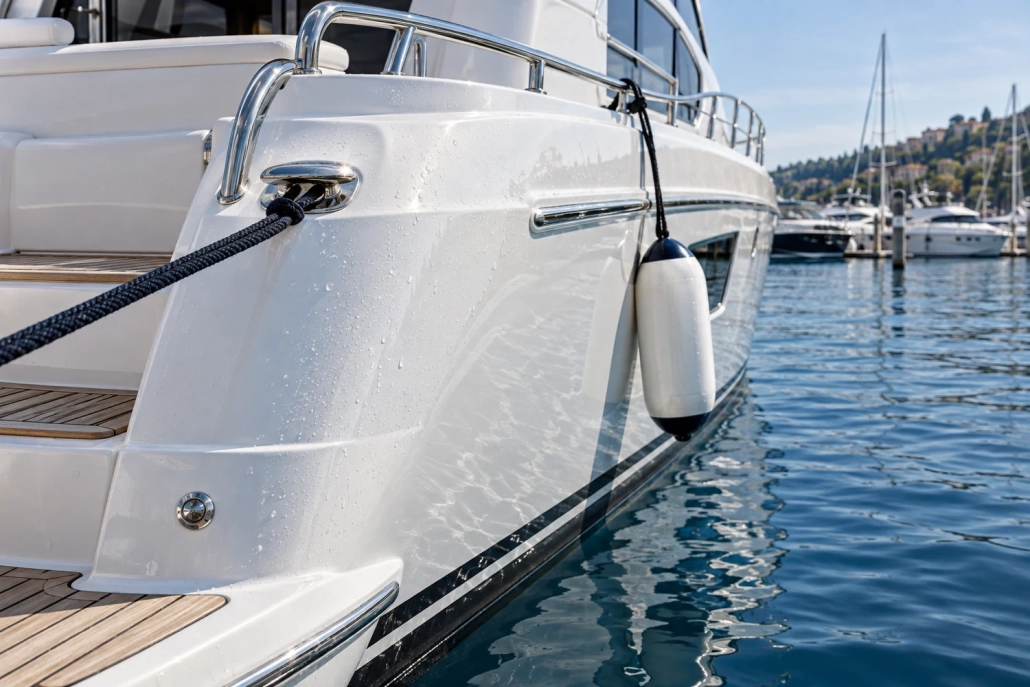
Fender contact creates a different challenge from ordinary weather exposure. A coating trial near a fender should record how the surfaces touch and move, otherwise a local change can be misrepresented as a general durability result.
Identify fender type, cover condition, contact location and the periods when contact occurs. Note dirt or grit and whether the boat moves against the fender during the observation period. Do not estimate a precise mechanical load from appearance alone.
| Record | Purpose |
|---|---|
| Contact duration | Separates occasional from sustained exposure |
| Movement conditions | Provides context for rubbing |
| Fender and cover cleanliness | Tracks possible abrasive contamination |
| Adjacent non-contact area | Provides a local comparison |
Photograph the dry hull and map marks relative to the fender. Use appropriate cleaning to distinguish removable transfer from persistent surface damage. Avoid polishing before the initial condition is recorded.
A cosmetic coating should not be assumed to prevent all rubbing damage or replace correct fender management. Mooring and fender arrangements must remain appropriate for vessel safety. Any change to that system should be made by the responsible competent person.
If a contact zone deteriorates while a nearby undisturbed zone remains acceptable, report the difference with its exposure history. It suggests that local mechanical conditions matter; it does not establish the coating’s performance on every part of the vessel.
If cleaning the fender cover and correcting a maintenance issue reduces recurring marks, continue observation before claiming the cause is fully resolved.
Include contact zones in routine inspection and record fender repositioning. A later mark at a new location can then be connected to the changed contact history.
This approach gives the owner a practical local care plan while keeping laboratory-style durability language separate from an uncontrolled rubbing environment.
Ask NANOLAB about your surface and intended use. For application and care, use the current instructions for the exact product.
A pre-coating inspection prevents attractive results in one area from hiding unresolved problems elsewhere.
Repositioned fenders create new contact zones on a coated boat.
Compare marine coatings within similar exposure zones instead of treating shaded hull sides, horizontal surfaces and contact areas as equivalent.

 Stainless Steel Coating Trials: Compare Fingerprint Visibility and Cleanabi...