






A full polishing range.
From cutting and one-step correction to final finishing.
Specialist chemistry. Expert application.
 QUARTZ99 / CERAMIC BASE COAT
The foundation of your coating system.
A layerable quartz base coat designed for mechanical protection. Pair it with a suitable top coat to create the final finish.
For application by NANOLAB certified installers only.
Four formulas. Extended working time. Find the coating for your finish.
Explore the BEAST family of ceramic coatings.
Find the coating for each exterior surface.
 PPF & VINYLGLOSSProtection for glossy films and wraps.Discover
 MATTE & SATINMATTEProtection that respects the finish.Discover
 GLASSWINDOWSExplore dedicated glass protection.Discover
 WHEEL PROTECTIONWHEELSA dedicated coating for your wheels.Discover
 TRIM PROTECTIONPLASTICProtection for plastic surfaces.Discover
Dedicated care for the surfaces inside.
 LEATHER SURFACESLEATHERDiscover NANOLAB leather protection.Discover PLASTIC SURFACESPLASTICProtection for interior plastic surfaces.Discover TEXTILE SURFACESFABRICExplore the latest fabric formulation.Discover
Spray protection, maintenance and upcoming wash products.
 MAINTENANCEBEAST 365Explore the BEAST maintenance range.Discover
Next in washing, cleaning & care.
Ceramic protection for boats and yachts.
An easy-to-apply ceramic coating with an established track record on boats and yachts around the world.
Results vary with surface preparation, exposure and maintenance.
Read 50 MARINE guides →Explore MARINEProtection for the surfaces you live with.
A look at what we’re developing.
From cutting and one-step correction to final finishing.
A wider range for professional vehicle care.
Taking shape alongside BEAST & MATRIX.
Practical guidance for your next coating project.
Explore all guides →
A preparation problem is easier to solve when the remaining material is described before another cleaner is chosen. Oily film, mineral deposits, loose particles and an altered finish can look similar under some lighting but call for different decisions.
Updated · NANOLAB Knowledge
Begin with the surface history and the steps already performed. Record the products used, their approved process and the appearance after drying. Do not assume that every persistent mark is removable contamination. Repeated chemical changes can make the history harder to interpret and can introduce new residue or compatibility questions.
Illustrative example: a panel remains uneven after preparation. One section carries a removable residue, while a neighbouring section has an existing finish defect. Treating both with progressively stronger cleaner would confuse two different problems and may not improve the second section.
Do not apply a coating to conceal an unresolved preparation issue. If the material or finish cannot be identified confidently, pause and seek qualified advice. The next useful action is the one that resolves the uncertainty while preserving the surface.
Ask NANOLAB about the exact product and intended use. Use the current product documentation for formulation-specific instructions.
A panel can look ready while gaps retain cleaner or polishing residue. Include accessible joints in the preparation check before coating the adjacent paint.
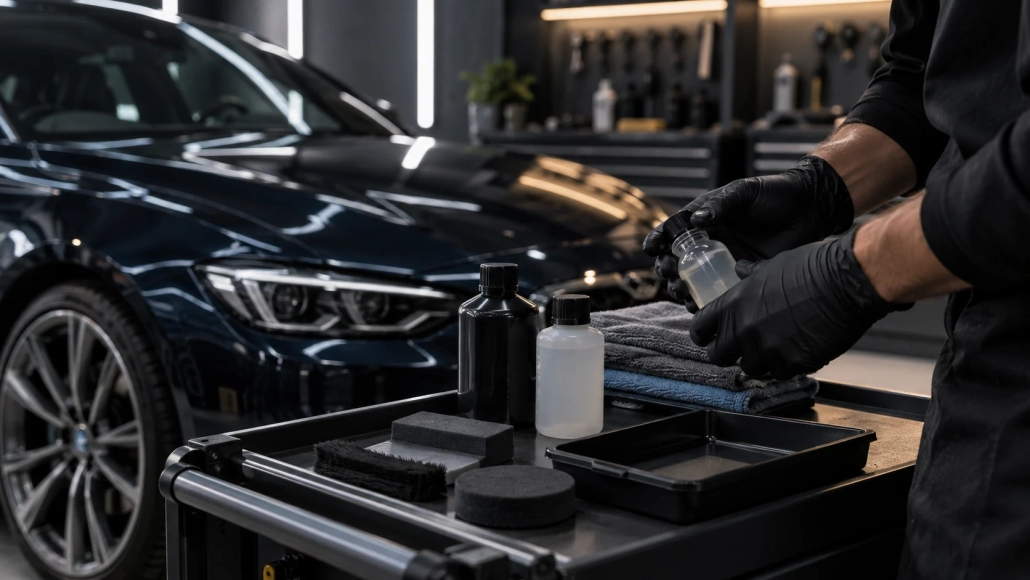
Assess an existing coating before removal and plan correction or renewal without assuming a wash or single chemical treatment removes every system.
A colour-changing iron remover can show that a reaction is occurring, but the colour alone does not certify that every contaminant has been removed or that the surface is ready for a coating. Follow the exact product's complete process.