






A full polishing range.
From cutting and one-step correction to final finishing.
Specialist chemistry. Expert application.
 QUARTZ99 / CERAMIC BASE COAT
The foundation of your coating system.
A layerable quartz base coat designed for mechanical protection. Pair it with a suitable top coat to create the final finish.
For application by NANOLAB certified installers only.
Four formulas. Extended working time. Find the coating for your finish.
Explore the BEAST family of ceramic coatings.
Find the coating for each exterior surface.
 PPF & VINYLGLOSSProtection for glossy films and wraps.Discover
 MATTE & SATINMATTEProtection that respects the finish.Discover
 GLASSWINDOWSExplore dedicated glass protection.Discover
 WHEEL PROTECTIONWHEELSA dedicated coating for your wheels.Discover
 TRIM PROTECTIONPLASTICProtection for plastic surfaces.Discover
Dedicated care for the surfaces inside.
 LEATHER SURFACESLEATHERDiscover NANOLAB leather protection.Discover PLASTIC SURFACESPLASTICProtection for interior plastic surfaces.Discover TEXTILE SURFACESFABRICExplore the latest fabric formulation.Discover
Spray protection, maintenance and upcoming wash products.
 MAINTENANCEBEAST 365Explore the BEAST maintenance range.Discover
Next in washing, cleaning & care.
Ceramic protection for boats and yachts.
An easy-to-apply ceramic coating with an established track record on boats and yachts around the world.
Results vary with surface preparation, exposure and maintenance.
Read 50 MARINE guides →Explore MARINEProtection for the surfaces you live with.
A look at what we’re developing.
From cutting and one-step correction to final finishing.
A wider range for professional vehicle care.
Taking shape alongside BEAST & MATRIX.
Practical guidance for your next coating project.
Explore all guides →
Inspect repeated tender and davit contact areas separately from the broader ceramic-coated marine finish.
Updated · NANOLAB Knowledge
Repeated contact from a tender, support pad or davit arrangement can create local wear on an otherwise well-maintained boat. Ceramic coating does not turn those contact points into abrasion-proof surfaces. Their maintenance plan should reflect the actual mechanical interaction.
Identify the cosmetic surfaces that touch pads, straps or the tender during normal use. Record existing marks and distinguish them from defects elsewhere on the vessel. Keep load-bearing and functional requirements under the guidance of the equipment and vessel professionals.
Do not change support geometry or apply a slippery treatment to a gripping component merely to reduce cosmetic marks. Any adjustment needs the appropriate technical approval.
Remove grit and contamination through methods compatible with both surfaces. Inspect padding or protective components using their manufacturer’s guidance. A dirty contact pad can repeatedly mark the same area even after the visible surface has been washed.
If residue appears, establish whether it is transferred material or damage before choosing a cleaner. Test a supported local method and avoid broad polishing that changes surrounding protection unnecessarily.
Check NANOLAB MARINE for coating suitability and care. Record local correction or renewed protection at contact points separately from the installation date for the rest of the boat.
At routine inspections, compare those high-contact zones with sheltered areas without expecting identical wear. If the mechanical contact continues to cause damage, address the equipment or handling issue with the appropriate professional rather than treating repeated recoating as the complete solution.
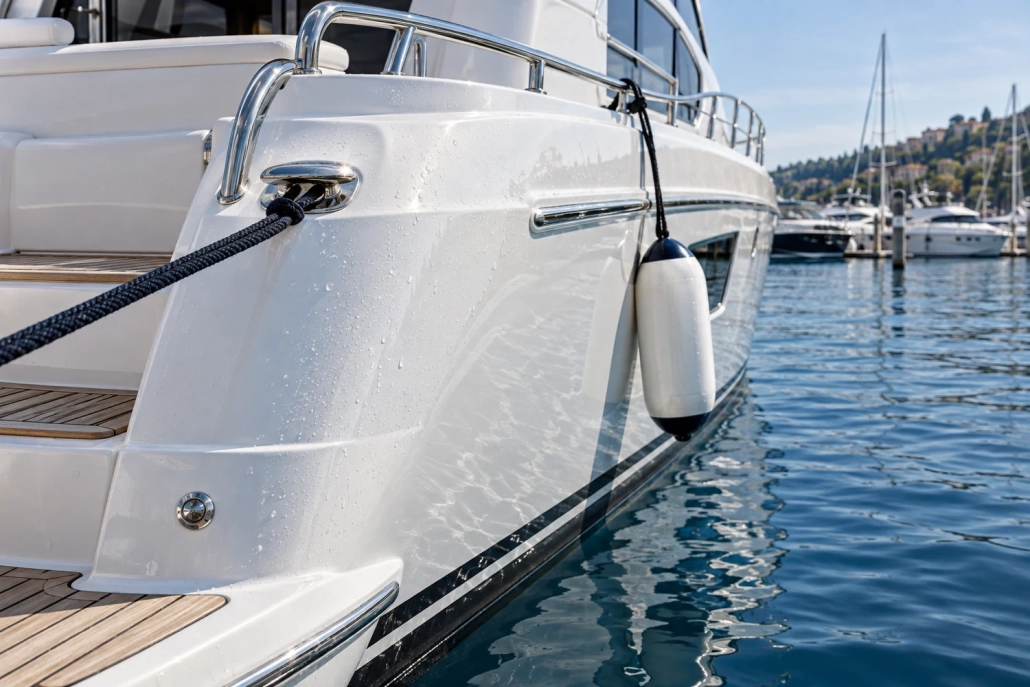
Fenders protect a boat from contact, but dirt and repeated movement at their contact points can still leave marks.
Give a marina cleaning team a concise record of coated surfaces, approved products and reporting requirements.
Keep cosmetic coating work distinct from structural and condition assessment when a boat is being inspected for purchase.
 Marine Ceramic Coating: Handover to a Marina Wash Contractor