


A full polishing range.
From cutting and one-step correction to final finishing.
Specialist chemistry. Expert application.
 QUARTZ99 / CERAMIC BASE COAT
The foundation of your coating system.
A layerable quartz base coat designed for mechanical protection. Pair it with a suitable top coat to create the final finish.
For application by NANOLAB certified installers only.
Four formulas. Extended working time. Find the coating for your finish.
Explore the BEAST family of ceramic coatings.
Find the coating for each exterior surface.
 PPF & VINYLGLOSSProtection for glossy films and wraps.Discover
 MATTE & SATINMATTEProtection that respects the finish.Discover
 GLASSWINDOWSExplore dedicated glass protection.Discover
 WHEEL PROTECTIONWHEELSA dedicated coating for your wheels.Discover
 TRIM PROTECTIONPLASTICProtection for plastic surfaces.Discover
Dedicated care for the surfaces inside.
 LEATHER SURFACESLEATHERDiscover NANOLAB leather protection.Discover PLASTIC SURFACESPLASTICProtection for interior plastic surfaces.Discover TEXTILE SURFACESFABRICExplore the latest fabric formulation.Discover
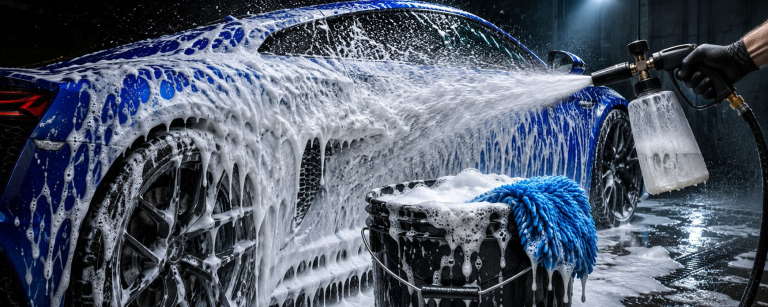 Preview all six shampoos →
Spray protection, maintenance and upcoming wash products.
 MAINTENANCEBEAST 365Explore the BEAST maintenance range.Discover
Next in washing, cleaning & care.
Ceramic protection for boats and yachts.
An easy-to-apply ceramic coating with an established track record on boats and yachts around the world.
Results vary with surface preparation, exposure and maintenance.
Read 50 MARINE guides →Explore MARINEProtection for the surfaces you live with.
A look at what we’re developing.
From cutting and one-step correction to final finishing.
A wider range for professional vehicle care.
Taking shape alongside BEAST & MATRIX.
Practical guidance for your next coating project.
Explore all guides →
Follow an illustrative empty-and-filled weighing calculation, check temperature and filling errors, and preserve the distinction between a bench estimate and a qualified density result.
Updated · NANOLAB Knowledge
A pycnometer estimates liquid density from the mass contained in a known volume. Its usefulness depends on a controlled filling procedure, temperature, suitable weighing and the calibration basis. The nominal number on a vessel is not enough to establish a precise result.
Anton Paar describes determining vessel volume with a calibration liquid of known density, followed by weighing the vessel filled with sample. Both volume and liquid density are temperature-dependent. Use the instrument’s approved procedure and a volume appropriate to the measurement temperature.
A coating manufacturer may use density as one batch-control observation. It does not identify the complete formula, establish active content or prove coating performance. Different mixtures can have similar densities.
The following invented values illustrate the arithmetic, not a validated measurement procedure or NANOLAB specification. Assume an established effective vessel volume of 50.00 mL at the test temperature.
| Recorded quantity | Illustrative value |
|---|---|
| Empty clean vessel and closure | 32.40 g |
| Same vessel and closure, filled with sample | 78.65 g |
| Net sample mass | 46.25 g |
| Net mass divided by volume | 0.9250 g/mL |
Subtract the tare before dividing: (78.65 − 32.40)/50.00 = 0.9250. Dividing the gross mass by 50.00 would incorrectly include the vessel. The displayed arithmetic precision does not establish measurement uncertainty.
Repeatedly reading the same filled vessel mainly checks reading stability. It does not test variability introduced by cleaning and refilling. Keep those two kinds of repetition distinguishable in the record.
For higher-accuracy work, address calibration, air-buoyancy corrections and the distinction between apparent and true density within the selected method. The simple arithmetic above omits those refinements and should not be used to claim metrological equivalence between different instruments.
Report vessel identity, volume basis, temperature, raw masses, calculation and method revision. Compare against a specification defined on the same basis. If a supplier provides only a density range, do not replace it with an unjustifiably precise assumed value for costing.
Use the grams-to-millilitres guide when applying a suitable density value to a consumption record.
Primary reference: Anton Paar: Density and density measurement.