






A full polishing range.
From cutting and one-step correction to final finishing.
Specialist chemistry. Expert application.
 QUARTZ99 / CERAMIC BASE COAT
The foundation of your coating system.
A layerable quartz base coat designed for mechanical protection. Pair it with a suitable top coat to create the final finish.
For application by NANOLAB certified installers only.
Four formulas. Extended working time. Find the coating for your finish.
Explore the BEAST family of ceramic coatings.
Find the coating for each exterior surface.
 PPF & VINYLGLOSSProtection for glossy films and wraps.Discover
 MATTE & SATINMATTEProtection that respects the finish.Discover
 GLASSWINDOWSExplore dedicated glass protection.Discover
 WHEEL PROTECTIONWHEELSA dedicated coating for your wheels.Discover
 TRIM PROTECTIONPLASTICProtection for plastic surfaces.Discover
Dedicated care for the surfaces inside.
 LEATHER SURFACESLEATHERDiscover NANOLAB leather protection.Discover PLASTIC SURFACESPLASTICProtection for interior plastic surfaces.Discover TEXTILE SURFACESFABRICExplore the latest fabric formulation.Discover
Spray protection, maintenance and upcoming wash products.
 MAINTENANCEBEAST 365Explore the BEAST maintenance range.Discover
Next in washing, cleaning & care.
Ceramic protection for boats and yachts.
An easy-to-apply ceramic coating with an established track record on boats and yachts around the world.
Results vary with surface preparation, exposure and maintenance.
Read 50 MARINE guides →Explore MARINEProtection for the surfaces you live with.
A look at what we’re developing.
From cutting and one-step correction to final finishing.
A wider range for professional vehicle care.
Taking shape alongside BEAST & MATRIX.
Practical guidance for your next coating project.
Explore all guides →
Compare water movement along and across brushed-metal grain without confusing surface direction, sample tilt and coating chemistry.
Updated · NANOLAB Knowledge
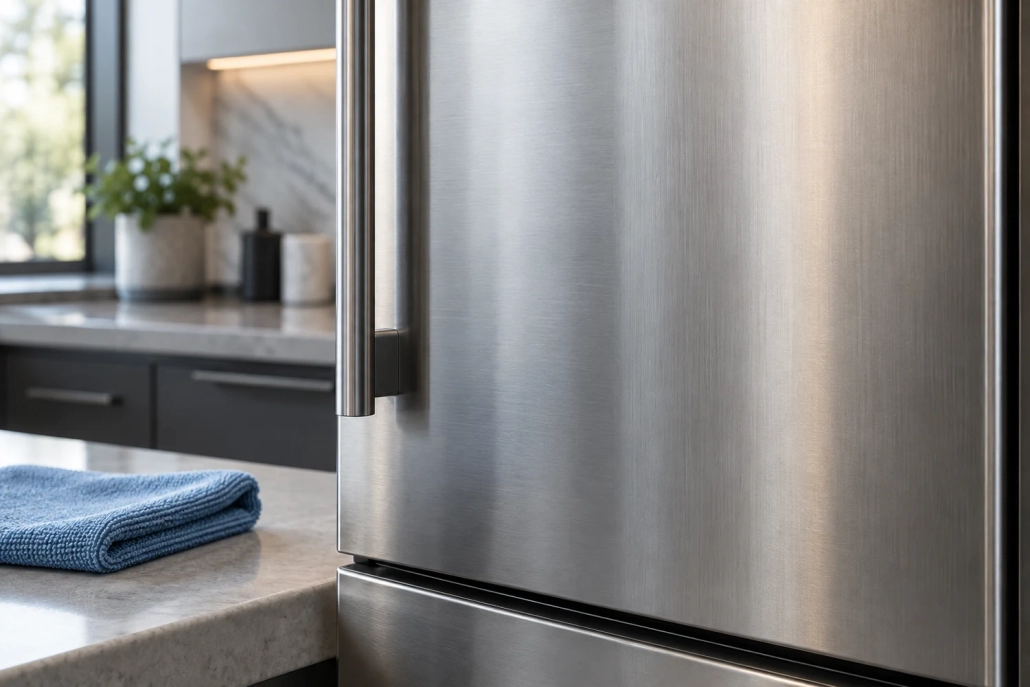
Water can follow a different path when a brushed-metal sample is rotated. A coating comparison that always presents one specimen with vertical grain and another with horizontal grain can therefore contain an avoidable geometry difference. Record orientation before interpreting the result as a chemistry advantage.
Record the grain direction on the material, the direction of gravity along the mounted surface and the camera’s viewing direction. These are related but not interchangeable. Rotating a sample can change both the water path and the reflected appearance, making a casual before-and-after video difficult to interpret.
KRUSS’s work on structured surfaces illustrates that topography influences wetting and that simple theoretical corrections do not always describe real samples. Do not turn the visible grain into a universal prediction; test the actual finish under defined conditions.
Where possible, cut or obtain comparable coupons from the same finish batch. Label orientation outside the measured area. Keep the treatment, preparation, cure conditions and cleaning history matched. An orientation comparison loses meaning if one coupon is freshly prepared and the other has been repeatedly handled.
| Condition | Purpose |
|---|---|
| Grain aligned with the surface fall | Observe movement along the main texture direction |
| Grain across the surface fall | Observe the alternative orientation |
| Untreated matched reference | Separate the substrate’s contribution from treatment |
| Repeated independent coupons | Check whether the pattern extends beyond one piece |
Decide whether you are recording runoff path, retained droplets, drying residue or a quantitative measurement. Standardise the water source, delivery, initial condition and observation time as appropriate. A visually longer trail is not automatically worse if the actual service question concerns residue after drying.
If the same coupon is reused at another orientation, document its cleaning and conditioning between observations. Better still, include independent matched samples so the first exposure does not silently become part of the second condition.
Suppose an illustrative coated coupon sheds water readily in one orientation but retains more droplets when rotated. That result suggests the installed orientation deserves consideration. It does not establish that the product chemically changed between observations or that every brushed finish behaves the same way.
Compare the untreated references and repeat the observation. If the difference is already strong without the coating, the substrate contributes to the result. If it appears only after treatment, investigate coverage and process as well as the interaction with the finish.
For an architectural panel, include the actual installed grain direction and drainage layout in the mock-up assessment. A sample approved lying flat on a desk may not represent the final vertical assembly. Keep orientation visible in photographs and reports so later maintenance decisions can be traced to the tested configuration.
These sources support the identified technical concepts. The planning examples in this guide are illustrative and are not NANOLAB performance test results.
Discuss your surface and intended use with NANOLAB. Follow the current instructions for the exact product when planning application and care.
On a brushed finish, the visible grain provides a useful guide for care where the manufacturer recommends following it.
Assess panel orientation and finish variation before expecting a nano coating to make adjacent stainless surfaces look identical.

 Marine Coating Trials on Port and Starboard: Balance Exposure before Comparing...