






A full polishing range.
From cutting and one-step correction to final finishing.
Specialist chemistry. Expert application.
 QUARTZ99 / CERAMIC BASE COAT
The foundation of your coating system.
A layerable quartz base coat designed for mechanical protection. Pair it with a suitable top coat to create the final finish.
For application by NANOLAB certified installers only.
Four formulas. Extended working time. Find the coating for your finish.
Explore the BEAST family of ceramic coatings.
Find the coating for each exterior surface.
 PPF & VINYLGLOSSProtection for glossy films and wraps.Discover
 MATTE & SATINMATTEProtection that respects the finish.Discover
 GLASSWINDOWSExplore dedicated glass protection.Discover
 WHEEL PROTECTIONWHEELSA dedicated coating for your wheels.Discover
 TRIM PROTECTIONPLASTICProtection for plastic surfaces.Discover
Dedicated care for the surfaces inside.
 LEATHER SURFACESLEATHERDiscover NANOLAB leather protection.Discover PLASTIC SURFACESPLASTICProtection for interior plastic surfaces.Discover TEXTILE SURFACESFABRICExplore the latest fabric formulation.Discover
Spray protection, maintenance and upcoming wash products.
 MAINTENANCEBEAST 365Explore the BEAST maintenance range.Discover
Next in washing, cleaning & care.
Ceramic protection for boats and yachts.
An easy-to-apply ceramic coating with an established track record on boats and yachts around the world.
Results vary with surface preparation, exposure and maintenance.
Read 50 MARINE guides →Explore MARINEProtection for the surfaces you live with.
A look at what we’re developing.
From cutting and one-step correction to final finishing.
A wider range for professional vehicle care.
Taking shape alongside BEAST & MATRIX.
Practical guidance for your next coating project.
Explore all guides →
Add a non-contact size reference and a fixed camera position when photographing water spots to make later comparisons interpretable.
Updated · NANOLAB Knowledge

A close photograph can make a small water mark appear larger than an entire cluster photographed from farther away. Without scale, spot size and affected area are easy to misjudge. A repeatable reference makes a photograph useful for maintenance decisions.
Take a context image showing the panel or glass section, then a detail image containing a suitable size reference in the same plane as the marks. Keep the reference off delicate or freshly treated surfaces. Do not press a ruler against the finish simply to obtain a scale.
Photograph as close to perpendicular as practical when estimating dimensions. Strong perspective makes a scale at one edge unreliable for the whole image. Retain a separate oblique view if it better reveals the deposits.
| Question | Record |
|---|---|
| Did a spot shrink? | The same identified spot and scale |
| Did the affected area decrease? | A fixed boundary and consistent lighting |
| Did marks become less visible? | Matched dry-state appearance |
Mark the location on a panel diagram rather than writing on the coating. After a supported cleaning step, allow the surface to reach the same inspection condition and repeat the photographs. A wet surface and a dry surface are different observations, even if photographed from the same position.
A phone image with a scale may support approximate dimensions, but it does not identify deposit chemistry or distinguish residue from etching conclusively. Record the cleaning method and whether the mark changes. If appearance stops improving or the finish changes, pause further treatment and seek surface-specific assessment.
Scale turns a dramatic close-up into a traceable observation; it does not replace diagnosis.
Ask NANOLAB about your surface and intended use. For application and care, use the current instructions for the exact product.
Use clear checkpoints before application, after levelling and at handover to make coating work consistent and traceable.
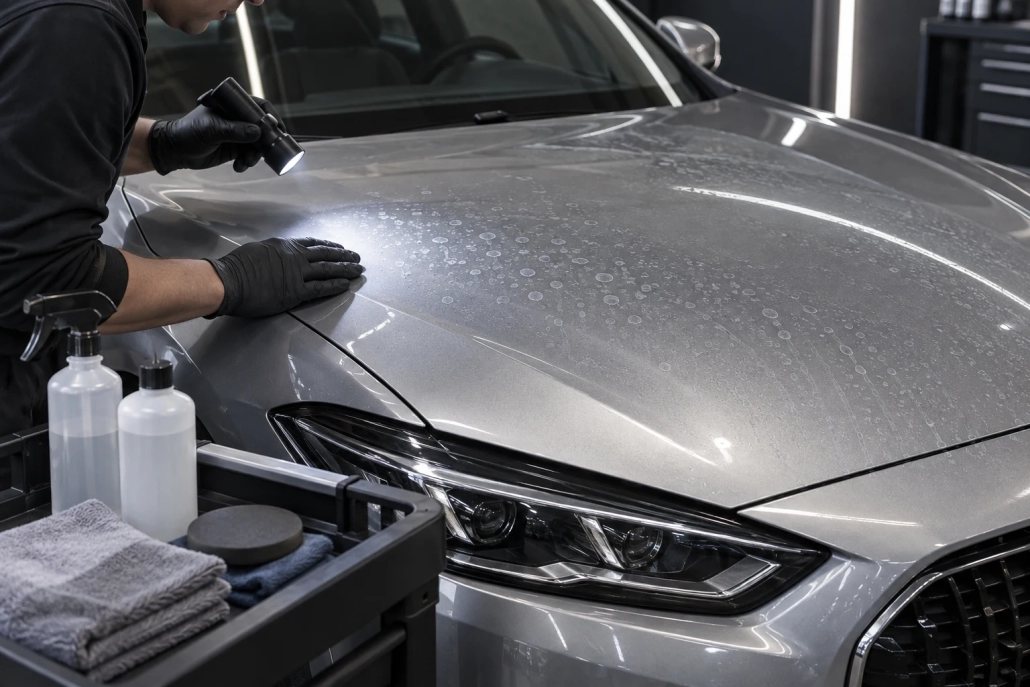
Distinguish mineral deposits from etched damage and choose a compatible response before considering polishing or coating renewal.
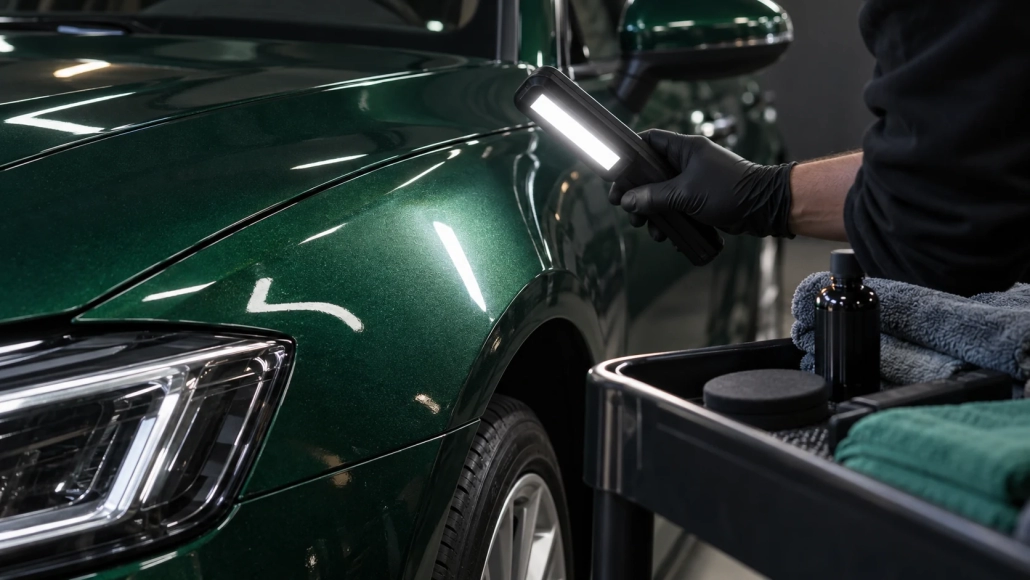
Keep focus, magnification and camera distance fixed when comparing surface reflections, especially in close photographs of coated paint.

 Keeping Focus and Camera Distance Consistent in Gloss Comparisons