






A full polishing range.
From cutting and one-step correction to final finishing.
Specialist chemistry. Expert application.
 QUARTZ99 / CERAMIC BASE COAT
The foundation of your coating system.
A layerable quartz base coat designed for mechanical protection. Pair it with a suitable top coat to create the final finish.
For application by NANOLAB certified installers only.
Four formulas. Extended working time. Find the coating for your finish.
Explore the BEAST family of ceramic coatings.
Find the coating for each exterior surface.
 PPF & VINYLGLOSSProtection for glossy films and wraps.Discover
 MATTE & SATINMATTEProtection that respects the finish.Discover
 GLASSWINDOWSExplore dedicated glass protection.Discover
 WHEEL PROTECTIONWHEELSA dedicated coating for your wheels.Discover
 TRIM PROTECTIONPLASTICProtection for plastic surfaces.Discover
Dedicated care for the surfaces inside.
 LEATHER SURFACESLEATHERDiscover NANOLAB leather protection.Discover PLASTIC SURFACESPLASTICProtection for interior plastic surfaces.Discover TEXTILE SURFACESFABRICExplore the latest fabric formulation.Discover
Spray protection, maintenance and upcoming wash products.
 MAINTENANCEBEAST 365Explore the BEAST maintenance range.Discover
Next in washing, cleaning & care.
Ceramic protection for boats and yachts.
An easy-to-apply ceramic coating with an established track record on boats and yachts around the world.
Results vary with surface preparation, exposure and maintenance.
Read 50 MARINE guides →Explore MARINEProtection for the surfaces you live with.
A look at what we’re developing.
From cutting and one-step correction to final finishing.
A wider range for professional vehicle care.
Taking shape alongside BEAST & MATRIX.
Practical guidance for your next coating project.
Explore all guides →
Understand how a polarising filter changes reflections in coating photographs and keep filter settings consistent in comparison images.
Updated · NANOLAB Knowledge

A polarising filter can improve a product photograph by changing reflected light. The same effect can make a technical comparison misleading if the filter is rotated between the before and after images. The photograph then contains a change in optics as well as a change in the surface.
If the purpose is to show paint colour, reducing certain reflections may help. If the purpose is to show reflected-image clarity or surface haze, suppressing those reflections can remove the feature being assessed. Decide which observation matters before adjusting the filter.
Keep camera position, illumination and filter orientation fixed for comparable shots. Record a second pair without the filter when reflections are central to the claim. A marked filter ring helps reproduce its position, but matching the ring alone is insufficient if the camera or lighting has moved.
| Image set | Useful interpretation |
|---|---|
| Matched unfiltered pair | Appearance under the stated lighting |
| Matched filtered pair | Appearance after a consistent optical treatment |
| Different filter settings | A creative presentation, not a controlled comparison |
A bonnet may look darker after rotating a filter because a sky reflection has been reduced. That change does not by itself demonstrate greater coating depth or colour saturation. Return the filter to its recorded position and repeat the observation.
Label photographs when a filter is relevant to interpreting the result. Preserve the unfiltered files and avoid presenting a filter-induced contrast change as a material property. For coating selection, combine appearance photographs with application records and tests addressing the required performance.
The goal is not to ban photographic tools. It is to ensure that the tool stays constant while the surface is being compared.
The sources below support the stated concepts or describe their own methods. The worked scenarios are editorial examples, not NANOLAB test results.
Ask NANOLAB about your surface and intended use. For application and care, use the current instructions for the exact product.
Use clear checkpoints before application, after levelling and at handover to make coating work consistent and traceable.
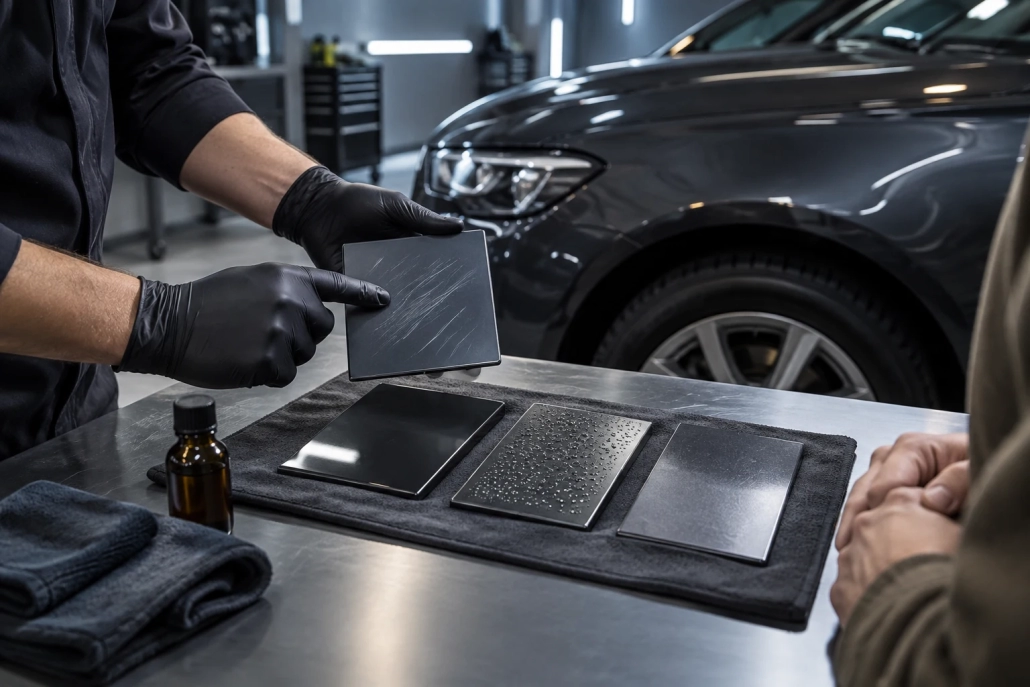
Set realistic expectations for scratches, stone chips, water spots and maintenance before choosing a ceramic coating for your vehicle.
Add a non-contact size reference and a fixed camera position when photographing water spots to make later comparisons interpretable.
 A Reference Scale for Comparing Water Spots in Photographs