






A full polishing range.
From cutting and one-step correction to final finishing.
Specialist chemistry. Expert application.
 QUARTZ99 / CERAMIC BASE COAT
The foundation of your coating system.
A layerable quartz base coat designed for mechanical protection. Pair it with a suitable top coat to create the final finish.
For application by NANOLAB certified installers only.
Four formulas. Extended working time. Find the coating for your finish.
Explore the BEAST family of ceramic coatings.
Find the coating for each exterior surface.
 PPF & VINYLGLOSSProtection for glossy films and wraps.Discover
 MATTE & SATINMATTEProtection that respects the finish.Discover
 GLASSWINDOWSExplore dedicated glass protection.Discover
 WHEEL PROTECTIONWHEELSA dedicated coating for your wheels.Discover
 TRIM PROTECTIONPLASTICProtection for plastic surfaces.Discover
Dedicated care for the surfaces inside.
 LEATHER SURFACESLEATHERDiscover NANOLAB leather protection.Discover PLASTIC SURFACESPLASTICProtection for interior plastic surfaces.Discover TEXTILE SURFACESFABRICExplore the latest fabric formulation.Discover
Spray protection, maintenance and upcoming wash products.
 MAINTENANCEBEAST 365Explore the BEAST maintenance range.Discover
Next in washing, cleaning & care.
Ceramic protection for boats and yachts.
An easy-to-apply ceramic coating with an established track record on boats and yachts around the world.
Results vary with surface preparation, exposure and maintenance.
Read 50 MARINE guides →Explore MARINEProtection for the surfaces you live with.
A look at what we’re developing.
From cutting and one-step correction to final finishing.
A wider range for professional vehicle care.
Taking shape alongside BEAST & MATRIX.
Practical guidance for your next coating project.
Explore all guides →
Water beading describes surface behaviour, while water absorption concerns uptake into a material or system. A photograph of droplets cannot, by itself, quantify how much water the underlying specimen absorbs during an exposure.
Updated · NANOLAB Knowledge
ASTM's public description of D570 discusses water absorption in plastics and the importance of specimen and exposure conditions. For coating buyers, the broader lesson is to separate the surface observation from the uptake question. The appropriate method must match the substrate and the intended claim.
Illustrative example: a treated sample shows rounded droplets during a short demonstration. That observation does not establish its water uptake after prolonged immersion or its suitability as a waterproofing system. A separate, relevant evaluation is needed for those claims.
Do not apply a plastics test automatically to every coated building material or vehicle surface. This guide does not claim that any NANOLAB coating prevents water penetration. Product selection must follow the documented substrate and use approvals, with evidence appropriate to the requested outcome.
Technical references: ASTM D570: water absorption of plastics. These sources describe their stated methods or products; they do not certify NANOLAB products or establish compatibility with an unlisted surface.
Ask NANOLAB about the exact product and intended use. Use the current product documentation for formulation-specific instructions.
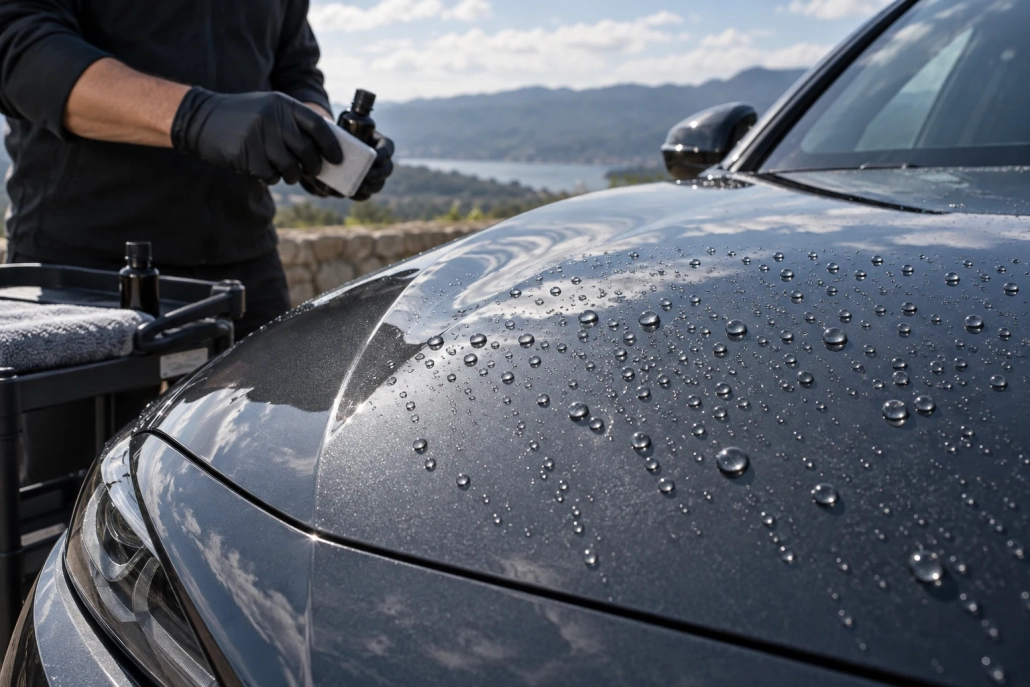
Understand water beading, sheeting and contamination, and why a single water test cannot prove a coating's condition or long-term protection.
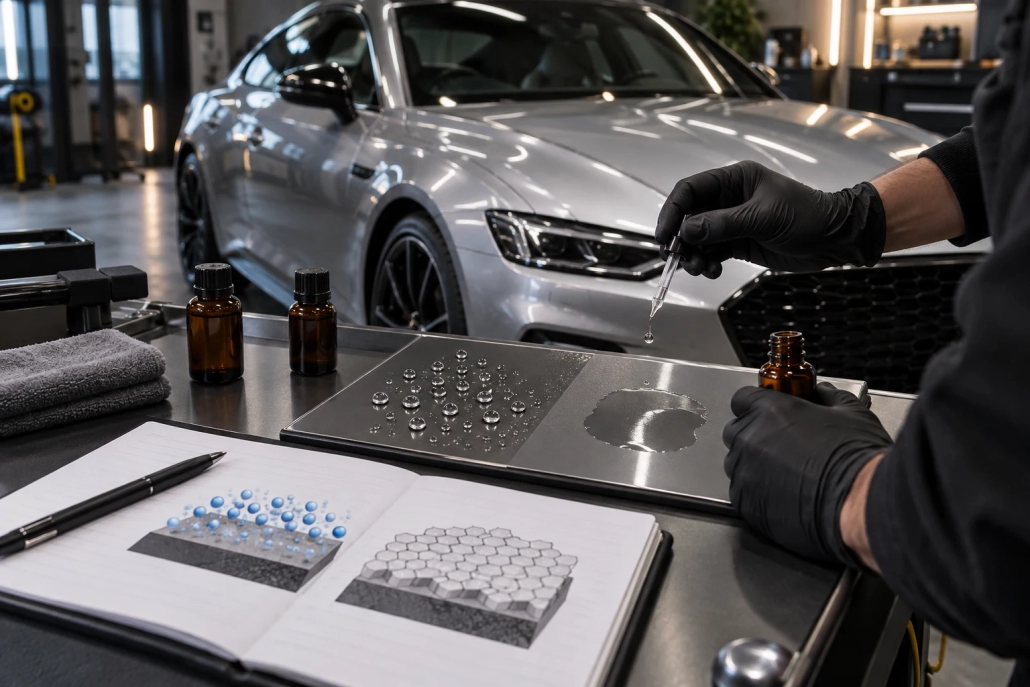
Understand sol-gel as a coating technology description and learn why it does not, by itself, establish a finished nano ceramic product’s performance.
A liquid-repellent surface is not automatically a vapour barrier. Water-vapour transmission concerns movement through a material under defined conditions and requires evidence different from a water-drop demonstration.