






A full polishing range.
From cutting and one-step correction to final finishing.
Specialist chemistry. Expert application.
 QUARTZ99 / CERAMIC BASE COAT
The foundation of your coating system.
A layerable quartz base coat designed for mechanical protection. Pair it with a suitable top coat to create the final finish.
For application by NANOLAB certified installers only.
Four formulas. Extended working time. Find the coating for your finish.
Explore the BEAST family of ceramic coatings.
Find the coating for each exterior surface.
 PPF & VINYLGLOSSProtection for glossy films and wraps.Discover
 MATTE & SATINMATTEProtection that respects the finish.Discover
 GLASSWINDOWSExplore dedicated glass protection.Discover
 WHEEL PROTECTIONWHEELSA dedicated coating for your wheels.Discover
 TRIM PROTECTIONPLASTICProtection for plastic surfaces.Discover
Dedicated care for the surfaces inside.
 LEATHER SURFACESLEATHERDiscover NANOLAB leather protection.Discover PLASTIC SURFACESPLASTICProtection for interior plastic surfaces.Discover TEXTILE SURFACESFABRICExplore the latest fabric formulation.Discover
Spray protection, maintenance and upcoming wash products.
 MAINTENANCEBEAST 365Explore the BEAST maintenance range.Discover
Next in washing, cleaning & care.
Ceramic protection for boats and yachts.
An easy-to-apply ceramic coating with an established track record on boats and yachts around the world.
Results vary with surface preparation, exposure and maintenance.
Read 50 MARINE guides →Explore MARINEProtection for the surfaces you live with.
A look at what we’re developing.
From cutting and one-step correction to final finishing.
A wider range for professional vehicle care.
Taking shape alongside BEAST & MATRIX.
Practical guidance for your next coating project.
Explore all guides →
A panel can look rinsed while cleaner remains in a recess and emerges later. Inspecting the final drainage points helps prevent a clean exterior surface from being recontaminated during drying or vehicle movement.
Updated · NANOLAB Knowledge
Identify gaps, trim interfaces and other accessible areas where the approved washing process can leave retained liquid. Their design and sensitivity vary, so do not direct aggressive pressure into openings simply to force water out. Plan the rinse and drying sequence around the vehicle manufacturer's guidance and the equipment's permitted use.
Illustrative example: a vehicle is dried immediately after washing, then a door is opened during handover and retained liquid marks the adjacent panel. Recording that drainage point can improve the next wash sequence without changing the cleaner concentration.
Do not assume every later drip is detergent or that conductivity alone identifies its composition. Inspect and record the actual condition. Persistent residue or unexpected staining calls for a controlled assessment rather than repeated rubbing or stronger chemicals applied without a diagnosis.
Ask NANOLAB about the exact product and intended use. Use the current product documentation for formulation-specific instructions.
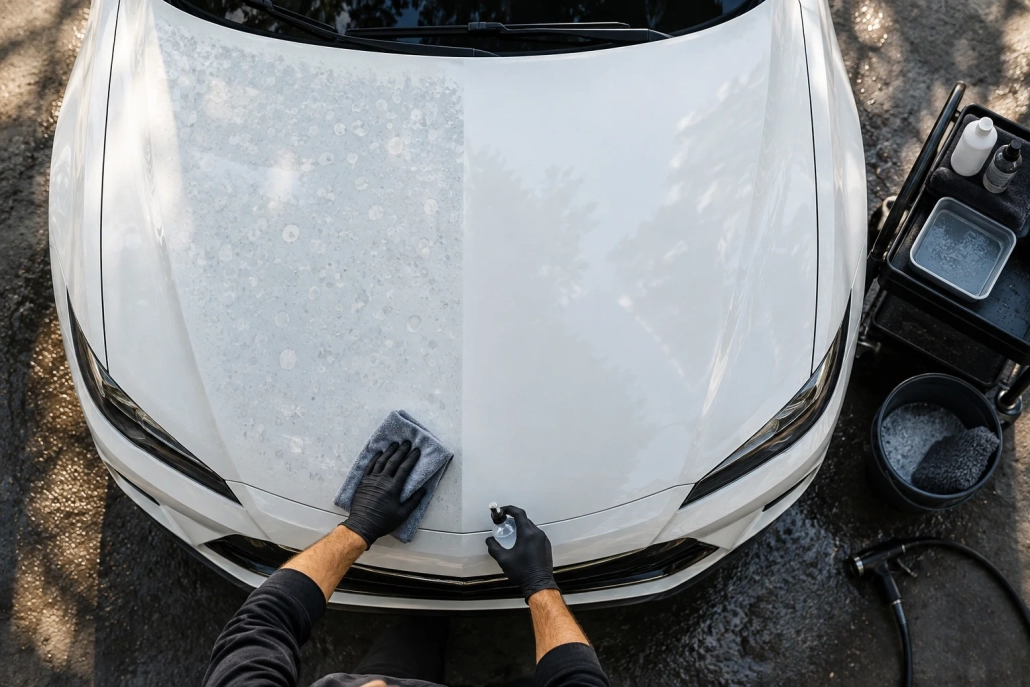
Use ceramic shampoo with a realistic hard-water routine, separating product residue from mineral deposits and planning the rinse and drying sequence.
Compare reverse osmosis and deionization for detailing by water quality, throughput, maintenance and cost per usable litre.
Water quality at the treatment outlet does not by itself describe water after storage and delivery. If a detailing operation uses a tank, include that stage in the sampling plan when investigating inconsistent rinse results.