






A full polishing range.
From cutting and one-step correction to final finishing.
Specialist chemistry. Expert application.
 QUARTZ99 / CERAMIC BASE COAT
The foundation of your coating system.
A layerable quartz base coat designed for mechanical protection. Pair it with a suitable top coat to create the final finish.
For application by NANOLAB certified installers only.
Four formulas. Extended working time. Find the coating for your finish.
Explore the BEAST family of ceramic coatings.
Find the coating for each exterior surface.
 PPF & VINYLGLOSSProtection for glossy films and wraps.Discover
 MATTE & SATINMATTEProtection that respects the finish.Discover
 GLASSWINDOWSExplore dedicated glass protection.Discover
 WHEEL PROTECTIONWHEELSA dedicated coating for your wheels.Discover
 TRIM PROTECTIONPLASTICProtection for plastic surfaces.Discover
Dedicated care for the surfaces inside.
 LEATHER SURFACESLEATHERDiscover NANOLAB leather protection.Discover PLASTIC SURFACESPLASTICProtection for interior plastic surfaces.Discover TEXTILE SURFACESFABRICExplore the latest fabric formulation.Discover
Spray protection, maintenance and upcoming wash products.
 MAINTENANCEBEAST 365Explore the BEAST maintenance range.Discover
Next in washing, cleaning & care.
Ceramic protection for boats and yachts.
An easy-to-apply ceramic coating with an established track record on boats and yachts around the world.
Results vary with surface preparation, exposure and maintenance.
Read 50 MARINE guides →Explore MARINEProtection for the surfaces you live with.
A look at what we’re developing.
From cutting and one-step correction to final finishing.
A wider range for professional vehicle care.
Taking shape alongside BEAST & MATRIX.
Practical guidance for your next coating project.
Explore all guides →
Water remaining in a rinsed bottle changes a prepared mixture if it is not included in the measurement. This is especially easy to miss when staff measure water separately and then pour it into a container that is still wet.
Updated · NANOLAB Knowledge
Decide how the preparation method controls the final quantity. A marked final-fill method and a separately measured ingredient method have different practical checks. Follow the product's required mixing sequence and do not assume that filling to the bottle shoulder is a calibrated volume. Keep the method simple enough that every operator can reproduce it.
Arithmetic example only: 50 ml concentrate plus 950 ml measured water is a nominal 1,000 ml mixture. If the receiving bottle also contains 50 ml of rinse water, the product fraction becomes 50 out of 1,050 ml rather than 50 out of 1,000 ml. The calculation illustrates the error; it is not a dilution recommendation.
Do not solve uncertainty by adding extra concentrate. Confirm the required ratio and measurement method first. If an existing mixture's composition is unknown, manage it under the product and workplace instructions instead of relabelling it with an assumed concentration.
Ask NANOLAB about the exact product and intended use. Use the current product documentation for formulation-specific instructions.
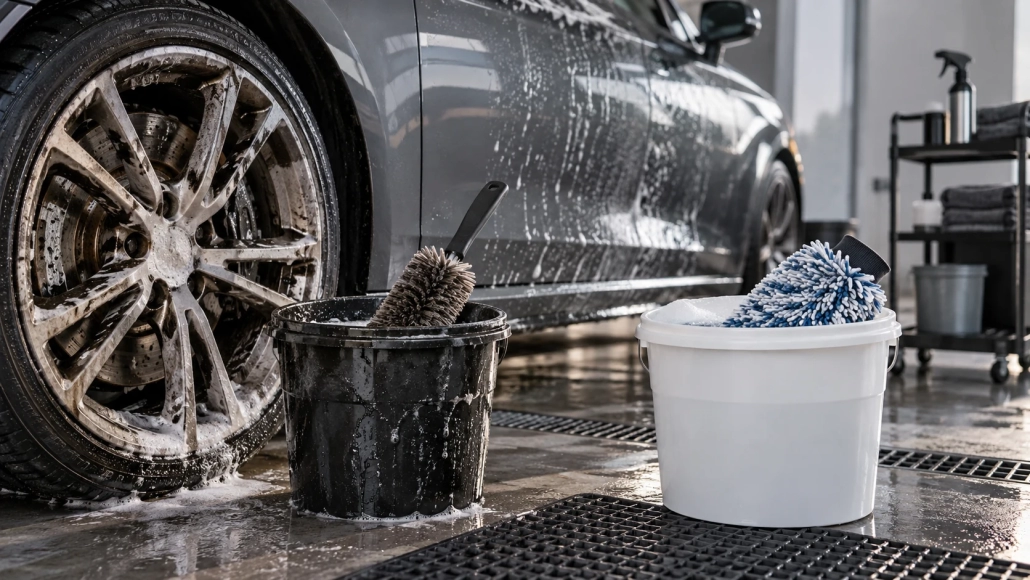
Inspect stitched edges, cuffs and trapped debris in wash mitts before they contact ceramic-coated paint.

Distinguish towel residue, incomplete rinsing and drying-aid buildup before assuming that streaks mean a problem with the ceramic coating.

As-found data describe an instrument's condition before relevant service or adjustment; as-left data describe its condition afterward. Both can matter when reviewing coating measurements made before the instrument was serviced.