






A full polishing range.
From cutting and one-step correction to final finishing.
Specialist chemistry. Expert application.
 QUARTZ99 / CERAMIC BASE COAT
The foundation of your coating system.
A layerable quartz base coat designed for mechanical protection. Pair it with a suitable top coat to create the final finish.
For application by NANOLAB certified installers only.
Four formulas. Extended working time. Find the coating for your finish.
Explore the BEAST family of ceramic coatings.
Find the coating for each exterior surface.
 PPF & VINYLGLOSSProtection for glossy films and wraps.Discover
 MATTE & SATINMATTEProtection that respects the finish.Discover
 GLASSWINDOWSExplore dedicated glass protection.Discover
 WHEEL PROTECTIONWHEELSA dedicated coating for your wheels.Discover
 TRIM PROTECTIONPLASTICProtection for plastic surfaces.Discover
Dedicated care for the surfaces inside.
 LEATHER SURFACESLEATHERDiscover NANOLAB leather protection.Discover PLASTIC SURFACESPLASTICProtection for interior plastic surfaces.Discover TEXTILE SURFACESFABRICExplore the latest fabric formulation.Discover
Spray protection, maintenance and upcoming wash products.
 MAINTENANCEBEAST 365Explore the BEAST maintenance range.Discover
Next in washing, cleaning & care.
Ceramic protection for boats and yachts.
An easy-to-apply ceramic coating with an established track record on boats and yachts around the world.
Results vary with surface preparation, exposure and maintenance.
Read 50 MARINE guides →Explore MARINEProtection for the surfaces you live with.
A look at what we’re developing.
From cutting and one-step correction to final finishing.
A wider range for professional vehicle care.
Taking shape alongside BEAST & MATRIX.
Practical guidance for your next coating project.
Explore all guides →
Distinguish instrument resolution from measurement uncertainty and avoid ranking coatings by differences the test cannot reliably resolve.
Updated · NANOLAB Knowledge
An instrument can display a small numerical change without establishing that the change is meaningful. Resolution concerns the ability to distinguish changes; measurement uncertainty describes the dispersion associated with the reported result. Displayed decimal places are not a substitute for either assessment.
Suppose an illustrative comparison gives readings of 80.1 and 80.3 in the same units. If the measurement process varies by an amount comparable to that difference, declaring a clear winner would be premature. The required confidence depends on the instrument, method, surface and sampling design.
Before purchasing equipment, state the smallest difference that would change the decision. A device suitable for broad incoming checks may be unsuitable for distinguishing subtle changes between two coating trials.
Instrument specifications are only part of the picture. Positioning, surface curvature, sample variation, environmental conditions and operator technique can contribute. Repeating a reading without moving the probe may underestimate the variation of the actual inspection process.
Use suitable reference checks and a documented procedure. Where a formal uncertainty statement is required, ask a competent laboratory to define and evaluate the relevant components rather than copying a display increment into the uncertainty field.
Keep raw readings, units and method information. Round the final result sensibly in relation to the uncertainty. Do not average many digits into a claim of accuracy that the method cannot support.
For a purchasing trial, an unresolved small difference can be reported as inconclusive under the chosen method. That is more useful than inventing a ranking. Other relevant outcomes—application effort, compatible surfaces and observed defects—can still support the decision, provided they are evaluated independently and not used to disguise an unsupported measurement claim.
Technical references: NIST: Measurement-system resolution; NIST: Measurement uncertainty.
For product-specific application instructions, consult NANOLAB technical documentation or ask about your surface and intended use.
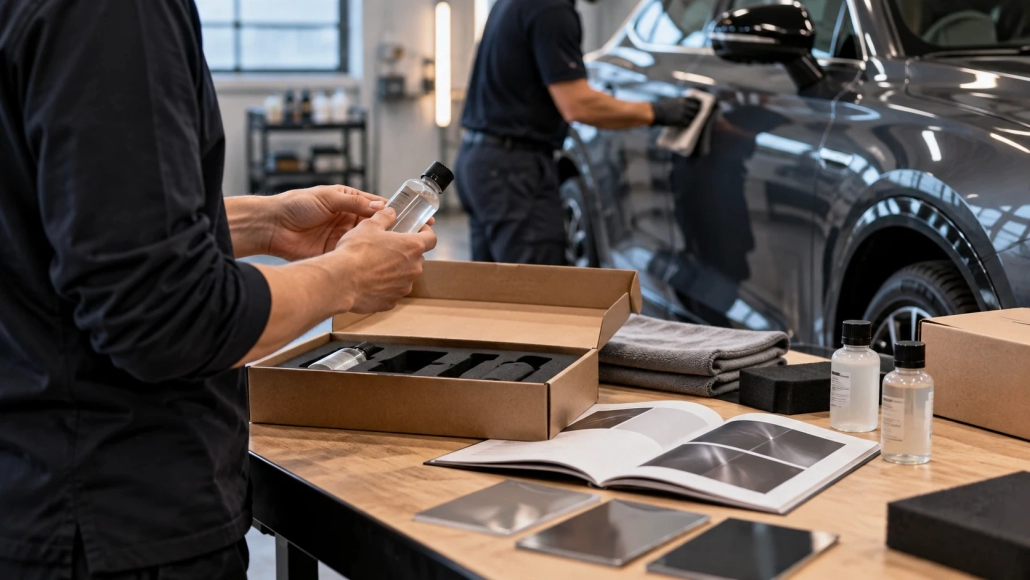
Design a coating field trial with recorded vehicles, use patterns, care routines and inspection points that produce interpretable feedback.

Several readings from one coated patch are not the same as several independently prepared test patches. Keep those two forms of repetition separate.

Understand how repeatable readings can remain biased, and use suitable references before claiming accuracy in a coating comparison.