






A full polishing range.
From cutting and one-step correction to final finishing.
Specialist chemistry. Expert application.
 QUARTZ99 / CERAMIC BASE COAT
The foundation of your coating system.
A layerable quartz base coat designed for mechanical protection. Pair it with a suitable top coat to create the final finish.
For application by NANOLAB certified installers only.
Four formulas. Extended working time. Find the coating for your finish.
Explore the BEAST family of ceramic coatings.
Find the coating for each exterior surface.
 PPF & VINYLGLOSSProtection for glossy films and wraps.Discover
 MATTE & SATINMATTEProtection that respects the finish.Discover
 GLASSWINDOWSExplore dedicated glass protection.Discover
 WHEEL PROTECTIONWHEELSA dedicated coating for your wheels.Discover
 TRIM PROTECTIONPLASTICProtection for plastic surfaces.Discover
Dedicated care for the surfaces inside.
 LEATHER SURFACESLEATHERDiscover NANOLAB leather protection.Discover PLASTIC SURFACESPLASTICProtection for interior plastic surfaces.Discover TEXTILE SURFACESFABRICExplore the latest fabric formulation.Discover
Spray protection, maintenance and upcoming wash products.
 MAINTENANCEBEAST 365Explore the BEAST maintenance range.Discover
Next in washing, cleaning & care.
Ceramic protection for boats and yachts.
An easy-to-apply ceramic coating with an established track record on boats and yachts around the world.
Results vary with surface preparation, exposure and maintenance.
Read 50 MARINE guides →Explore MARINEProtection for the surfaces you live with.
A look at what we’re developing.
From cutting and one-step correction to final finishing.
A wider range for professional vehicle care.
Taking shape alongside BEAST & MATRIX.
Practical guidance for your next coating project.
Explore all guides →
Compare reverse osmosis and deionization for detailing by water quality, throughput, maintenance and cost per usable litre.
Updated · NANOLAB Knowledge
Reverse osmosis and deionization can both reduce dissolved ions, but they operate differently and create different equipment and operating requirements. Selecting a rinse system requires the incoming water profile, desired outlet quality and actual daily demand.
Reverse osmosis uses a pressure-driven membrane process and produces permeate plus a concentrate stream. Mixed-bed deionization uses ion-exchange media. In some installations, reverse osmosis reduces the load before a deionization stage polishes the water further.
That combination is not automatically necessary for every workshop. A low-volume mobile operator and a busy fixed wash bay may face very different space, water-supply and maintenance constraints.
Ask for expected output at the site's feed conditions, required pretreatment, outlet-quality monitoring, service intervals and storage arrangements. For reverse osmosis, include concentrate-water handling and realistic production rate. For resin systems, include replacement or service cost and the supplier's changeout criterion.
An illustrative comparison should calculate cost per usable litre under the same water-quality target. Comparing the purchase price of one unit with only the consumable cost of another hides significant differences.
The water reaching a car may pass through a tank, pump and hose after treatment. Check the relevant outlet instead of relying only on a display mounted upstream. Use the treatment supplier's specified measurement method and maintain the equipment as instructed.
A low conductivity reading is useful but is not a universal cleanliness certificate. Dust, detergent residue and contamination introduced downstream remain possible. Keep the coating's recommended washing and drying routine in place while evaluating the system.
For a purchasing decision, request a site-specific proposal based on measured feedwater and demand. Avoid selecting equipment from a generic “spot-free” label without understanding its operating conditions and monitoring requirements.
Technical references: DuPont: Reverse Osmosis; Ecolab Purolite: Mixed-bed ion-exchange resins.
For product-specific application instructions, consult NANOLAB technical documentation or ask about your surface and intended use.
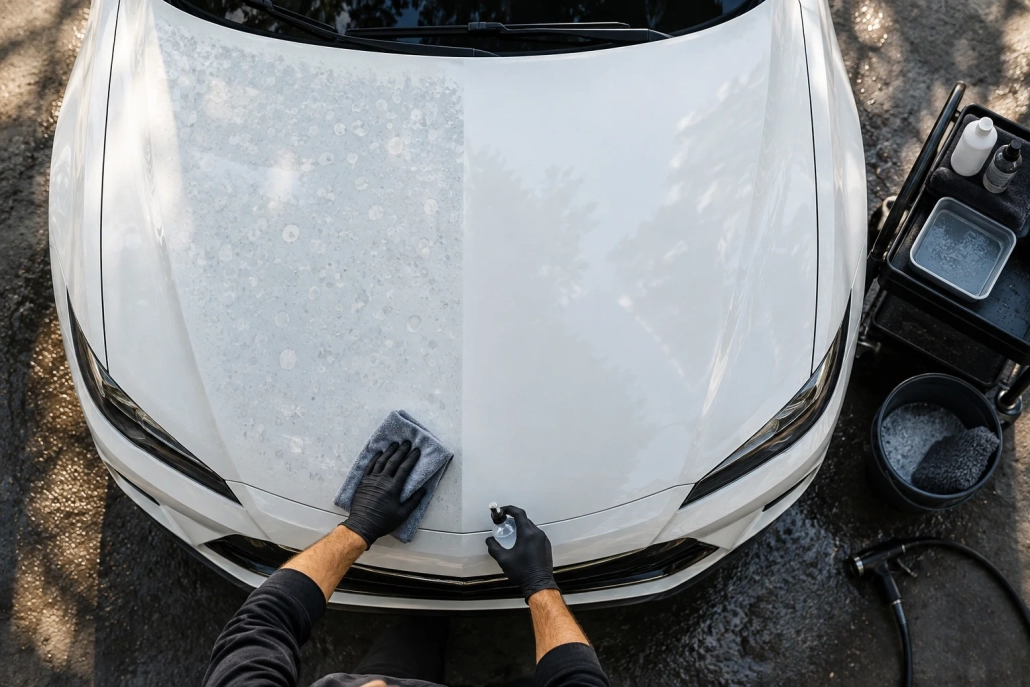
Understand why softened water and deionised rinse water are different when planning washing and drying for a ceramic-coated car.
A TDS display can help monitor a water-treatment system, but it does not describe every contaminant or guarantee that drying will leave no marks.

Calculate DI resin cost per acceptable litre using actual throughput, consistent changeout criteria and representative service intervals.