






A full polishing range.
From cutting and one-step correction to final finishing.
Specialist chemistry. Expert application.
 QUARTZ99 / CERAMIC BASE COAT
The foundation of your coating system.
A layerable quartz base coat designed for mechanical protection. Pair it with a suitable top coat to create the final finish.
For application by NANOLAB certified installers only.
Four formulas. Extended working time. Find the coating for your finish.
Explore the BEAST family of ceramic coatings.
Find the coating for each exterior surface.
 PPF & VINYLGLOSSProtection for glossy films and wraps.Discover
 MATTE & SATINMATTEProtection that respects the finish.Discover
 GLASSWINDOWSExplore dedicated glass protection.Discover
 WHEEL PROTECTIONWHEELSA dedicated coating for your wheels.Discover
 TRIM PROTECTIONPLASTICProtection for plastic surfaces.Discover
Dedicated care for the surfaces inside.
 LEATHER SURFACESLEATHERDiscover NANOLAB leather protection.Discover PLASTIC SURFACESPLASTICProtection for interior plastic surfaces.Discover TEXTILE SURFACESFABRICExplore the latest fabric formulation.Discover
Spray protection, maintenance and upcoming wash products.
 MAINTENANCEBEAST 365Explore the BEAST maintenance range.Discover
Next in washing, cleaning & care.
Ceramic protection for boats and yachts.
An easy-to-apply ceramic coating with an established track record on boats and yachts around the world.
Results vary with surface preparation, exposure and maintenance.
Read 50 MARINE guides →Explore MARINEProtection for the surfaces you live with.
A look at what we’re developing.
From cutting and one-step correction to final finishing.
A wider range for professional vehicle care.
Taking shape alongside BEAST & MATRIX.
Practical guidance for your next coating project.
Explore all guides →
Check technical meaning, product identity and units separately from fluent marketing language.
Updated · NANOLAB Knowledge
Reviewing a translated product page requires more than checking whether the language sounds natural. The translation must preserve product identity, technical meaning and the boundaries of the original claims. Treat language quality and product accuracy as separate review tasks.
Use the current approved source page and record its revision. Provide a terminology list for product names, surfaces and units. Identify links and documents that should remain connected to the exact product. Do not translate an old reseller description merely because it is easier to obtain.
Compare numbers, conditions, exclusions and sequence words. Review whether optional guidance has become mandatory or whether a limited statement has become universal. For example, a phrase describing suitability for a defined finish must not expand into all surfaces during adaptation.
Check headings, tables, image captions and button destinations in the translated layout. Confirm that the correct language version of supporting information is linked where available, and explain when it is not. Resolve technical ambiguity with the product owner rather than choosing a more persuasive sentence. The page is ready when it is understandable to the intended reader and remains faithful to the approved offer, not merely when every source sentence has a translated counterpart.
Review the page as a buying journey: title, product variant, pack size, image caption, comparison table and enquiry button. These commercial elements need checking in addition to the technical instructions linked from the page.
An example error is a translation that turns available for evaluation into approved for every application. Another is a localized button that sends the buyer to the wrong product enquiry. Keep a side-by-side record of the disputed wording and the approved correction. Have a fluent reviewer check readability and the product owner check meaning. This page-level review complements instruction translation; it catches errors introduced by layout, marketing adaptation and the paths a customer follows.
Discuss a NANOLAB private-label project. For supporting information, review the current product documentation and the private-label guides.
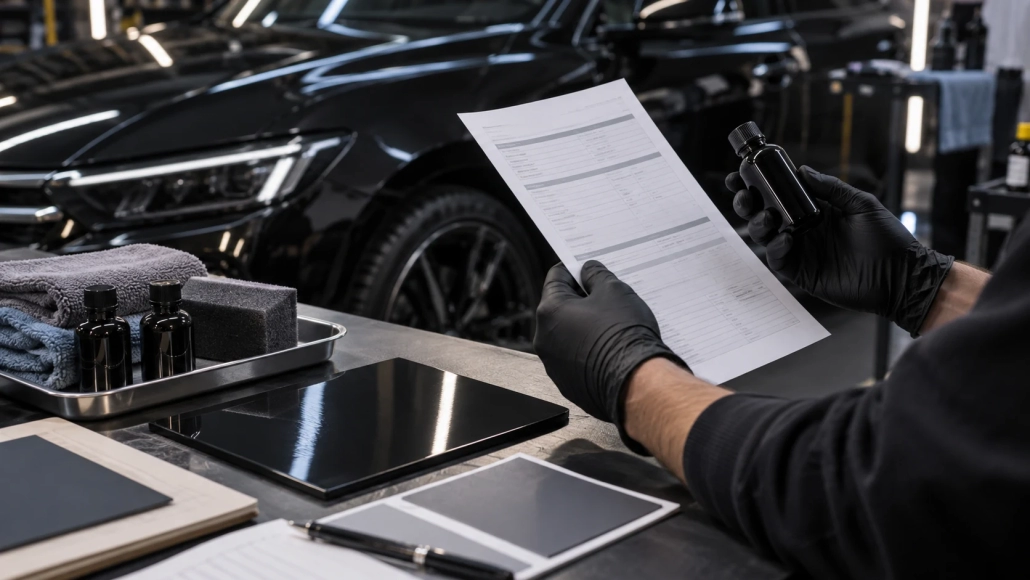
Keep translated coating instructions aligned with the approved product, sequence and safety information before distributing them to a new market.

Use consistent product codes to distinguish coating formulas, pack sizes and kits across purchasing, storage and customer orders.

Collect readable observations and context without asking inexperienced users to diagnose chemistry.