






A full polishing range.
From cutting and one-step correction to final finishing.
Specialist chemistry. Expert application.
 QUARTZ99 / CERAMIC BASE COAT
The foundation of your coating system.
A layerable quartz base coat designed for mechanical protection. Pair it with a suitable top coat to create the final finish.
For application by NANOLAB certified installers only.
Four formulas. Extended working time. Find the coating for your finish.
Explore the BEAST family of ceramic coatings.
Find the coating for each exterior surface.
 PPF & VINYLGLOSSProtection for glossy films and wraps.Discover
 MATTE & SATINMATTEProtection that respects the finish.Discover
 GLASSWINDOWSExplore dedicated glass protection.Discover
 WHEEL PROTECTIONWHEELSA dedicated coating for your wheels.Discover
 TRIM PROTECTIONPLASTICProtection for plastic surfaces.Discover
Dedicated care for the surfaces inside.
 LEATHER SURFACESLEATHERDiscover NANOLAB leather protection.Discover PLASTIC SURFACESPLASTICProtection for interior plastic surfaces.Discover TEXTILE SURFACESFABRICExplore the latest fabric formulation.Discover
Spray protection, maintenance and upcoming wash products.
 MAINTENANCEBEAST 365Explore the BEAST maintenance range.Discover
Next in washing, cleaning & care.
Ceramic protection for boats and yachts.
An easy-to-apply ceramic coating with an established track record on boats and yachts around the world.
Results vary with surface preparation, exposure and maintenance.
Read 50 MARINE guides →Explore MARINEProtection for the surfaces you live with.
A look at what we’re developing.
From cutting and one-step correction to final finishing.
A wider range for professional vehicle care.
Taking shape alongside BEAST & MATRIX.
Practical guidance for your next coating project.
Explore all guides →
Organise polishing pads by their approved machine movement and role. Colour alone cannot prevent a wrong-pad selection in a mixed-tool workshop.
Updated · NANOLAB Knowledge
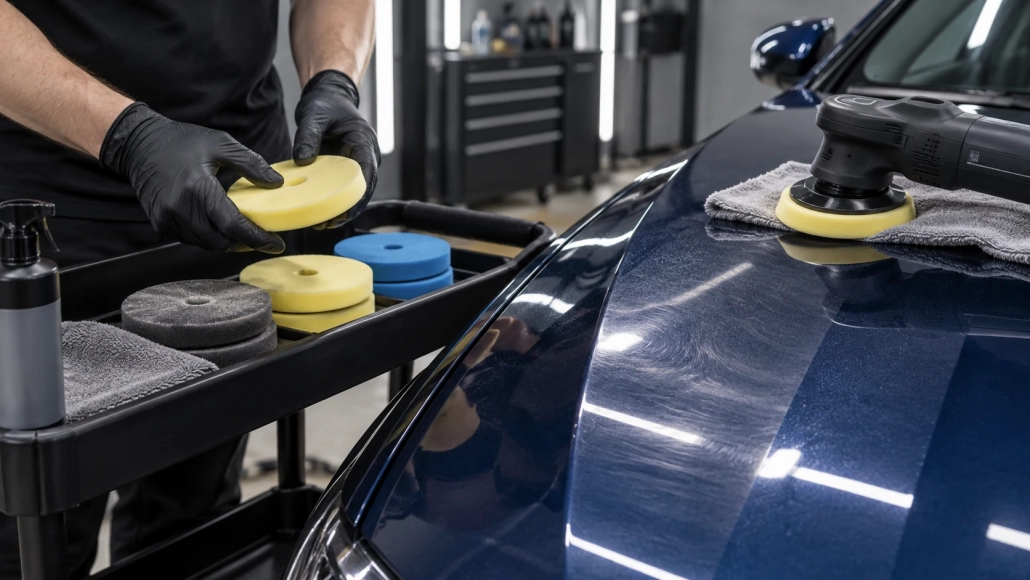
A workshop using rotary, free-spinning orbital and gear-driven orbital tools needs more than a colour-coded pad shelf. Similar-looking pads can have different approved applications, and colours are not a universal compatibility standard.
Record the manufacturer, pad identifier, size and approved machine movements from its documentation. Keep the appropriate backing-plate pairing with the record. Do not relabel a pad as universal simply because it attaches to more than one tool.
Organise storage by approved system, then by role such as cutting or refinement. Keep the role label separate from the compatibility label: a finishing pad’s intended abrasive role does not establish which machine it belongs on.
Before fitting a pad, compare its identifier with the job’s selected machine and backing plate. Inspect the pad and attachment surfaces. If packaging has been discarded, use an authoritative stock record rather than identifying compatibility from foam colour or thickness.
Keep used pads traceable to their liquid and role. A correctly compatible pad can still be unsuitable for final refinement if it carries residue from an earlier cutting stage or has not been cleaned and dried appropriately.
If the wrong pad is selected, stop and assess the equipment and surface before continuing. Record the exact components and whether any work occurred. Do not assume that a mismatch always causes visible damage, or that the absence of visible damage makes the pairing approved.
Use near-miss records to improve labels and storage. Place look-alike pads in clearly distinct locations rather than relying only on staff memory during a busy handover.
RUPES documents movement-specific pad families in its polishing-system guidance. The vibration diagnostic guide supports a check when equipment behaviour changes after fitting a pad.

 Paint Correction Training: Assess the Decision to Stop