






A full polishing range.
From cutting and one-step correction to final finishing.
Specialist chemistry. Expert application.
 QUARTZ99 / CERAMIC BASE COAT
The foundation of your coating system.
A layerable quartz base coat designed for mechanical protection. Pair it with a suitable top coat to create the final finish.
For application by NANOLAB certified installers only.
Four formulas. Extended working time. Find the coating for your finish.
Explore the BEAST family of ceramic coatings.
Find the coating for each exterior surface.
 PPF & VINYLGLOSSProtection for glossy films and wraps.Discover
 MATTE & SATINMATTEProtection that respects the finish.Discover
 GLASSWINDOWSExplore dedicated glass protection.Discover
 WHEEL PROTECTIONWHEELSA dedicated coating for your wheels.Discover
 TRIM PROTECTIONPLASTICProtection for plastic surfaces.Discover
Dedicated care for the surfaces inside.
 LEATHER SURFACESLEATHERDiscover NANOLAB leather protection.Discover PLASTIC SURFACESPLASTICProtection for interior plastic surfaces.Discover TEXTILE SURFACESFABRICExplore the latest fabric formulation.Discover
Spray protection, maintenance and upcoming wash products.
 MAINTENANCEBEAST 365Explore the BEAST maintenance range.Discover
Next in washing, cleaning & care.
Ceramic protection for boats and yachts.
An easy-to-apply ceramic coating with an established track record on boats and yachts around the world.
Results vary with surface preparation, exposure and maintenance.
Read 50 MARINE guides →Explore MARINEProtection for the surfaces you live with.
A look at what we’re developing.
From cutting and one-step correction to final finishing.
A wider range for professional vehicle care.
Taking shape alongside BEAST & MATRIX.
Practical guidance for your next coating project.
Explore all guides →
Communicate excluded paint areas between detailers so a second operator does not repeat correction on thin, damaged or otherwise unsuitable zones.
Updated · NANOLAB Knowledge
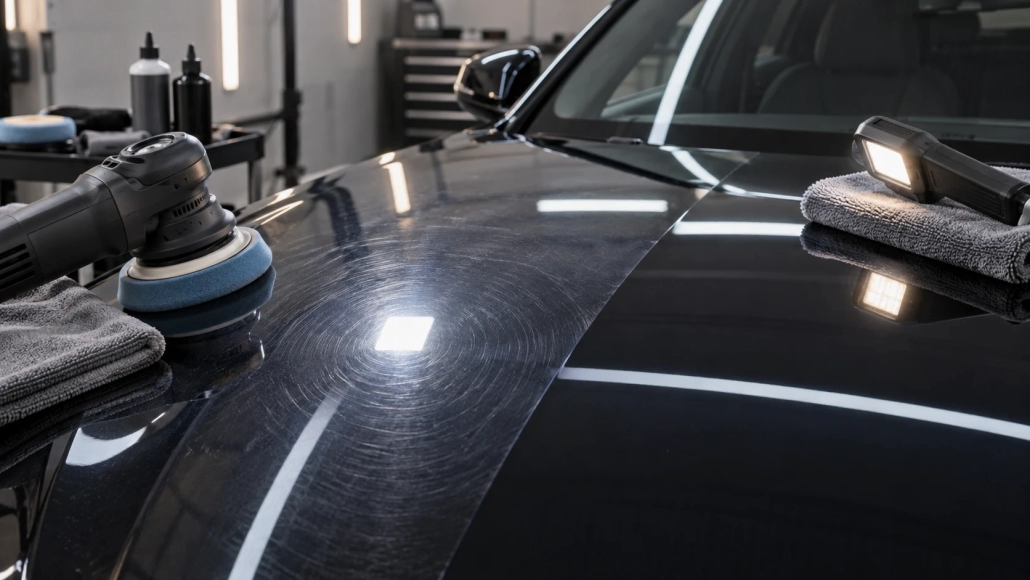
A second operator can unknowingly undo a careful preservation decision by correcting an area the first operator deliberately left alone. A polishing handover needs exclusions as well as completed-panel ticks.
Use a panel diagram and supporting photographs to identify zones excluded from further abrasion. State the reason: a finish defect needing repair, an uncertain repair history, inaccessible geometry or an agreed residual scratch. Keep the explanation factual rather than inventing a precise remaining clear-coat value.
Record whether the restriction concerns abrasive correction, a specific machine approach or all contact beyond approved cleaning. These are different boundaries. A vague note such as careful on the bonnet does not reliably communicate the intended action.
For each working area, distinguish not started, corrected, awaiting refinement, accepted after inspection and excluded. Include the accepted liquid and pad pairing and any panel-specific change. Mark consumables so the incoming operator can identify their role without assuming that every pad left on the trolley is a finishing pad.
Keep the map available at the work bay. Use vehicle features to locate small zones; do not depend on a tape marker that may have been removed during cleanup.
The incoming operator should compare the map with the vehicle and inspect the accepted reference area. Resolve inconsistent notes before another machine pass. If a customer changes the requested outcome, reassess the excluded area instead of silently treating the new request as proof that more abrasion is appropriate.
At completion, retain the final exclusions and remaining defects in the customer record. This prevents a later maintenance visit from starting a fresh correction attempt on a known limitation.
The local-defect reference method supports the map. Use the fine cut acceptance guide to record which completed sections have actually passed inspection.
 DA Polish Comparisons: Use Coded Bottles Responsibly