






A full polishing range.
From cutting and one-step correction to final finishing.
Specialist chemistry. Expert application.
 QUARTZ99 / CERAMIC BASE COAT
The foundation of your coating system.
A layerable quartz base coat designed for mechanical protection. Pair it with a suitable top coat to create the final finish.
For application by NANOLAB certified installers only.
Four formulas. Extended working time. Find the coating for your finish.
Explore the BEAST family of ceramic coatings.
Find the coating for each exterior surface.
 PPF & VINYLGLOSSProtection for glossy films and wraps.Discover
 MATTE & SATINMATTEProtection that respects the finish.Discover
 GLASSWINDOWSExplore dedicated glass protection.Discover
 WHEEL PROTECTIONWHEELSA dedicated coating for your wheels.Discover
 TRIM PROTECTIONPLASTICProtection for plastic surfaces.Discover
Dedicated care for the surfaces inside.
 LEATHER SURFACESLEATHERDiscover NANOLAB leather protection.Discover PLASTIC SURFACESPLASTICProtection for interior plastic surfaces.Discover TEXTILE SURFACESFABRICExplore the latest fabric formulation.Discover
Spray protection, maintenance and upcoming wash products.
 MAINTENANCEBEAST 365Explore the BEAST maintenance range.Discover
Next in washing, cleaning & care.
Ceramic protection for boats and yachts.
An easy-to-apply ceramic coating with an established track record on boats and yachts around the world.
Results vary with surface preparation, exposure and maintenance.
Read 50 MARINE guides →Explore MARINEProtection for the surfaces you live with.
A look at what we’re developing.
From cutting and one-step correction to final finishing.
A wider range for professional vehicle care.
Taking shape alongside BEAST & MATRIX.
Practical guidance for your next coating project.
Explore all guides →
A clear-looking liquid does not reveal every aspect of its composition or physical state. Do not use visual transparency alone to conclude that a coating contains only dissolved material or a single chemical component.
Updated · NANOLAB Knowledge
Appearance is a useful observation within a defined product specification, but it is not a complete analytical method. The supplier's technical description and relevant testing determine what can be said about the formulation. A buyer should avoid turning a photograph into a detailed chemistry claim.
Illustrative example: a sales presentation calls a coating pure because the bottle contents look transparent. The photograph does not establish purity, composition or application suitability. A more accurate presentation describes the documented product and the evidence supporting its intended use.
Do not filter, dilute or mix a product to make it look clearer. This guide does not identify NANOLAB's formulation or prescribe a clarity acceptance test. Any unexpected appearance should be assessed against the exact product specification and supplier guidance rather than a general expectation about transparent liquids.
Ask NANOLAB about the exact product and intended use. Use the current product documentation for formulation-specific instructions.
Understand what coating viscosity reveals about application, which test conditions matter, and why liquid thickness does not prove film protection.
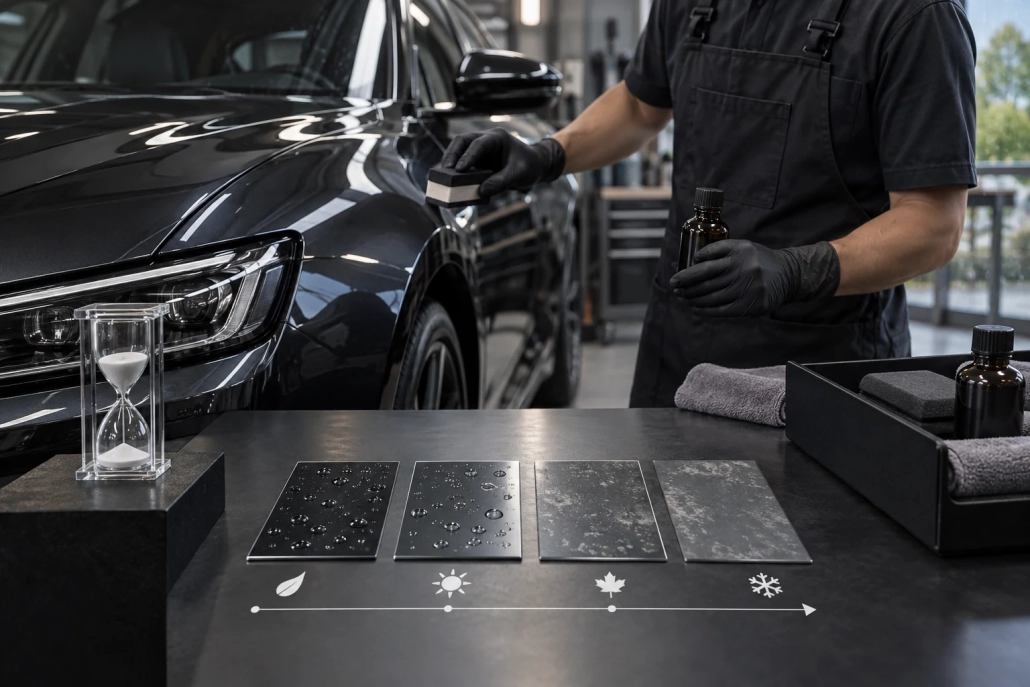
Understand the difference between coating lifespan, visible water behaviour and warranty terms, and how use and maintenance affect the result.
Quartz and amorphous silica describe different structural forms of silica. A commercial product called quartz coating should still be evaluated from its own documentation rather than assumed to contain a particular raw-material structure.