






A full polishing range.
From cutting and one-step correction to final finishing.
Specialist chemistry. Expert application.
 QUARTZ99 / CERAMIC BASE COAT
The foundation of your coating system.
A layerable quartz base coat designed for mechanical protection. Pair it with a suitable top coat to create the final finish.
For application by NANOLAB certified installers only.
Four formulas. Extended working time. Find the coating for your finish.
Explore the BEAST family of ceramic coatings.
Find the coating for each exterior surface.
 PPF & VINYLGLOSSProtection for glossy films and wraps.Discover
 MATTE & SATINMATTEProtection that respects the finish.Discover
 GLASSWINDOWSExplore dedicated glass protection.Discover
 WHEEL PROTECTIONWHEELSA dedicated coating for your wheels.Discover
 TRIM PROTECTIONPLASTICProtection for plastic surfaces.Discover
Dedicated care for the surfaces inside.
 LEATHER SURFACESLEATHERDiscover NANOLAB leather protection.Discover PLASTIC SURFACESPLASTICProtection for interior plastic surfaces.Discover TEXTILE SURFACESFABRICExplore the latest fabric formulation.Discover
Spray protection, maintenance and upcoming wash products.
 MAINTENANCEBEAST 365Explore the BEAST maintenance range.Discover
Next in washing, cleaning & care.
Ceramic protection for boats and yachts.
An easy-to-apply ceramic coating with an established track record on boats and yachts around the world.
Results vary with surface preparation, exposure and maintenance.
Read 50 MARINE guides →Explore MARINEProtection for the surfaces you live with.
A look at what we’re developing.
From cutting and one-step correction to final finishing.
A wider range for professional vehicle care.
Taking shape alongside BEAST & MATRIX.
Practical guidance for your next coating project.
Explore all guides →
Create a shower-cleaning matrix that accounts for coated glass, seals, metal finishes, stone and cabinetry before one cleaner reaches every surface.
Updated · NANOLAB Knowledge
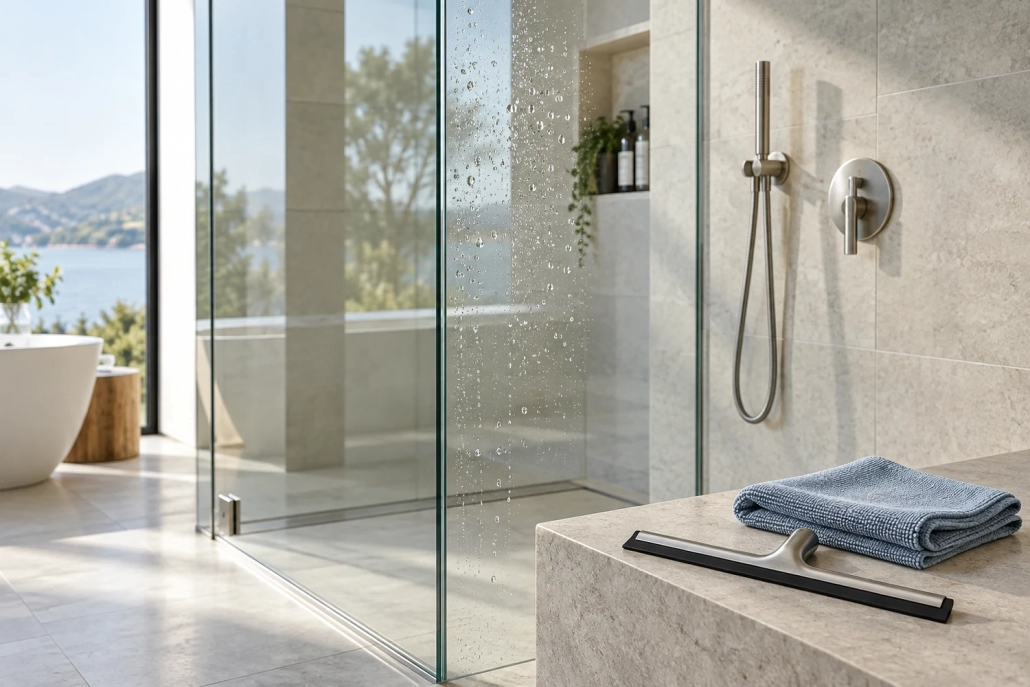
A cleaner suitable for a shower’s glass is not automatically suitable for its metal fittings, stone threshold, grout or nearby cabinet. In a mixed-material enclosure, the maintenance process must account for where liquid travels and where the cleaning tool touches. A compatibility matrix turns those boundaries into usable instructions.
Identify the glass and any existing treatment, frame finish, handles, seals, tray, wall panels and adjacent flooring. Record supplier care instructions for the actual materials. “Black metal” is not a sufficiently precise description when it could be painted, anodised or another finish. Mark unknown materials as unresolved rather than assuming they behave like a familiar surface.
| Zone | What to confirm | Process question |
|---|---|---|
| Coated glass | Glass and coating care guidance | Which cleaner and tool are permitted? |
| Handles and frames | Exact decorative finish | Can the glass cleaner contact it? |
| Seals and joints | Material and installation guidance | Where might liquid collect? |
| Threshold and walls | Stone, tile, grout or panel identity | What happens to runoff? |
| Nearby cabinet | Finish and moisture sensitivity | How is splash prevented? |
If the glass treatment guidance permits a product that the adjacent stone guidance excludes, the answer is not to ignore one supplier. Choose a compatible alternative or a controlled application method agreed for the assembly. Keep protection, application, rinsing and drying within the relevant instructions. Never mix cleaners to create a compromise formula.
Test only in a suitable, inconspicuous area with the owner’s agreement and supplier support. A successful small test does not erase an explicit material restriction or guarantee every aged joint will behave identically.
Name the product, permitted dilution basis, tool and target zone. Explain how to avoid runoff onto excluded surfaces and how to handle unavoidable contact under the product guidance. Use separate clean tools where transferring a product would create a compatibility problem. Colour coding is useful only if the team knows what each colour means.
For example, a cleaner may have separate instructions for glass and a stone threshold. The worksheet should show the order and contact boundary, not simply list both products in a cupboard. This is a planning example, not an endorsement of a particular combination.
Update the matrix when a handle, seal, glass panel or cleaning product is replaced. A new decorative finish can change the permitted contact even if the bathroom looks almost identical. Keep the previous version with its dates so a later problem can be traced to the instructions in use.
The completed matrix should fit on one practical page. It protects the whole shower assembly and makes the coating-care advice easier to follow because the user no longer has to reconcile conflicting instructions while cleaning.
Discuss your shower-glass project. Follow the current instructions for the exact product when planning application and care.
 Testing Coating Cleanability with Repeated Soil-and-Clean Cycles