






A full polishing range.
From cutting and one-step correction to final finishing.
Specialist chemistry. Expert application.
 QUARTZ99 / CERAMIC BASE COAT
The foundation of your coating system.
A layerable quartz base coat designed for mechanical protection. Pair it with a suitable top coat to create the final finish.
For application by NANOLAB certified installers only.
Four formulas. Extended working time. Find the coating for your finish.
Explore the BEAST family of ceramic coatings.
Find the coating for each exterior surface.
 PPF & VINYLGLOSSProtection for glossy films and wraps.Discover
 MATTE & SATINMATTEProtection that respects the finish.Discover
 GLASSWINDOWSExplore dedicated glass protection.Discover
 WHEEL PROTECTIONWHEELSA dedicated coating for your wheels.Discover
 TRIM PROTECTIONPLASTICProtection for plastic surfaces.Discover
Dedicated care for the surfaces inside.
 LEATHER SURFACESLEATHERDiscover NANOLAB leather protection.Discover PLASTIC SURFACESPLASTICProtection for interior plastic surfaces.Discover TEXTILE SURFACESFABRICExplore the latest fabric formulation.Discover
Spray protection, maintenance and upcoming wash products.
 MAINTENANCEBEAST 365Explore the BEAST maintenance range.Discover
Next in washing, cleaning & care.
Ceramic protection for boats and yachts.
An easy-to-apply ceramic coating with an established track record on boats and yachts around the world.
Results vary with surface preparation, exposure and maintenance.
Read 50 MARINE guides →Explore MARINEProtection for the surfaces you live with.
A look at what we’re developing.
From cutting and one-step correction to final finishing.
A wider range for professional vehicle care.
Taking shape alongside BEAST & MATRIX.
Practical guidance for your next coating project.
Explore all guides →
Use a water-break check for its narrow screening purpose, with controlled water and a suitable surface, rather than treating wetting as proof of adhesion.
Updated · NANOLAB Knowledge

A continuous film of water is sometimes treated as a universal certificate that a surface is ready for coating. That interpretation is too broad. Water behaviour can be a useful preparation observation, but its meaning depends on the surface, water, inspection method and contamination being investigated.
ASTM F22 describes a qualitative approach for detecting hydrophobic surface films. Its published scope distinguishes a cleanliness screening decision from quantitative measurement. Wetting observations can help flag preparation inconsistencies; adhesion, compatibility and durability remain separate questions.
This guide is a planning explanation, not a reproduction of the ASTM procedure. When a project specifies compliance, use the applicable full method, trained personnel and documented acceptance requirements.
Choose a reference coupon of the same known material and finish, prepared by a documented method. Compare it with the work sample under matched observation conditions. Control the water source, container and dispensing equipment. A bottle that previously held cleaner is a poor diagnostic choice unless its suitability has been established.
| Variable | Record |
|---|---|
| Substrate | Material, finish and previous treatments |
| Preparation | Products, sequence and time since cleaning |
| Water path | Source, container and dispensing equipment |
| Observation | Area, timing, temperature and visible discontinuities |
| Decision | Accept, investigate or repeat after correcting a documented problem |
A deliberately hydrophobic coating should behave differently from an untreated reference. On a vehicle with unknown protection history, broken water films do not automatically identify dirt. Conversely, a uniform wet appearance is not proof that all residues are absent. Rough, porous or complex surfaces require particular care when selecting a screening method.
Avoid introducing test water into assemblies where it can become trapped. The test must fit the component and its preparation requirements. If it does not, select an appropriate alternative with the technical team rather than inventing a pass condition.
In an illustrative production check, three nominally identical panels show similar wetting while a fourth has a sharply bounded patch. Preserve the location and preparation record. Check handling, local wiping and the water-delivery route. The patch shows a difference that deserves investigation; it does not identify a specific chemical.
After resolving the cause, repeat the defined check and complete the remaining release requirements. These may include dry visual inspection, compatibility assessment and supplier preparation controls. A photograph of sheeting water cannot replace those steps.
State the method, tested area and observed result. “No discontinuity observed under the documented screening conditions” is more defensible than “perfectly clean and guaranteed to bond.” Include any deviation from the planned method and identify who reviewed it. A meaningful pass is tied to a defined process, not merely to an attractive image.
These sources support the identified technical concepts. The planning examples in this guide are illustrative and are not NANOLAB performance test results.
Discuss your surface and intended use with NANOLAB. Follow the current instructions for the exact product when planning application and care.
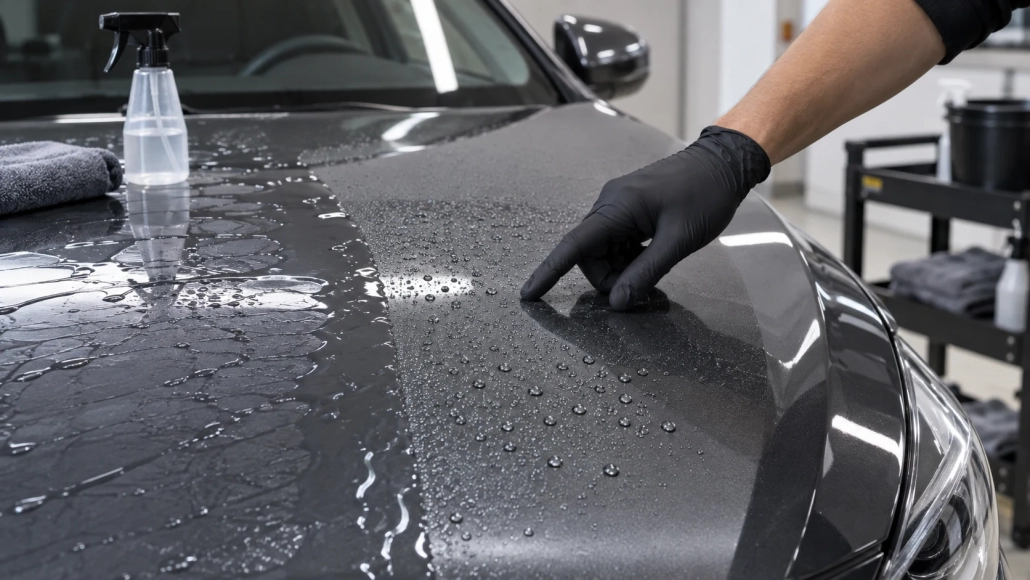
Use water behaviour as one preparation observation while relying on product-specific cleaning, inspection and surface history for readiness.
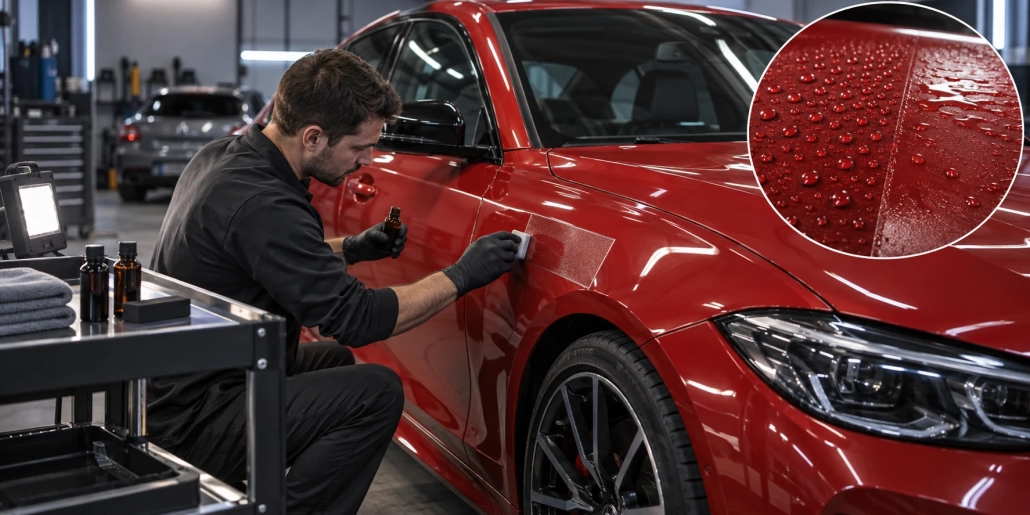
Use a small test area to verify compatibility, finish change and levelling before applying a coating across the vehicle.
 Coated Car Returning from a Body Shop: A Panel-by-Panel Reconciliation