






A full polishing range.
From cutting and one-step correction to final finishing.
Specialist chemistry. Expert application.
 QUARTZ99 / CERAMIC BASE COAT
The foundation of your coating system.
A layerable quartz base coat designed for mechanical protection. Pair it with a suitable top coat to create the final finish.
For application by NANOLAB certified installers only.
Four formulas. Extended working time. Find the coating for your finish.
Explore the BEAST family of ceramic coatings.
Find the coating for each exterior surface.
 PPF & VINYLGLOSSProtection for glossy films and wraps.Discover
 MATTE & SATINMATTEProtection that respects the finish.Discover
 GLASSWINDOWSExplore dedicated glass protection.Discover
 WHEEL PROTECTIONWHEELSA dedicated coating for your wheels.Discover
 TRIM PROTECTIONPLASTICProtection for plastic surfaces.Discover
Dedicated care for the surfaces inside.
 LEATHER SURFACESLEATHERDiscover NANOLAB leather protection.Discover PLASTIC SURFACESPLASTICProtection for interior plastic surfaces.Discover TEXTILE SURFACESFABRICExplore the latest fabric formulation.Discover
Spray protection, maintenance and upcoming wash products.
 MAINTENANCEBEAST 365Explore the BEAST maintenance range.Discover
Next in washing, cleaning & care.
Ceramic protection for boats and yachts.
An easy-to-apply ceramic coating with an established track record on boats and yachts around the world.
Results vary with surface preparation, exposure and maintenance.
Read 50 MARINE guides →Explore MARINEProtection for the surfaces you live with.
A look at what we’re developing.
From cutting and one-step correction to final finishing.
A wider range for professional vehicle care.
Taking shape alongside BEAST & MATRIX.
Practical guidance for your next coating project.
Explore all guides →
Distinguish organic surface films, mineral deposits and mixed contamination when selecting an approved cleaning approach for coated marine surfaces.
Updated · NANOLAB Knowledge
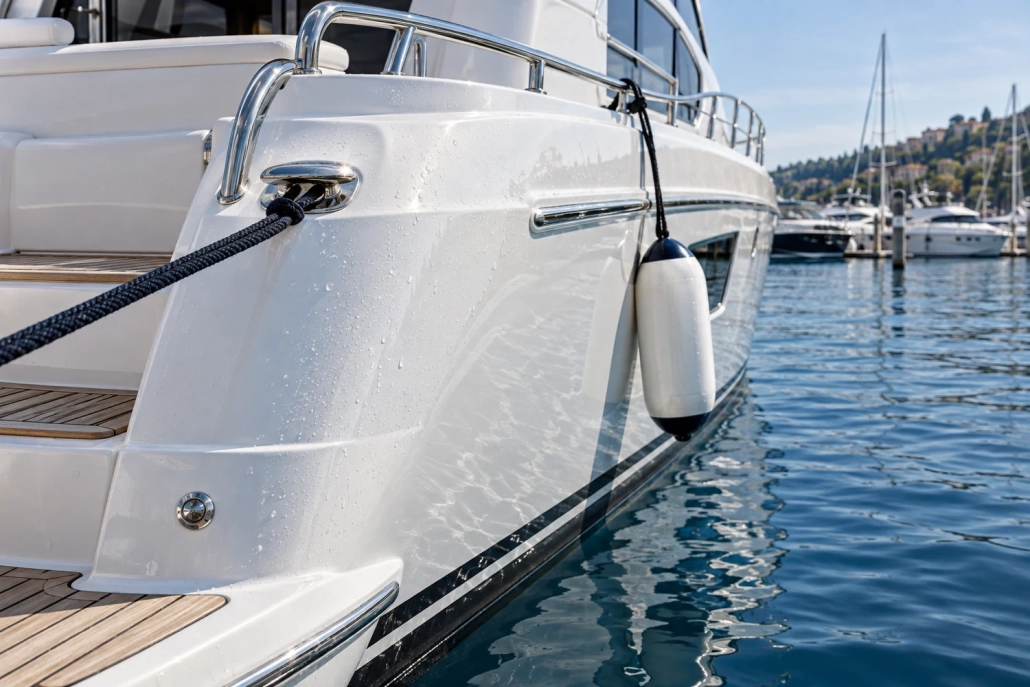
A marine surface can carry organic films, mineral residue and ordinary dirt at the same time. Appearance alone may not identify the mixture, and one cleaning product may not address every component.
Record location, texture, colour and the exposure history. Note whether the area is immersed, splash-exposed or sheltered. Keep photographs before cleaning and identify the substrate and coating system.
Above-waterline easy-clean maintenance and underwater fouling management are distinct tasks. Refer immersed hull treatment and specialist contamination questions to the appropriate marine professional rather than extending a routine decorative-surface method.
Do not combine cleaners or assume that a persistent residue always requires greater strength.
If a soft film is removed but a hard ring remains, record the two outcomes separately. The observation can guide further identification without proving the remaining material’s chemistry. Compare cleaning effort only under similar contamination loads. A coating may make a particular deposit easier to remove while still requiring different approved care for another deposit type; the maintenance plan should preserve that distinction.
Ask NANOLAB about your surface and intended use. For application and care, use the current instructions for the exact product.

Use clear checkpoints before application, after levelling and at handover to make coating work consistent and traceable.
An installer should be able to explain how the proposed process fits your boat.
Use a controlled known-area coupon to estimate retained dry coating mass, and check whether the mass difference exceeds measurement uncertainty.

 Teach-Back Training for Coating Installers: Verify the Decision, Not the Memorised...