






A full polishing range.
From cutting and one-step correction to final finishing.
Specialist chemistry. Expert application.
 QUARTZ99 / CERAMIC BASE COAT
The foundation of your coating system.
A layerable quartz base coat designed for mechanical protection. Pair it with a suitable top coat to create the final finish.
For application by NANOLAB certified installers only.
Four formulas. Extended working time. Find the coating for your finish.
Explore the BEAST family of ceramic coatings.
Find the coating for each exterior surface.
 PPF & VINYLGLOSSProtection for glossy films and wraps.Discover
 MATTE & SATINMATTEProtection that respects the finish.Discover
 GLASSWINDOWSExplore dedicated glass protection.Discover
 WHEEL PROTECTIONWHEELSA dedicated coating for your wheels.Discover
 TRIM PROTECTIONPLASTICProtection for plastic surfaces.Discover
Dedicated care for the surfaces inside.
 LEATHER SURFACESLEATHERDiscover NANOLAB leather protection.Discover PLASTIC SURFACESPLASTICProtection for interior plastic surfaces.Discover TEXTILE SURFACESFABRICExplore the latest fabric formulation.Discover
Spray protection, maintenance and upcoming wash products.
 MAINTENANCEBEAST 365Explore the BEAST maintenance range.Discover
Next in washing, cleaning & care.
Ceramic protection for boats and yachts.
An easy-to-apply ceramic coating with an established track record on boats and yachts around the world.
Results vary with surface preparation, exposure and maintenance.
Read 50 MARINE guides →Explore MARINEProtection for the surfaces you live with.
A look at what we’re developing.
From cutting and one-step correction to final finishing.
A wider range for professional vehicle care.
Taking shape alongside BEAST & MATRIX.
Practical guidance for your next coating project.
Explore all guides →
A surface can reflect strongly while producing an indistinct image. Gloss and distinctness of image describe different aspects of appearance, so a gloss reading alone may not capture the finish quality a customer is describing.
Updated · NANOLAB Knowledge
BYK distinguishes reflected-image sharpness from other appearance characteristics. For a coating trial, translate the customer's concern into an observable question before selecting a measurement. If the concern is the clarity of reflected lines or objects, a single gloss value may provide only part of the relevant evidence.
Illustrative example: two panels have similar gloss readings, but one produces visibly softer reflected edges. Calling them visually identical because one number matches would overlook the customer's observation. The next step is a suitable appearance assessment, with consistent viewing conditions and a documented baseline.
Do not claim that a ceramic coating removes underlying texture or restores image clarity without direct evidence. Preparation, substrate and the complete finish system remain relevant. A measurement term helps define the question; it does not establish the cause or guarantee a particular treatment outcome.
Technical references: BYK: Orange peel and brilliance. These sources describe their stated methods or products; they do not certify NANOLAB products or establish compatibility with an unlisted surface.
Ask NANOLAB about the exact product and intended use. Use the current product documentation for formulation-specific instructions.
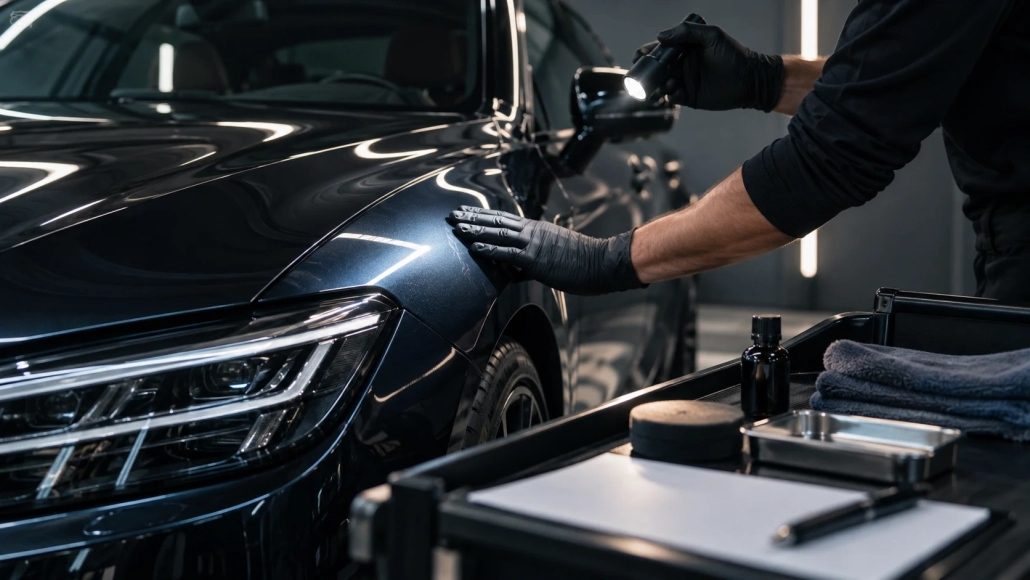
Compare gloss readings with the same measurement geometry, surface preparation and locations rather than treating every gloss number as equivalent.
Learn how to assess gloss and finish quality without confusing visual enhancement, tactile slickness and documented protective performance.
Film formation and attachment to the substrate are different questions. A coating that appears hard or dry has not, on that observation alone, demonstrated adequate adhesion to the underlying surface.