






A full polishing range.
From cutting and one-step correction to final finishing.
Specialist chemistry. Expert application.
 QUARTZ99 / CERAMIC BASE COAT
The foundation of your coating system.
A layerable quartz base coat designed for mechanical protection. Pair it with a suitable top coat to create the final finish.
For application by NANOLAB certified installers only.
Four formulas. Extended working time. Find the coating for your finish.
Explore the BEAST family of ceramic coatings.
Find the coating for each exterior surface.
 PPF & VINYLGLOSSProtection for glossy films and wraps.Discover
 MATTE & SATINMATTEProtection that respects the finish.Discover
 GLASSWINDOWSExplore dedicated glass protection.Discover
 WHEEL PROTECTIONWHEELSA dedicated coating for your wheels.Discover
 TRIM PROTECTIONPLASTICProtection for plastic surfaces.Discover
Dedicated care for the surfaces inside.
 LEATHER SURFACESLEATHERDiscover NANOLAB leather protection.Discover PLASTIC SURFACESPLASTICProtection for interior plastic surfaces.Discover TEXTILE SURFACESFABRICExplore the latest fabric formulation.Discover
Spray protection, maintenance and upcoming wash products.
 MAINTENANCEBEAST 365Explore the BEAST maintenance range.Discover
Next in washing, cleaning & care.
Ceramic protection for boats and yachts.
An easy-to-apply ceramic coating with an established track record on boats and yachts around the world.
Results vary with surface preparation, exposure and maintenance.
Read 50 MARINE guides →Explore MARINEProtection for the surfaces you live with.
A look at what we’re developing.
From cutting and one-step correction to final finishing.
A wider range for professional vehicle care.
Taking shape alongside BEAST & MATRIX.
Practical guidance for your next coating project.
Explore all guides →
A cleaner that receives more brushing or wiping may appear more effective even when the liquid itself is not the reason. Record agitation effort separately so a product comparison shows how much work produced the final result.
Updated · NANOLAB Knowledge
Decide whether the question concerns cleaning under a fixed effort or the complete effort needed to reach an agreed standard. Both can be useful, but they require different records. A fixed-pass test compares one controlled condition; a clean-to-standard test compares the practical work required. Do not switch between these interpretations after seeing the result.
Illustrative example: cleaner A reaches the target after one permitted cleaning cycle, while cleaner B requires another. Reporting only that both areas became clean hides the workload difference. Conversely, claiming that A has superior chemistry from one uncontrolled demonstration would go beyond the evidence.
Never increase pressure or use a more abrasive tool just to force a test area to pass. Stay within the surface and product instructions. If the required effort risks damaging the finish, stop and reassess the cleaning method and the nature of the remaining mark.
Ask NANOLAB about the exact product and intended use. Use the current product documentation for formulation-specific instructions.
A bucket can look free of grit while retaining cleaner from its previous use. Dedicated identification and appropriate cleaning reduce confusion.
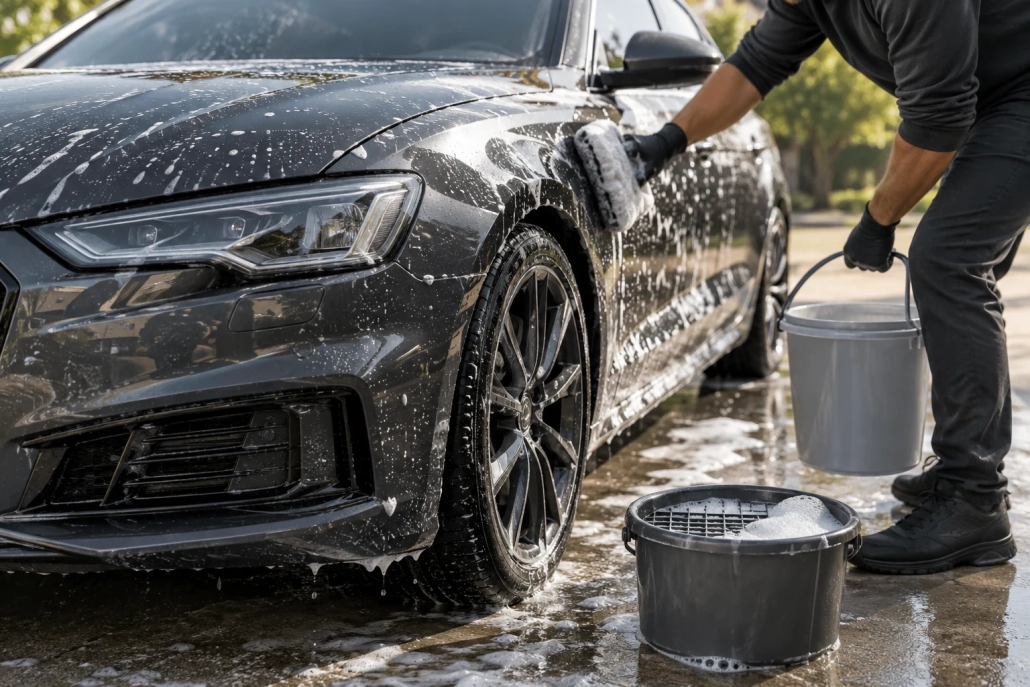
Build a gentle wash routine that removes loose grit before contact, keeps wheel tools separate and ends with careful rinsing and drying.
The time a cleaner remains on a surface is not the same as the total time spent on the cleaning job. Track the relevant exposure interval when assessing an approved process or investigating a surface change.